
Choose the deployment mode and install its dependencies before deploying models.
Knative, Standard and LLMInferenceService modes require different networking and infrastructure components, affecting installation and operations.
Evidence source ↗
KServe is an open-source Kubernetes platform for deploying and operating predictive and generative AI inference workloads.
Documentation describes multi-framework serving, autoscaling, traffic management and several deployment modes. The self-managed Kubernetes setup has infrastructure prerequisites, and no reliable public review rating was verified.
This profile combines documented product information and independent evidence where available. It is not a hands-on test unless TechZella explicitly identifies one.
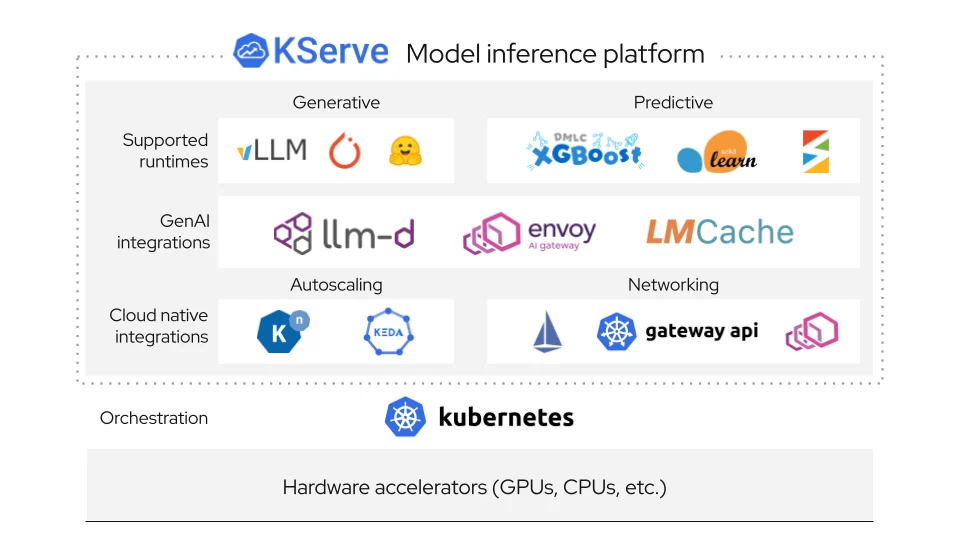
KServe is an open-source platform for deploying and operating predictive and generative AI inference on Kubernetes. Teams define model-serving workloads through Kubernetes resources, then select compatible runtimes and infrastructure for their models.
Its standard InferenceService resource covers common predictive and generative serving. A separate LLMInferenceService resource targets advanced LLM patterns, including prefix-aware routing and disaggregated serving. KServe is self-managed, so buyers need Kubernetes operations capacity and should account for cluster and compute costs.
A quick way to understand who this product may suit, where its limits matter, and which facts are most relevant before you compare alternatives.
Platform and ML engineering teams running predictive models or LLM inference on Kubernetes that want declarative deployment, multiple serving runtimes and Kubernetes-native operations.
Teams seeking a hosted, managed inference service or a turnkey setup without Kubernetes administration and supporting infrastructure, and should evaluate alternatives such as Seldon Core 2 or BentoML instead.
API, Kubernetes, Self-hosted
6.6/10
These are the product-specific differences that may matter when deciding whether the software fits your workflow. They are based on documented evidence rather than a universal ranking.
These are documented constraints or practical friction points that may matter before you adopt the product.
Knative, Standard and LLMInferenceService modes require different networking and infrastructure components, affecting installation and operations.
Evidence source ↗Workloads that rely on scale-to-zero to reduce idle resource use need a different mode or serving design.
Evidence source ↗Apache-2.0 licensed software. Kubernetes infrastructure, storage and compute are not included.
Check current pricing →Pricing may change. Verify current plans on the vendor's website.
Compare similar products directly, then see which alternatives may make more sense when your requirements differ.
| Decision factor | KServe | Seldon Core 2 | BentoML |
|---|---|---|---|
| Deployment model | Kubernetes-native platform with Standard, Knative and LLMInferenceService deployment paths. | Can be installed on Kubernetes; documentation also describes Docker Compose for local environments. Source ↗ | Packages an AI application as a Bento container and documents deployment to Kubernetes or EC2. Source ↗ |
| Workflow orchestration | InferenceGraph supports multi-model orchestration; core resources also include InferenceService and serving runtimes. | Pipelines connect models and processing steps, with Kafka used for pipeline communication. Source ↗ | Not documented |
| Inference API | Supports V1 and Open Inference Protocol V2 for predictive models, and OpenAI-compatible APIs for generative workloads. | Supports the Seldon V2 inference protocol over REST and gRPC. Source ↗ | Not documented |
| Serving workflow | Uses Kubernetes resources and pluggable serving runtimes to deploy and manage models. | Not documented | Provides a framework for building inference APIs and packaging model applications. Source ↗ |
| Model formats and runtimes | Documents built-in and custom runtimes for frameworks including scikit-learn, XGBoost, TensorFlow, PyTorch, ONNX, vLLM and Triton. | Not documented | Documents services for open-source or custom AI models; deployment and model packaging are organized around BentoML Services and Bentos. Source ↗ |
Only factors supported by the available research are shown. The comparison is descriptive, not a ranking.
These products address broadly similar requirements. The descriptions focus on documented reasons a buyer might compare them with KServe.
| License | Apache-2.0 |
|---|---|
| Deployment | Self-managed Kubernetes |
| Deployment modes | Standard, Knative, LLMInferenceService |
| API | V1, Open Inference Protocol V2, OpenAI-compatible generative API |
| Model artifact sources | S3, Google Cloud Storage, Azure Blob Storage, HTTP(S), Git, PVC, Hugging Face, ModelScope, OCI images |
| Free trial | No vendor-listed trial; users can install the open-source software |
Verified installation, hosting, administration, or environment details that can affect implementation.
| Installation or hosting | Self-managed installation on a Kubernetes cluster. Standard, Knative and LLMInferenceService modes have different dependencies. Source ↗ |
|---|---|
| Networking | Standard deployments can use Kubernetes Ingress or Gateway API; the administrator guide recommends Gateway API. Source ↗ |
Documented portability, standards, export, or switching considerations. No switching-cost score is shown unless the evidence supports one.
Model artifacts can be referenced from S3, Google Cloud Storage, Azure Blob Storage, HTTP(S), Git, PVCs, Hugging Face, ModelScope or OCI images. This documents artifact sources, not automated migration.
Evidence source ↗A proprietary editorial score based on product capabilities, usability, value, performance, support and user sentiment evidence.
Documentation describes multi-framework serving, autoscaling, traffic management and several deployment modes. The self-managed Kubernetes setup has infrastructure prerequisites, and no reliable public review rating was verified.
Methodology v1.0. The assessment weighs feature coverage (25%), ease of use (15%), value for money (20%), performance (15%), support (10%) and user sentiment (15%), using researched product evidence and verified review evidence where available. It is a TechZella editorial assessment, not a direct user-review average.
Key claims are linked to the sources used to verify them. This evidence record is separate from third-party user ratings.
TechZella evaluates software using documented product capabilities, pricing information, usability and value considerations, independent user evidence where available, and competitive context. The assessment is an editorial review, not a hands-on test unless one is explicitly identified. Our editorial assessment is based on 6 documented sources.
The documentation describes InferenceService and related custom resources as the foundation for model deployment and management.
View source ↗Verified 2026-11-11The installation and architecture documentation distinguish predictive serving from generative and LLM serving.
View source ↗Verified 2026-11-11The storage guide lists object storage, model hubs, HTTP(S), Git, PVCs and OCI images.
View source ↗Verified 2026-11-11The data-plane documentation lists V1, Open Inference Protocol V2 and the OpenAI-compatible API for generative workloads.
View source ↗Verified 2026-11-11The project package metadata specifies Apache-2.0.
View source ↗Verified 2026-11-11CNCF states that KServe was accepted at the incubating level on September 29, 2025.
View source ↗Verified 2026-11-11Answers begin with the clearest available response, followed by the context that helps you act on it.
No reviews yet. Be the first to share your experience.
Please log in to submit a review.