
Starter and Team plan prices are not displayed publicly, and Enterprise requires contacting sales.
Buyers cannot compare total subscription cost from the public plan page alone.
Evidence source ↗
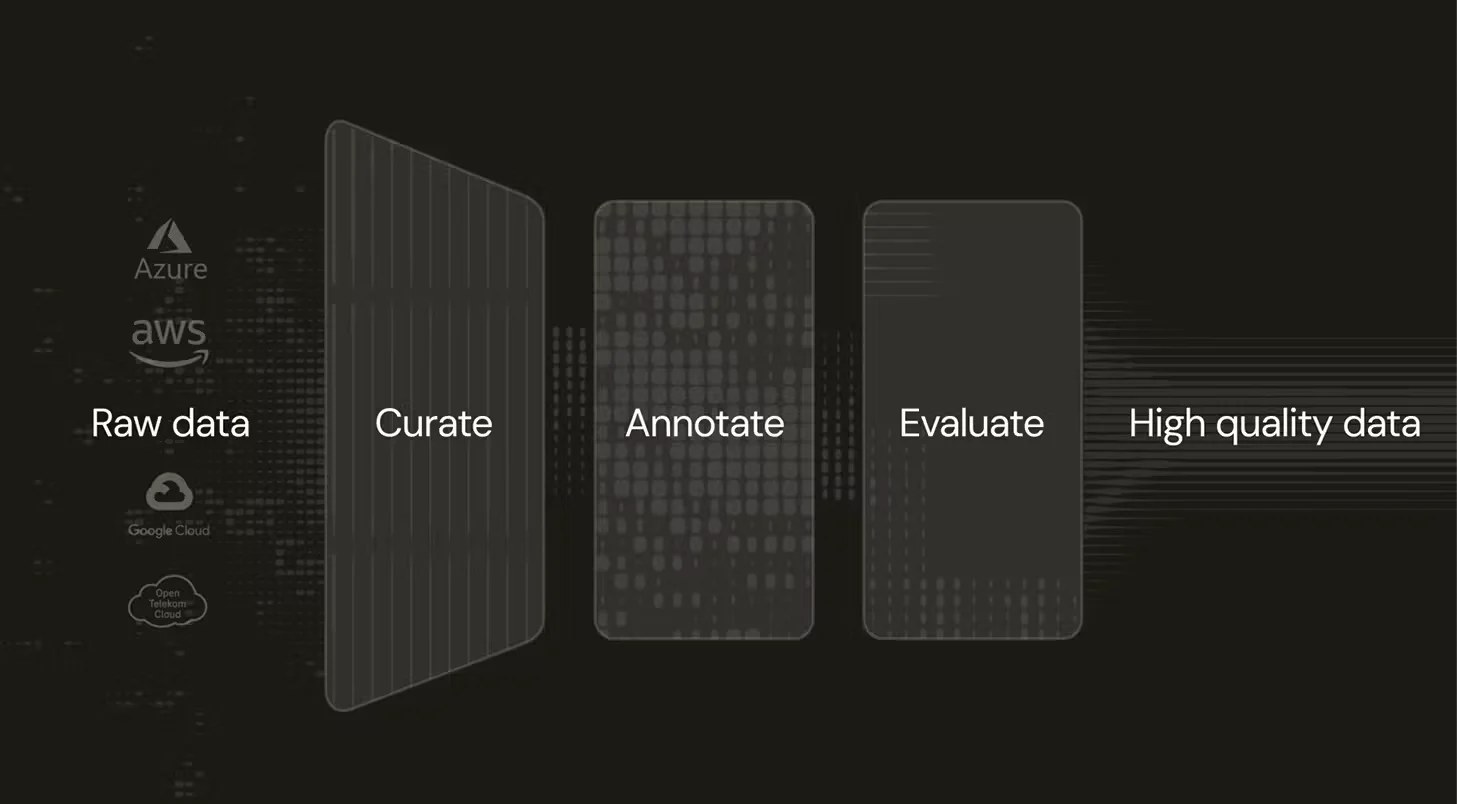
Encord is a multimodal data platform for curating, annotating, and evaluating datasets used to develop AI systems.
The platform documents broad multimodal data workflows, annotation, curation, model evaluation, APIs, and multiple deployment options. G2 lists a 4.8 rating from 65 reviews. Public plan prices are not displayed, limiting value comparisons.
This profile combines documented product information and independent evidence where available. It is not a hands-on test unless TechZella explicitly identifies one.
Encord provides data-management software for AI development. Its platform brings together data curation, annotation, and model evaluation for multimodal datasets.
Teams can connect cloud storage rather than move raw files into a separate data store. Documented integrations include AWS S3, Azure Data Lake Storage, and Google Cloud Storage.
The product targets workflows including computer vision, robotics, autonomous vehicles, industrial AI, and medical imaging. Its plans page lists cloud hosting, with VPC and on-premises options available as Enterprise add-ons.
A quick way to understand who this product may suit, where its limits matter, and which facts are most relevant before you compare alternatives.
AI and machine-learning teams preparing multimodal image, video, audio, document, medical-imaging, or sensor datasets for training and evaluation.
Buyers seeking publicly listed plan prices, or teams needing a self-hosted deployment without an enterprise engagement, should verify plan and deployment requirements before selecting Encord, and should evaluate alternatives such as Labelbox instead.
API, AWS, Google Cloud, Microsoft Azure, SaaS
8.2/10
These are the product-specific differences that may matter when deciding whether the software fits your workflow. They are based on documented evidence rather than a universal ranking.
These are documented constraints or practical friction points that may matter before you adopt the product.
Buyers cannot compare total subscription cost from the public plan page alone.
Evidence source ↗Teams using LiDAR, DICOM/NIfTI, geospatial, ECG, or custom data should confirm the required add-on and its price.
Evidence source ↗Production teams may need account-team access and should confirm feature maturity before making them workflow dependencies.
Evidence source ↗For individuals and small teams prototyping AI applications. Includes image and video annotation, customizable workflows, and self-serve support. Price not published.
Check current pricing →Adds data agents, performance analytics, model evaluation, and onboarding support. Price not published.
Check current pricing →Adds multiple workspaces, SSO, enterprise SLA and support, plus VPC and on-premises deployment add-ons. Contact sales for pricing.
Check current pricing →Pricing may change. Verify current plans on the vendor's website.
Compare similar products directly, then see which alternatives may make more sense when your requirements differ.
| Decision factor | Encord | Labelbox | Label Studio |
|---|---|---|---|
| Core scope | Multimodal data curation, annotation, and model evaluation for AI workflows. | Training-data workflows span Catalog, Annotate, and Model; Foundry adds model-assisted data labeling and inference. Source ↗ | Open-source and commercial editions provide data labeling, with enterprise features for team management, analytics, and evaluation. Source ↗ |
| API and SDK | Encord lists API and SDK access; its documentation describes programmatic project, metadata, and prediction workflows. | Labelbox documents an API and Python SDK for organization, dataset, and cloud-storage operations. Source ↗ | The Community, Starter Cloud, and Enterprise editions list API, SDK, and webhook capabilities. Source ↗ |
| Cloud storage connectivity | Official materials name AWS S3, Azure Data Lake Storage, and Google Cloud Storage integrations. | Labelbox documents delegated-access integrations for AWS, Google Cloud, and Azure storage. Source ↗ | Not documented |
| Deployment options | Cloud is listed, while VPC and on-premises deployments are Enterprise add-ons. | Not documented | Label Studio documents self-installation on premises or in the cloud, alongside a separate Enterprise cloud service. Source ↗ |
Only factors supported by the available research are shown. The comparison is descriptive, not a ranking.
These products address broadly similar requirements. The descriptions focus on documented reasons a buyer might compare them with Encord.





| Deployment | Cloud; Enterprise VPC and on-premises options are listed as add-ons |
|---|---|
| Integrations | AWS S3, Azure Data Lake Storage, Google Cloud Storage |
| API | API and SDK listed on pricing page; Python SDK documented |
| Pricing transparency | Plan prices not publicly listed |
| Specialized modalities | DICOM/NIfTI, geospatial, ECG, LiDAR/point cloud, and other capabilities listed as add-ons |
Verified installation, hosting, administration, or environment details that can affect implementation.
| Hosting options | Cloud is listed on the plans page; VPC and on-premises deployments are listed as Enterprise add-ons. Source ↗ |
|---|
Documented portability, standards, export, or switching considerations. No switching-cost score is shown unless the evidence supports one.
The platform supports API/SDK access to projects, datasets, and annotations; documentation also describes exporting labels and prediction data through the SDK. No vendor migration service or complete exit process was verified.
Evidence source ↗A proprietary editorial score based on product capabilities, usability, value, performance, support and user sentiment evidence.
The platform documents broad multimodal data workflows, annotation, curation, model evaluation, APIs, and multiple deployment options. G2 lists a 4.8 rating from 65 reviews. Public plan prices are not displayed, limiting value comparisons.
Methodology v1.0. The assessment weighs feature coverage (25%), ease of use (15%), value for money (20%), performance (15%), support (10%) and user sentiment (15%), using researched product evidence and verified review evidence where available. It is a TechZella editorial assessment, not a direct user-review average.
Key claims are linked to the sources used to verify them. This evidence record is separate from third-party user ratings.
TechZella evaluates software using documented product capabilities, pricing information, usability and value considerations, independent user evidence where available, and competitive context. The assessment is an editorial review, not a hands-on test unless one is explicitly identified. Our editorial assessment is based on 4 documented sources.
The official pricing page identifies three plan tiers and summarizes their intended team sizes and included features.
View source ↗Verified 2026-11-12The plan comparison presents the API/SDK feature and deployment options, including VPC and on-premises add-ons.
View source ↗Verified 2026-11-12The official integrations page names those storage systems and describes keeping raw data in place.
View source ↗Verified 2026-11-12The plans page lists images, video, audio, documents, and several additional formats, while the integrations page describes data curation and API/SDK access.
View source ↗Verified 2026-11-12The public G2 seller page displays the rating and review count.
View source ↗Verified 2026-11-12The company's announcement identifies the funding amount, date, and reported total funding.
View source ↗Verified 2026-11-12Answers begin with the clearest available response, followed by the context that helps you act on it.
No reviews yet. Be the first to share your experience.
Please log in to submit a review.