
Open-source scans require a separately configured LLM provider and API key.
The scan uses a model to generate attacks and judge agent responses; external provider calls may transmit agent descriptions and replies.
Evidence source ↗
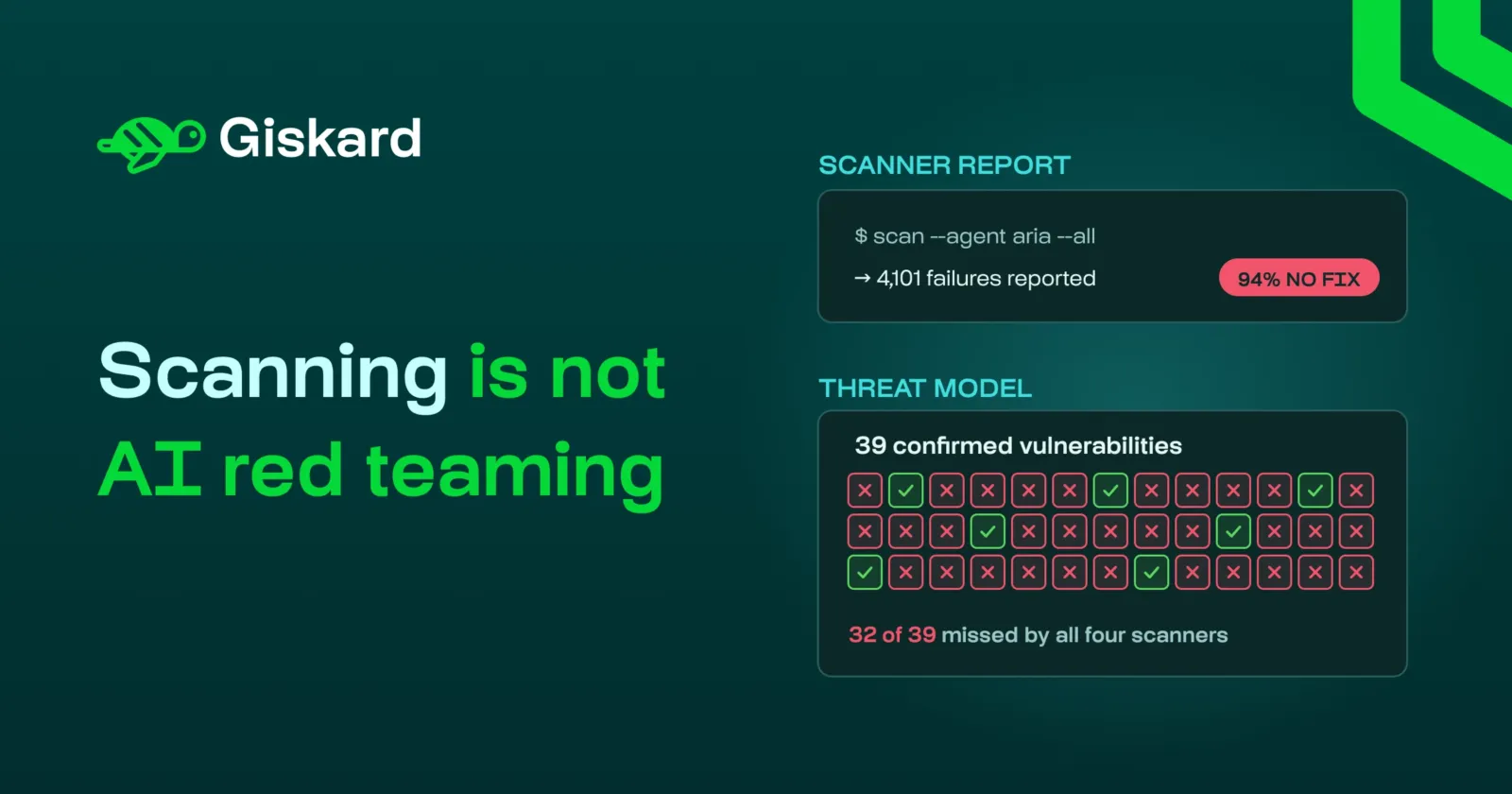
Giskard provides open-source Python tools and a commercial platform for evaluating AI agents and testing them for security vulnerabilities.
The open-source library, Hub SDK, agent testing, and red-teaming functions are documented. Public enterprise pricing and sufficiently accessible independent reviews were not found; scores are editorial assessments, not user ratings or performance tests.
This profile combines documented product information and independent evidence where available. It is not a hands-on test unless TechZella explicitly identifies one.
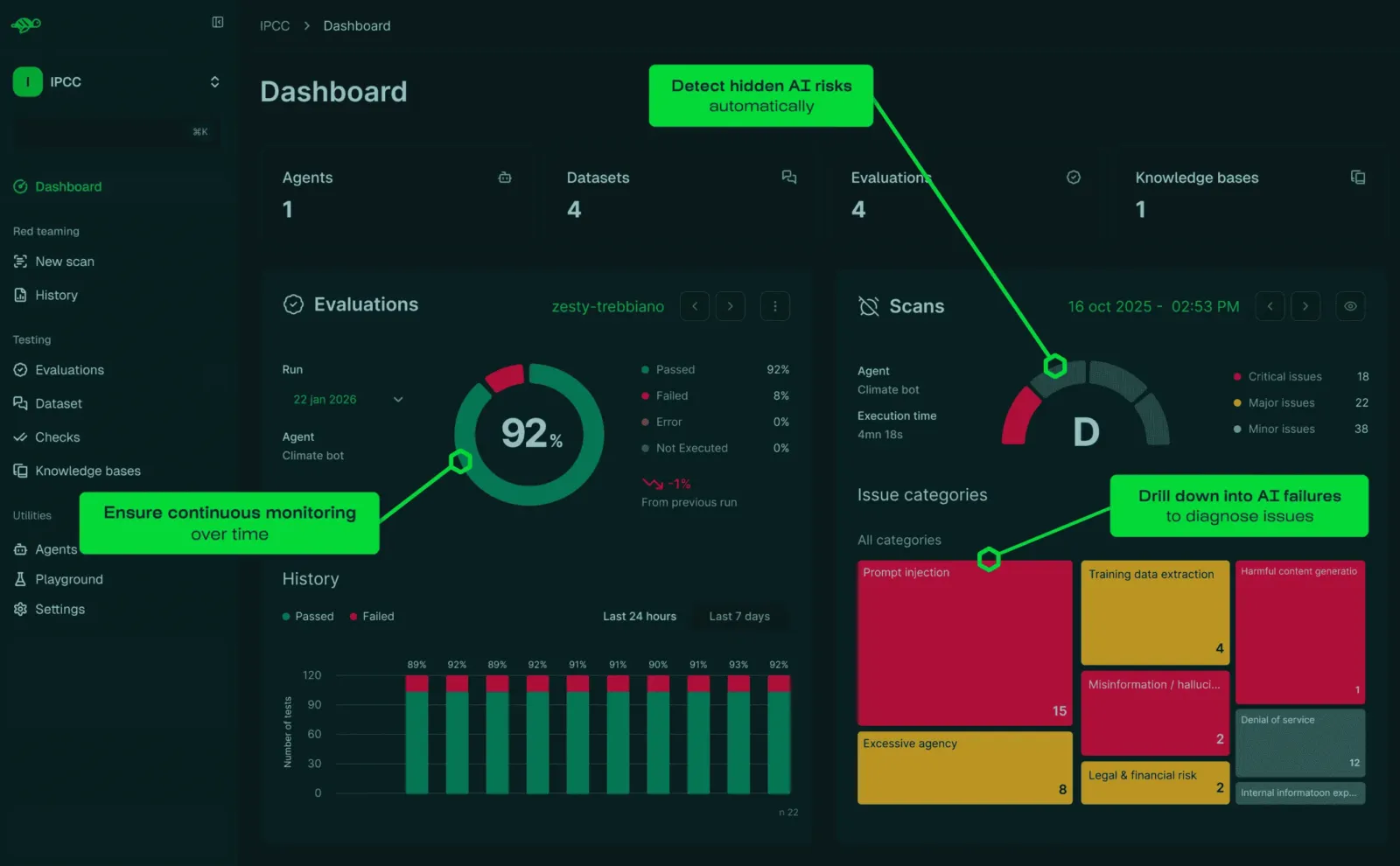
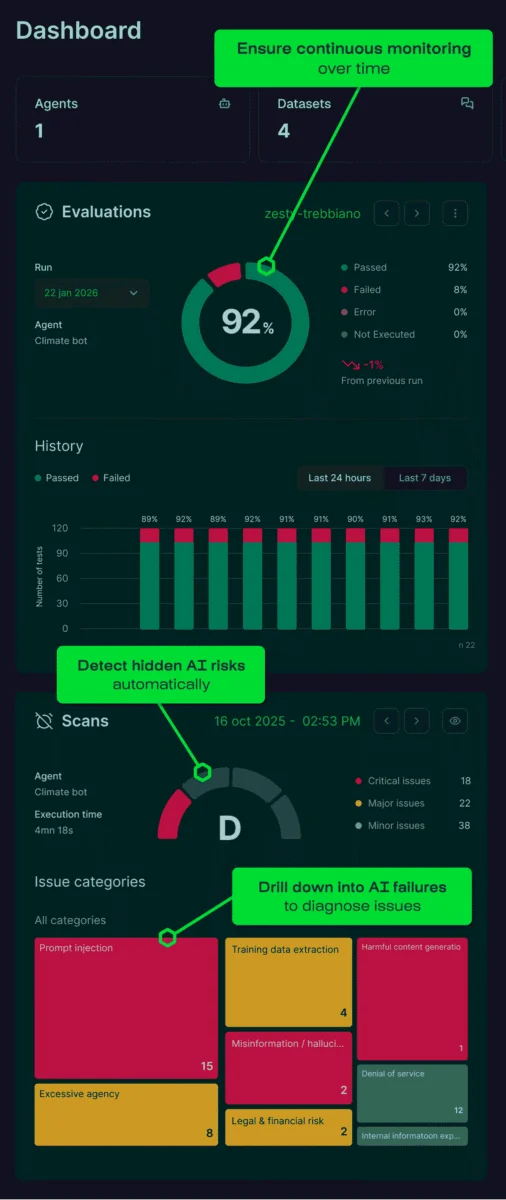
Giskard combines a free, local Python library with a commercial Hub for AI agent evaluation and security testing. Its documented workflows include vulnerability scans, quality checks, datasets, and scheduled evaluations.
The Hub can test chat agents and structured JSON endpoints. This makes it relevant to teams testing conversational products as well as classifiers, extraction pipelines, and scoring services.
A quick way to understand who this product may suit, where its limits matter, and which facts are most relevant before you compare alternatives.
AI engineering and security teams that need to test agent quality and probe for security failures during development or in collaborative Hub workflows.
Teams seeking a publicly priced enterprise subscription, or teams unable to configure a Python environment and an LLM provider for open-source scans, may need another approach, and should evaluate alternatives such as LangSmith or Arize Phoenix instead.
Cloud, On-premises, Private Cloud, Python, SaaS
7.2/10
These are the product-specific differences that may matter when deciding whether the software fits your workflow. They are based on documented evidence rather than a universal ranking.
These are documented constraints or practical friction points that may matter before you adopt the product.
The scan uses a model to generate attacks and judge agent responses; external provider calls may transmit agent descriptions and replies.
Evidence source ↗These settings apply across the deployment rather than being independently configured for each agent.
Evidence source ↗Free Python library for local deployment; scans require a configured LLM provider.
Check current pricing →Commercial option for production AI agents; includes advanced scans, evaluations, collaboration, and deployment choices.
Check current pricing →Pricing may change. Verify current plans on the vendor's website.
Compare similar products directly, then see which alternatives may make more sense when your requirements differ.
| Decision factor | Giskard | LangSmith | Arize Phoenix |
|---|---|---|---|
| Primary workflow | AI agent security red-teaming and quality evaluation, including multi-turn vulnerability probes. | Agent and LLM evaluation integrated with tracing, production monitoring, and prompt iteration. Source ↗ | Open-source tracing, evaluation, experimentation, and prompt iteration for AI applications. Source ↗ |
| Pricing model | Open-source option is free; Professional pricing is available by contacting the vendor. | Developer plan is free; Plus is listed at $39 per seat monthly plus usage, and Enterprise is custom-priced. Source ↗ | Phoenix is listed as open-source and self-hosted; Arize AX also has a free hosted tier and a $50 monthly Pro tier. Source ↗ |
| Deployment model | Professional Hub lists SaaS, private-cloud, and on-premises options. | LangSmith lists cloud plans and self-hosted or hybrid deployment options for Enterprise. Source ↗ | Phoenix supports self-hosting; Arize AX Enterprise is listed as SaaS or self-hosted. Source ↗ |
Only factors supported by the available research are shown. The comparison is descriptive, not a ranking.
These products address broadly similar requirements. The descriptions focus on documented reasons a buyer might compare them with Giskard.


| Open-source runtime | Python 3.12 or higher for vulnerability scans |
|---|---|
| Agent connection | HTTP API endpoint using Chat or Structured request and response formats |
| Hosting options | Local, SaaS, private cloud, or on-premises, depending on offering |
| Model provider | OpenAI, Anthropic, Google, or LiteLLM-supported models for open-source scans |
| Enterprise pricing | Not publicly listed |
Verified installation, hosting, administration, or environment details that can affect implementation.
| Open-source installation | Local Python package installation; vulnerability scans require Python 3.12 or higher. Source ↗ |
|---|---|
| Hub hosting | Professional deployment options are listed as on-premises, private cloud, or SaaS. Source ↗ |
Documented portability, standards, export, or switching considerations. No switching-cost score is shown unless the evidence supports one.
The SDK documentation says Hub v2 users can use the SDK with Hub v3 with little change; it also points to a migration guide for breaking changes.
Evidence source ↗Hub release notes document importing Giskard OSS scenario JSON datasets; JSON and JSONL are the supported knowledge-base import and export formats in the documented Hub release notes.
Evidence source ↗A proprietary editorial score based on product capabilities, usability, value, performance, support and user sentiment evidence.
The open-source library, Hub SDK, agent testing, and red-teaming functions are documented. Public enterprise pricing and sufficiently accessible independent reviews were not found; scores are editorial assessments, not user ratings or performance tests.
Methodology v1.0. The assessment weighs feature coverage (25%), ease of use (15%), value for money (20%), performance (15%), support (10%) and user sentiment (15%), using researched product evidence and verified review evidence where available. It is a TechZella editorial assessment, not a direct user-review average.
Key claims are linked to the sources used to verify them. This evidence record is separate from third-party user ratings.
TechZella evaluates software using documented product capabilities, pricing information, usability and value considerations, independent user evidence where available, and competitive context. The assessment is an editorial review, not a hands-on test unless one is explicitly identified. Our editorial assessment is based on 4 documented sources.
The company history identifies 2021 as its founding year.
View source ↗Verified 2026-11-12The installation documentation states both requirements and describes provider configuration.
View source ↗Verified 2026-11-12Hub 3.0 release notes describe Structured mode, JSON schemas, and testing classifiers, extraction pipelines, and scoring APIs.
View source ↗Verified 2026-11-12The release notes list both additions and require Hub upgrade before SDK upgrade.
View source ↗Verified 2026-11-12The pricing page presents the open-source features and directs Professional buyers to contact the company.
View source ↗Verified 2026-11-12The Professional pricing page names these deployment options.
View source ↗Verified 2026-11-12The installation documentation explicitly describes these provider calls and their possible data contents.
View source ↗Verified 2026-11-12Answers begin with the clearest available response, followed by the context that helps you act on it.
No reviews yet. Be the first to share your experience.
Please log in to submit a review.