
Self-hosted agents leave infrastructure management to the customer.
Teams must account for provisioning, scaling, security, and maintenance in addition to the Buildkite subscription.
Evidence source ↗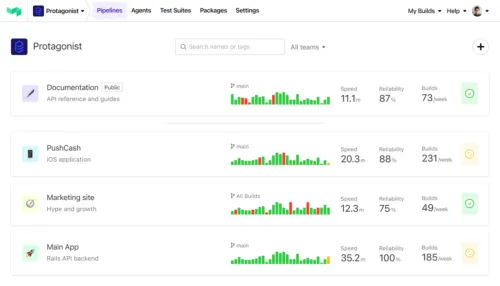
Buildkite is a CI/CD platform that orchestrates software builds and tests using hosted or self-managed agents, with APIs and integrations for development workflows.
Buildkite offers configurable pipelines, hosted and self-hosted agents, test analytics, package registries, APIs, and a free tier. G2's public review page shows 31 reviews and a 4.7 rating; visible feedback also notes customization and learning-curve trade-offs.
This profile combines documented product information and independent evidence where available. It is not a hands-on test unless TechZella explicitly identifies one.
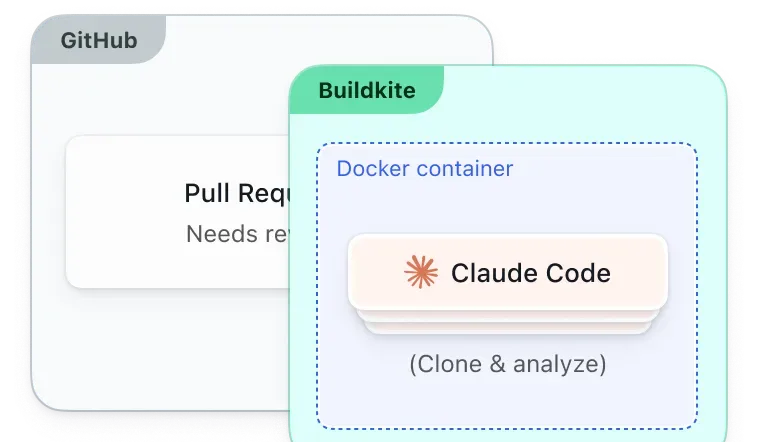
Buildkite is a continuous integration and delivery platform for building and testing code changes. Its SaaS control plane coordinates jobs, while agents can run on Buildkite-hosted compute or infrastructure managed by the customer.
The product connects to several source-control systems and supports configurable, dynamic pipelines. Buyers choosing self-hosted agents retain control of the build environment, but also take responsibility for provisioning, scaling, security, and maintenance.
A quick way to understand who this product may suit, where its limits matter, and which facts are most relevant before you compare alternatives.
Engineering organizations that need customizable CI/CD pipelines and want to run agents on their own infrastructure, Buildkite-hosted compute, or a combination.
Teams seeking a single, fully managed CI environment with no agent infrastructure decisions may prefer a more prescriptive hosted CI service. Buildkite requires users to choose and manage self-hosted agent infrastructure when they use that deployment option, and should evaluate alternatives such as CircleCI or GitHub Actions instead.
AWS, Cloud, Kubernetes, Linux, SaaS
8.3/10
These are the product-specific differences that may matter when deciding whether the software fits your workflow. They are based on documented evidence rather than a universal ranking.
These are documented constraints or practical friction points that may matter before you adopt the product.
Teams must account for provisioning, scaling, security, and maintenance in addition to the Buildkite subscription.
Evidence source ↗Teams with longer audit needs or larger artifact volumes should compare tier limits and retention settings before adopting the Free plan.
Evidence source ↗Large build outputs or frequent downloads can add usage charges beyond the active-user price.
Evidence source ↗Up to 5 users, 10 concurrent jobs, and 2,000 Linux vCPU minutes per month. Also includes 250,000 test executions monthly.
Check current pricing →Up to 50 users, up to 250 concurrent agents with 10 included, and 4,000 Linux AMD64 vCPU minutes monthly. Additional usage rates and allowances apply.
Check current pricing →Custom usage and rate limits, enterprise controls, and support options. Contact sales for pricing.
Check current pricing →Pricing may change. Verify current plans on the vendor's website.
Compare similar products directly, then see which alternatives may make more sense when your requirements differ.
| Decision factor | Buildkite | CircleCI | GitHub Actions |
|---|---|---|---|
| Core scope | CI/CD platform with pipelines, test capabilities, package registries, and hosted or self-hosted agents. | CI/CD platform with cloud and self-hosted runners, test insights, and usage credits. Source ↗ | GitHub Actions is available across GitHub products and runs workflow automation for GitHub repositories. Source ↗ |
| Deployment model | SaaS control plane with customer-managed agents, Buildkite-hosted agents, or both. | Offers cloud server compute and self-hosted runners; the pricing page identifies both deployment options. Source ↗ | Uses GitHub-hosted or self-hosted runners. Source ↗ |
| Pricing model | Free plan, Pro at $30 per active user per month, and custom Enterprise pricing. | Free plan, Performance starting at $15 per month, and custom Scale pricing; compute and features use credits. Source ↗ | Standard GitHub-hosted runner use is free in public repositories; private-repository compute is subject to included usage and billing rules, while self-hosted runners are free. Source ↗ |
Only factors supported by the available research are shown. The comparison is descriptive, not a ranking.
These products address broadly similar requirements. The descriptions focus on documented reasons a buyer might compare them with Buildkite.

| Deployment | SaaS control plane; hosted or self-hosted agents |
|---|---|
| Source control | GitHub, GitHub Enterprise, GitLab, Bitbucket, Bitbucket Server, and other Git servers |
| API | REST API v2 and GraphQL API |
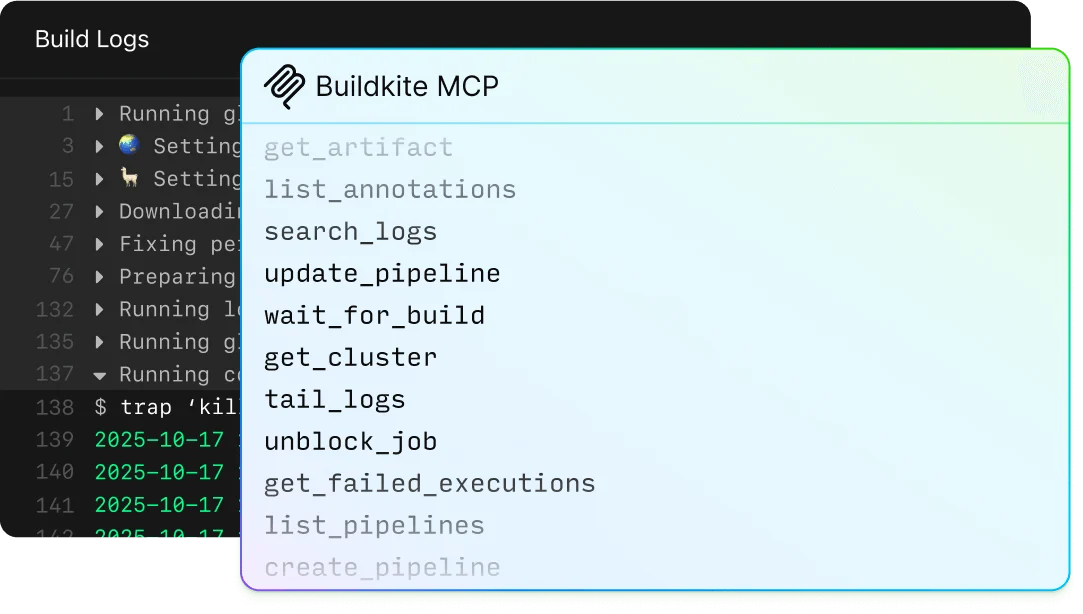
| Self-hosted environments | On-premises, AWS, Google Cloud, and Kubernetes |
| Free trial | 30-day all-access trial; no credit card required |
| Build retention | 30 days on Free, 90 days on Pro, and one year plus historical export on Enterprise |
| Artifact storage | Free: 50 GB/month; Pro: 250 GB/month; Enterprise: custom |
| Support | Community support on Free; priority email support on Pro; Enterprise support with SLA credits |
Verified installation, hosting, administration, or environment details that can affect implementation.
| Installation or hosting | SaaS platform with either customer-managed self-hosted agents or Buildkite-hosted agents. Source ↗ |
|---|---|
| Self-hosted environments | Customer infrastructure may include on-premises servers, AWS, Google Cloud, or Kubernetes. Source ↗ |
Documented portability, standards, export, or switching considerations. No switching-cost score is shown unless the evidence supports one.
Buildkite publishes migration guidance and tools for translating pipelines from GitHub Actions, CircleCI, and Bitbucket; migration services also cover Jenkins, GitLab CI, Azure DevOps, and TeamCity.
Evidence source ↗Build and pipeline information can be accessed through REST and GraphQL APIs; the reviewed pages do not establish a general one-click export of all account data.
Evidence source ↗A proprietary editorial score based on product capabilities, usability, value, performance, support and user sentiment evidence.
Buildkite offers configurable pipelines, hosted and self-hosted agents, test analytics, package registries, APIs, and a free tier. G2's public review page shows 31 reviews and a 4.7 rating; visible feedback also notes customization and learning-curve trade-offs.
Methodology v1.0. The assessment weighs feature coverage (25%), ease of use (15%), value for money (20%), performance (15%), support (10%) and user sentiment (15%), using researched product evidence and verified review evidence where available. It is a TechZella editorial assessment, not a direct user-review average.
Key claims are linked to the sources used to verify them. This evidence record is separate from third-party user ratings.
TechZella evaluates software using documented product capabilities, pricing information, usability and value considerations, independent user evidence where available, and competitive context. The assessment is an editorial review, not a hands-on test unless one is explicitly identified. Our editorial assessment is based on 6 documented sources.
The company's official page states that Buildkite was founded in Australia in 2013.
View source ↗Verified 2026-11-08The official pricing page describes a 30-day trial of the Buildkite Platform and states that no credit card is required.
View source ↗Verified 2026-11-08Official agent documentation describes both self-hosted and hosted agent options.
View source ↗Verified 2026-11-08The source-control documentation lists these providers and additional Git-server options.
View source ↗Verified 2026-11-08The API documentation describes both APIs, authentication, and their different capabilities.
View source ↗Verified 2026-11-08The official pricing page lists the Free plan's user and concurrency limits.
View source ↗Verified 2026-11-08The official integrations documentation organizes these services under notifications and observability.
View source ↗Verified 2026-11-08Answers begin with the clearest available response, followed by the context that helps you act on it.
No reviews yet. Be the first to share your experience.
Please log in to submit a review.