Editorial overview
Aggregated Overview
Official documentation verifies broad integrations, APIs, mobile apps, on-call scheduling, incident workflows, and automation. Public ratings are positive overall, while review summaries flag setup complexity, interface usability, and pricing concerns.
This profile combines documented product information and independent evidence where available. It is not a hands-on test unless TechZella explicitly identifies one.
Overview
PagerDuty is a cloud service for managing operational incidents, on-call schedules, alerts, and response workflows. Teams connect monitoring and service-management systems, route alerts to responders, and coordinate resolution through web, mobile, or chat integrations.
The product spans entry-level Incident Management plans and the broader PD Reliability Platform. Plan boundaries matter: some advanced analytics, automation, and AI capabilities require add-ons or higher tiers.
PagerDuty Decision Snapshot
A quick way to understand who this product may suit, where its limits matter, and which facts are most relevant before you compare alternatives.
Best suited toTechnology and operations teams that need structured on-call coverage, event-driven incident response, integrations with monitoring and collaboration tools, and automation across services.
Look elsewhere ifSmall teams needing only a simple pager may find the broader platform and paid-plan limits more than they need; advanced functions and usage capacity can require higher plans or add-ons, and should evaluate alternatives such as incident.io or Rootly instead.
PlatformsAndroid, API, iOS, SaaS, Web
TechZella assessment8.2/10
PagerDuty — What Sets It Apart?
These are the product-specific differences that may matter when deciding whether the software fits your workflow. They are based on documented evidence rather than a universal ranking.
- A documented integration catalog spanning monitoring, cloud, collaboration, security, and service-management tools, alongside REST and Events APIs.
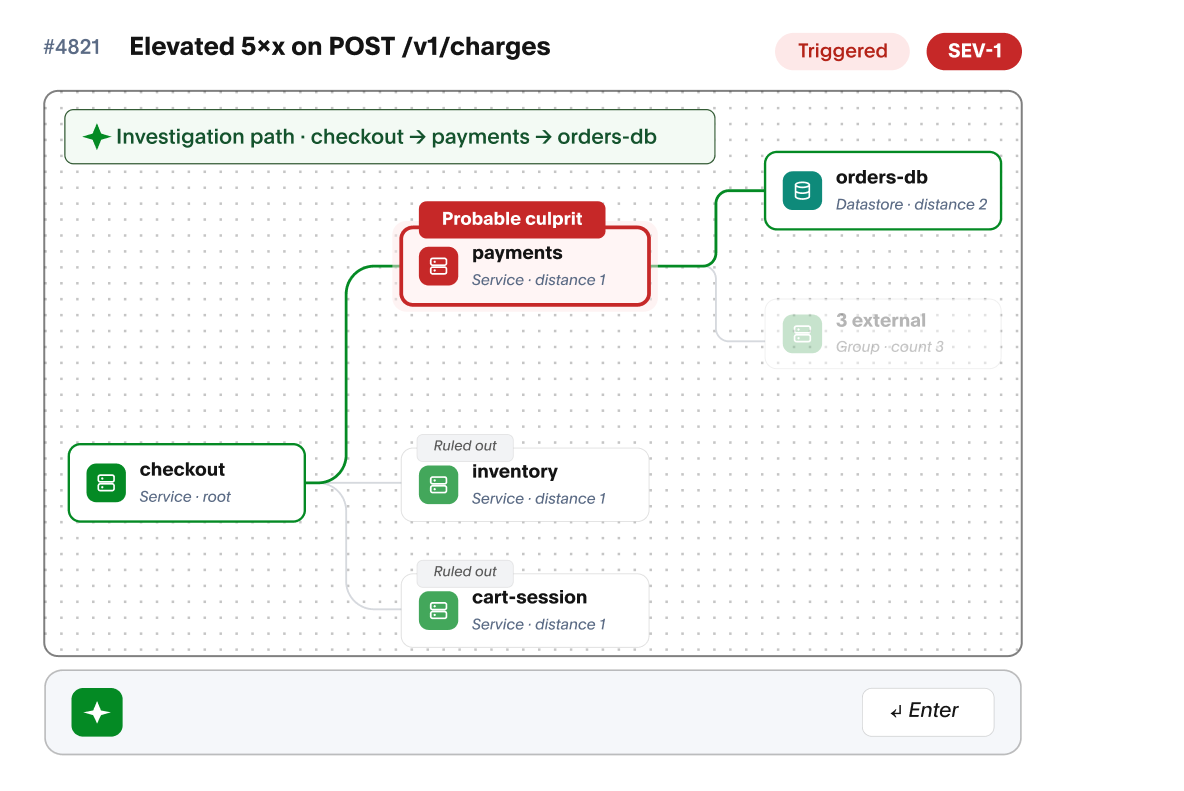
- Incident response combines schedules, escalation policies, notifications, team collaboration, service context, and post-incident review workflows.
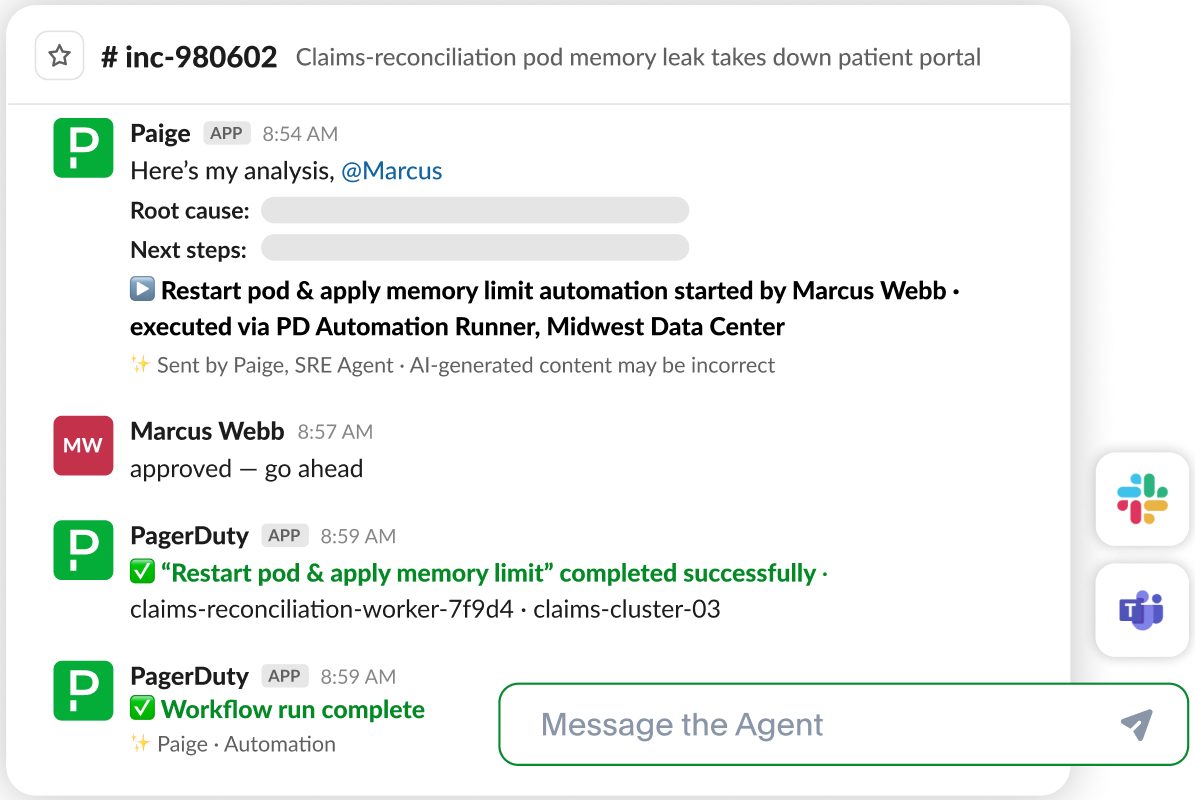
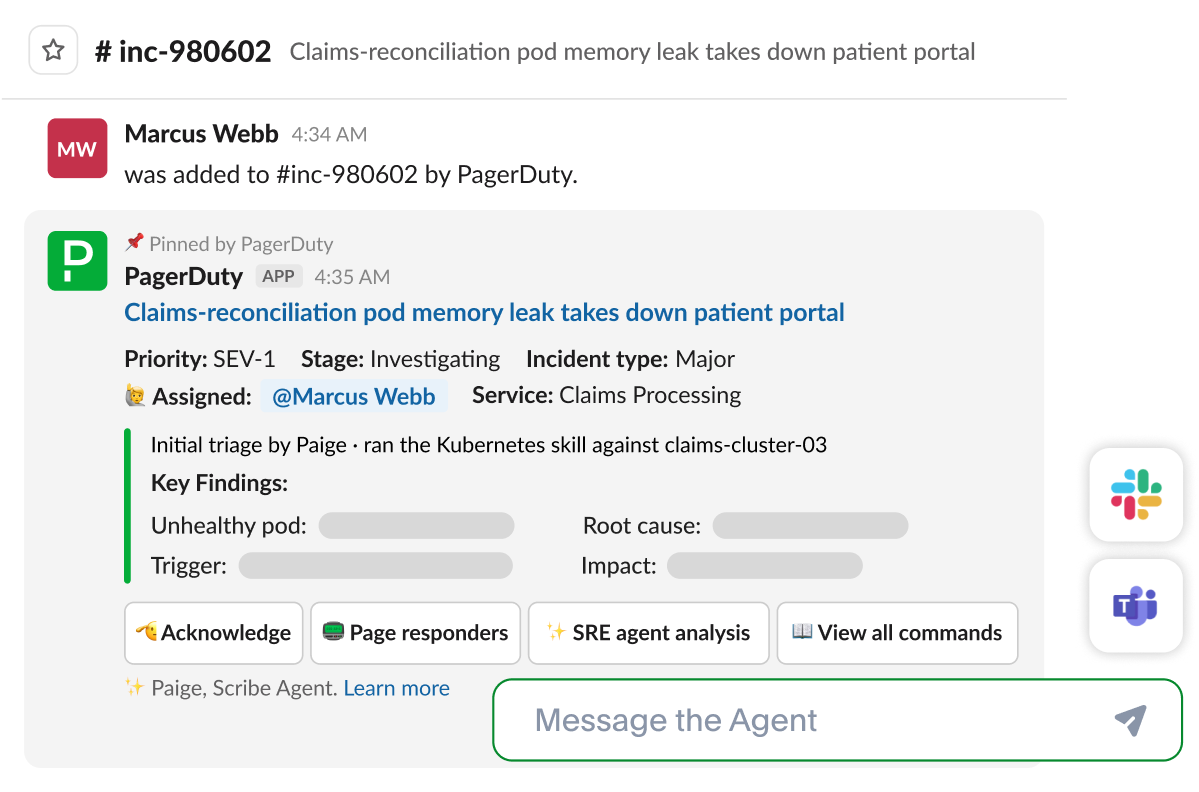
- The November 2026 launch introduced Paige, an SRE agent, and renamed the flagship platform PD Reliability Platform.
Editorial assessmentPagerDuty Pros & Cons
Pros
- Broad catalog of documented integrations across cloud, monitoring, security, collaboration, and service-management tools.
- REST, Events, and webhook options support both configuration management and event ingestion.
- Free plan provides a limited on-call and incident-response starting point.
- Mobile apps and Slack or Microsoft Teams integrations support distributed response workflows.
Cons
- Advanced functions and some AI capabilities require add-ons or higher-tier plans.
- PD Reliability Platform plans have fixed seat, event, and AI-action allocations; additional usage requires credit packs.
- Public review summaries identify configuration complexity, usability concerns, and perceived pricing as drawbacks.
- Mobile app updates require newer operating systems beginning November 16, 2026.
PagerDuty Gotchas & Operational Limits
These are documented constraints or practical friction points that may matter before you adopt the product.
PD Reliability Platform plans include defined seats, Events, and AI Actions; additional capacity is purchased through credit packs.
Teams should estimate responders, incoming events, and premium or AI actions before selecting a platform tier.
Evidence source ↗Several capabilities, including AIOps and PagerDuty Advance on some Incident Management plans, are add-ons or have separate usage allocations.
A base per-user price may not represent the total cost for teams needing advanced alert grouping, automation, or AI features.
Evidence source ↗New PagerDuty mobile app versions require iOS 18 or Android 13 beginning November 16, 2026, according to the mobile documentation.
Organizations relying on mobile response should check managed-device OS upgrade plans before that date.
Evidence source ↗Security & Privacy
For security-sensitive software, TechZella focuses on documented architecture, authentication, data handling, deployment and privacy details that can affect a buying decision. This is product research, not an independent security audit.
Security posture at a glance
| Deployment | Cloud-hosted SaaS |
|---|
| Security documentation | PagerDuty states ISO 27001 certification and provides SOC 2 Type 2 reports by request |
|---|
What the documented evidence tells us
PagerDuty's security page describes SOC 2 and ISO 27001-related security documentation and certifications.The security page references SOC 2 Type 2 reports and states ISO 27001 certification; documents may require a request.
Source ↗ Security claims are presented only when supported by documented sources. The presence of this section does not constitute a penetration test, certification or independent security audit.
Plans & pricingPagerDuty Pricing & Plans
Free
$0
year
Incident Management plan for up to five users, one on-call schedule, and one escalation policy.
Check current pricing →Professional
$21 per user
month, billed annually
Incident Management paid plan; monthly billing is also offered at a higher listed rate. Add-ons are sold separately.
Check current pricing →Business
$41 per user
month, billed annually
Incident Management plan with additional administrative, integration, and incident-management capabilities.
Check current pricing →Starter
$2,800
year
PD Reliability Platform plan with 10 seats, 5,000 Signal Intelligence Events, and 1,000 AI Actions.
Check current pricing →Essential
$12,000
year
PD Reliability Platform plan with 20 seats, 40,000 Events, and 4,000 AI Actions.
Check current pricing →Plus
$48,000
year
PD Reliability Platform plan with 50 seats, 150,000 Events, and 16,000 AI Actions.
Check current pricing →Ultimate
Custom pricing
custom
PD Reliability Platform plan with 500 seats, 2,000,000 Events, and 100,000 AI Actions, according to the pricing page.
Check current pricing →Pricing may change. Verify current plans on the vendor's website.
Cost contextTotal Cost & Hidden Costs
Additional costs or implementation requirements that are documented in the available evidence.
Implementation and onboarding
PagerDuty's public product and pricing pages do not specify a standard implementation duration or mandatory onboarding fee; confirm any services or onboarding scope with sales.
Evidence source ↗Hosting and infrastructure
PagerDuty is a hosted SaaS service; no separate customer-hosted infrastructure requirement is listed on the pricing page.
Evidence source ↗Usage and feature expansion
PD Reliability Platform plans include different seat, event, and AI-action allowances; additional capacity is available through credit packs. Some Incident Management features are add-ons.
Evidence source ↗PagerDuty Competitors & Alternatives
Compare similar products directly, then see which alternatives may make more sense when your requirements differ.
At a glance
DevOps PlatformOnly factors supported by the available research are shown. The comparison is descriptive, not a ranking.
Direct competitors
These products address broadly similar requirements. The descriptions focus on documented reasons a buyer might compare them with PagerDuty.
incident.ioPricing model: Free Basic tier; Team starts at $15 per user/month with annual discount; on-call is separately priced on Team and Pro.
RootlyPricing model: Incident Response and On-Call each list at $20 per user/month; enterprise pricing is custom.
CapabilitiesPagerDuty Features
Incident management
- On-call schedules and escalation policies
- Incident creation, response, and resolution workflows
- Responder notifications through email, push, SMS, and phone, with plan-dependent limits
- Post-incident reviews and incident activity reporting
Integrations and APIs
- 750+ listed integrations
- REST API for account resources
- Events API for submitting events
- Webhook options
Automation and intelligence
- Incident Workflows
- Plan-dependent alert grouping and event orchestration
- Usage-metered AI Actions in PD Reliability Platform tiers
- Paige SRE agent announced November 3, 2026
Mobile and collaboration
- iOS and Android apps
- Slack and Microsoft Teams incident collaboration
- Mobile access to incidents, account objects, and settings
PagerDuty Specifications
| Deployment | Cloud-hosted SaaS |
|---|
| Web access | Web application |
|---|
| Mobile apps | iOS and Android |
|---|
| API | REST API, Events API, webhooks |
|---|
| Integrations | 750+ listed integrations |
|---|
| Trial | 14 days; no credit card required, according to PagerDuty FAQ |
|---|
| Free plan limit | Up to 5 users, 1 on-call schedule, and 1 escalation policy |
|---|
| Security documentation | PagerDuty states ISO 27001 certification and provides SOC 2 Type 2 reports by request |
|---|
| Mobile OS minimum | iOS 17 and Android 12 currently; new app versions require iOS 18 or Android 13 from November 16, 2026 |
|---|
Exit planningMigration & Lock-In
Documented portability, standards, export, or switching considerations. No switching-cost score is shown unless the evidence supports one.
Configuration portability
The REST API can access or manipulate account configuration data. The reviewed public documentation does not establish a complete cross-vendor migration process or universal export of historical data.
Evidence source ↗Our evidence-based assessmentTechZella Score
A proprietary editorial score based on product capabilities, usability, value, performance, support and user sentiment evidence.
8.2/10Moderate confidence
Official documentation verifies broad integrations, APIs, mobile apps, on-call scheduling, incident workflows, and automation. Public ratings are positive overall, while review summaries flag setup complexity, interface usability, and pricing concerns.
Methodology v1.0. The assessment weighs feature coverage (25%), ease of use (15%), value for money (20%), performance (15%), support (10%) and user sentiment (15%), using researched product evidence and verified review evidence where available. It is a TechZella editorial assessment, not a direct user-review average.
Editorial transparency
Our Review Methodology
Key claims are linked to the sources used to verify them. This evidence record is separate from third-party user ratings.
TechZella evaluates software using documented product capabilities, pricing information, usability and value considerations, independent user evidence where available, and competitive context. The assessment is an editorial review, not a hands-on test unless one is explicitly identified. Our editorial assessment is based on 6 documented sources.
What TechZella adds- A documented integration catalog spanning monitoring, cloud, collaboration, security, and service-management tools, alongside REST and Events APIs.
- Incident response combines schedules, escalation policies, notifications, team collaboration, service context, and post-incident review workflows.
- The November 2026 launch introduced Paige, an SRE agent, and renamed the flagship platform PD Reliability Platform.
Important limitations- Some advanced features are not included in the Free or Professional tiers, and several are sold as add-ons.
- PD Reliability Platform plans include fixed seat, event, and AI-action allocations; additional capacity uses credit packs.
- Public review summaries cite setup complexity, mobile-app usability concerns, and perceived pricing concerns.
Evidence-backed claimsPagerDuty offers Free and paid Incident Management plans, as well as PD Reliability Platform plans.The official pricing page lists Free and Professional Incident Management plans and Starter, Essential, Plus, and Ultimate platform plans.
View source ↗Verified 2026-11-08PagerDuty documents more than 750 integrations.PagerDuty's company page states 750+ integrations; its integration documentation also describes a catalog of supported integration guides.
View source ↗Verified 2026-11-08PagerDuty provides REST, Events, and webhook options for programmatic integration.The developer documentation surveys these options and distinguishes account-management REST calls from event submission.
View source ↗Verified 2026-11-08PagerDuty mobile apps are available for iOS and Android.The official mobile documentation identifies Apple App Store and Google Play availability and lists current OS minimums.
View source ↗Verified 2026-11-08PagerDuty's security page describes SOC 2 and ISO 27001-related security documentation and certifications.The security page references SOC 2 Type 2 reports and states ISO 27001 certification; documents may require a request.
View source ↗Verified 2026-11-08PagerDuty announced Paige and the PD Reliability Platform on November 3, 2026.The company's newsroom release describes Paige as an SRE agent and identifies the renamed flagship product.
View source ↗Verified 2026-11-08 Independent review sources
PagerDuty Ratings & Reviews
Ratings are published by the respective review platforms and may change over time.
Common questionsPagerDuty FAQs
Answers begin with the clearest available response, followed by the context that helps you act on it.
Does PagerDuty have a free plan?
Yes. The Free Incident Management plan supports up to five users, one on-call schedule, and one escalation policy.
Does PagerDuty offer a free trial?
Yes. PagerDuty's FAQ states that new accounts receive a 14-day trial without a credit card.
Does PagerDuty have an API?
Yes. It documents a REST API for account resources and an Events API for sending events, as well as webhook options.
Does PagerDuty have iOS and Android apps?
Yes. Its mobile documentation lists both apps and currently specifies iOS 17 and Android 12 minimums; new versions move to iOS 18 and Android 13 on November 16, 2026.
Community feedback
Reviews
No reviews yet. Be the first to share your experience.
Write a Review
Please log in to submit a review.
Recently added DevOps Platform