
The announced end-of-support date is April 5, 2027.
Current users need to plan migration before access ends; Atlassian says unmigrated data will be deleted after shutdown.
Evidence source ↗
Opsgenie is Atlassian’s cloud incident alerting and on-call management software. New sales ended in June 2025, and Atlassian plans to end support on April 5, 2027.
Official documentation describes alerting, on-call schedules, escalations, integrations, reporting, and APIs. G2 shows a 4.2/5 rating from 53 reviews, but the productu2019s announced sunset is a major purchasing and continuity constraint.
This profile combines documented product information and independent evidence where available. It is not a hands-on test unless TechZella explicitly identifies one.
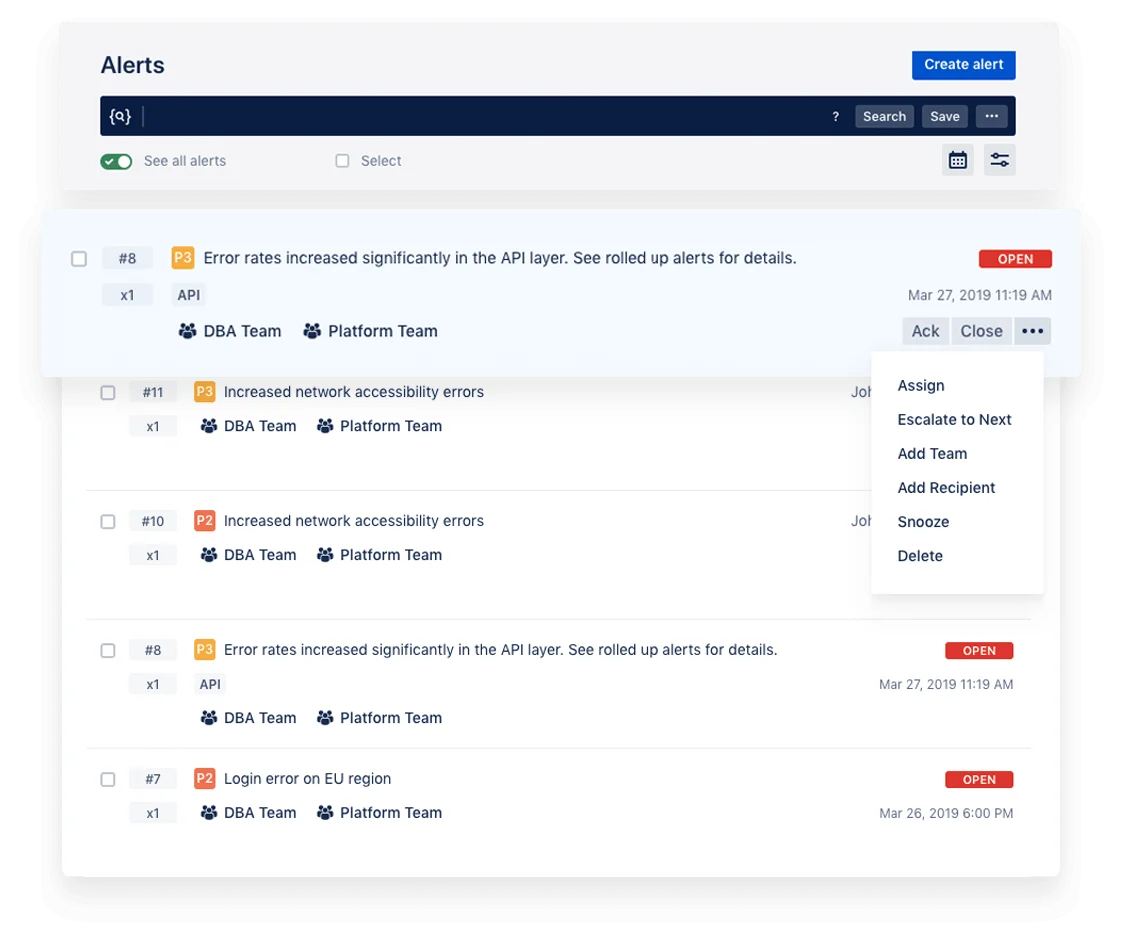
Opsgenie is Atlassian software for routing operational alerts and coordinating on-call response. It combines alert management with schedules, escalation rules, notification policies, and incident reporting.
Atlassian ended new sales and signups on June 4, 2025. Existing customers can continue using the service until the announced end-of-support date, April 5, 2027. That deadline makes migration planning central to any assessment of the product.
A quick way to understand who this product may suit, where its limits matter, and which facts are most relevant before you compare alternatives.
Existing Atlassian customers using Opsgenie for alert routing and on-call schedules while planning migration to Jira Service Management or Compass.
Organizations seeking a new incident-response subscription or a product with support beyond April 5, 2027, and should evaluate alternatives such as PagerDuty or xMatters instead.
Android, Cloud, iOS, REST API, Web
7.7/10
These are the product-specific differences that may matter when deciding whether the software fits your workflow. They are based on documented evidence rather than a universal ranking.
These are documented constraints or practical friction points that may matter before you adopt the product.
Current users need to plan migration before access ends; Atlassian says unmigrated data will be deleted after shutdown.
Evidence source ↗Teams should identify the required account owners and administrators before setting a cutover date.
Evidence source ↗API-based integration administration may not cover every configured integration type.
Evidence source ↗Legacy plan listed for up to five users. New signups and sales have ended.
Check current pricing →Legacy listed price; monthly billing is listed at $11.55 per user. Existing subscription terms apply because new sales ended.
Check current pricing →Legacy listed price; monthly billing is listed at $24.15 per user. Existing subscription terms apply because new sales ended.
Check current pricing →Legacy listed price; monthly billing is listed at $38.50 per user. Existing subscription terms apply because new sales ended.
Check current pricing →Pricing may change. Verify current plans on the vendor's website.
Compare similar products directly, then see which alternatives may make more sense when your requirements differ.
| Decision factor | Opsgenie | PagerDuty | Jira Service Management |
|---|---|---|---|
| Core scope | Alert routing, on-call scheduling, escalations, and incident reporting. | Incident Management plans include on-call schedules, escalation policies, and incident-response features. Source ↗ | Adds IT service management workflows, including change and problem management, alongside alerting and incident response. Source ↗ |
| Integrations | Atlassian lists more than 200 apps and web services, including Slack, Datadog, Jira, and Amazon CloudWatch. | PagerDuty lists more than 750 out-of-the-box integrations on its pricing page. Source ↗ | Not documented |
| Pricing model | Legacy Opsgenie prices are listed per user per month, but new sales ended in 2025. | PagerDuty lists a free plan up to five users and paid Incident Management pricing per user per month. Source ↗ | Jira Service Management Cloud pricing is offered through Atlassian subscription plans and a pricing calculator. Source ↗ |
| Migration | Existing customers can use Atlassian’s migration tool to transfer operational configurations. | Not documented | Atlassian identifies Jira Service Management as a migration destination and provides a structured transfer process. Source ↗ |
Only factors supported by the available research are shown. The comparison is descriptive, not a ranking.
These products address broadly similar requirements. The descriptions focus on documented reasons a buyer might compare them with Opsgenie.




| Deployment | Cloud |
|---|---|
| Web access | Available |
| Mobile apps | iOS and Android |
| API | REST Integration API |
| Integrations | 200+ listed apps and web services |
| End of new sales | June 4, 2025 |
| End of support | April 5, 2027 |
| Free plan user limit | Up to 5 users, legacy plan |
Verified installation, hosting, administration, or environment details that can affect implementation.
| Hosting | Atlassian-hosted cloud service with web access and mobile apps; the product page also documents solutions for on-premises systems. Source ↗ |
|---|---|
| Mobile access | Atlassian lists iOS and Android apps in the plan comparison. Source ↗ |
Documented portability, standards, export, or switching considerations. No switching-cost score is shown unless the evidence supports one.
The in-product process can transfer alerts, on-call schedules, escalation policies, and integrations to Jira Service Management. Atlassian also identifies Compass as a destination for developer alerting.
Evidence source ↗Atlassian says migration starts syncing data to the destination; turning off Opsgenie permanently removes access to unsynced alerts, schedules, and integrations.
Evidence source ↗A proprietary editorial score based on product capabilities, usability, value, performance, support and user sentiment evidence.
Official documentation describes alerting, on-call schedules, escalations, integrations, reporting, and APIs. G2 shows a 4.2/5 rating from 53 reviews, but the productu2019s announced sunset is a major purchasing and continuity constraint.
Methodology v1.0. The assessment weighs feature coverage (25%), ease of use (15%), value for money (20%), performance (15%), support (10%) and user sentiment (15%), using researched product evidence and verified review evidence where available. It is a TechZella editorial assessment, not a direct user-review average.
Key claims are linked to the sources used to verify them. This evidence record is separate from third-party user ratings.
TechZella evaluates software using documented product capabilities, pricing information, usability and value considerations, independent user evidence where available, and competitive context. The assessment is an editorial review, not a hands-on test unless one is explicitly identified. Our editorial assessment is based on 5 documented sources.
Atlassian states the end-of-sale and end-of-support dates and notes that product access will end at the support cutoff.
View source ↗Verified 2026-11-08Atlassian’s integrations page states the integration catalog count and names featured integrations.
View source ↗Verified 2026-11-08Atlassian lists these capabilities on the product feature and pricing pages.
View source ↗Verified 2026-11-08The API documentation describes GET, POST, PUT, and DELETE integration operations and regional API endpoints.
View source ↗Verified 2026-11-08The public G2 review page displayed that aggregate rating and review count when accessed.
View source ↗Verified 2026-11-08See the product-specific buyer questions below for verified answers on sales status, support timing, API access, and integrations.
No reviews yet. Be the first to share your experience.
Please log in to submit a review.