
Free and Premium plans have different retention and usage ceilings.
Teams should compare expected trace, inference, evaluation, and retention needs against the listed plan limits before rollout.
Evidence source ↗
Arthur provides AI observability, evaluation, governance, and agent discovery tools for teams operating AI applications.
Arthur documents model and agent monitoring, tracing, evaluations, governance policies, connectors, and a free plan. Public review evidence is sparse, and no independent performance testing was found.
This profile combines documented product information and independent evidence where available. It is not a hands-on test unless TechZella explicitly identifies one.
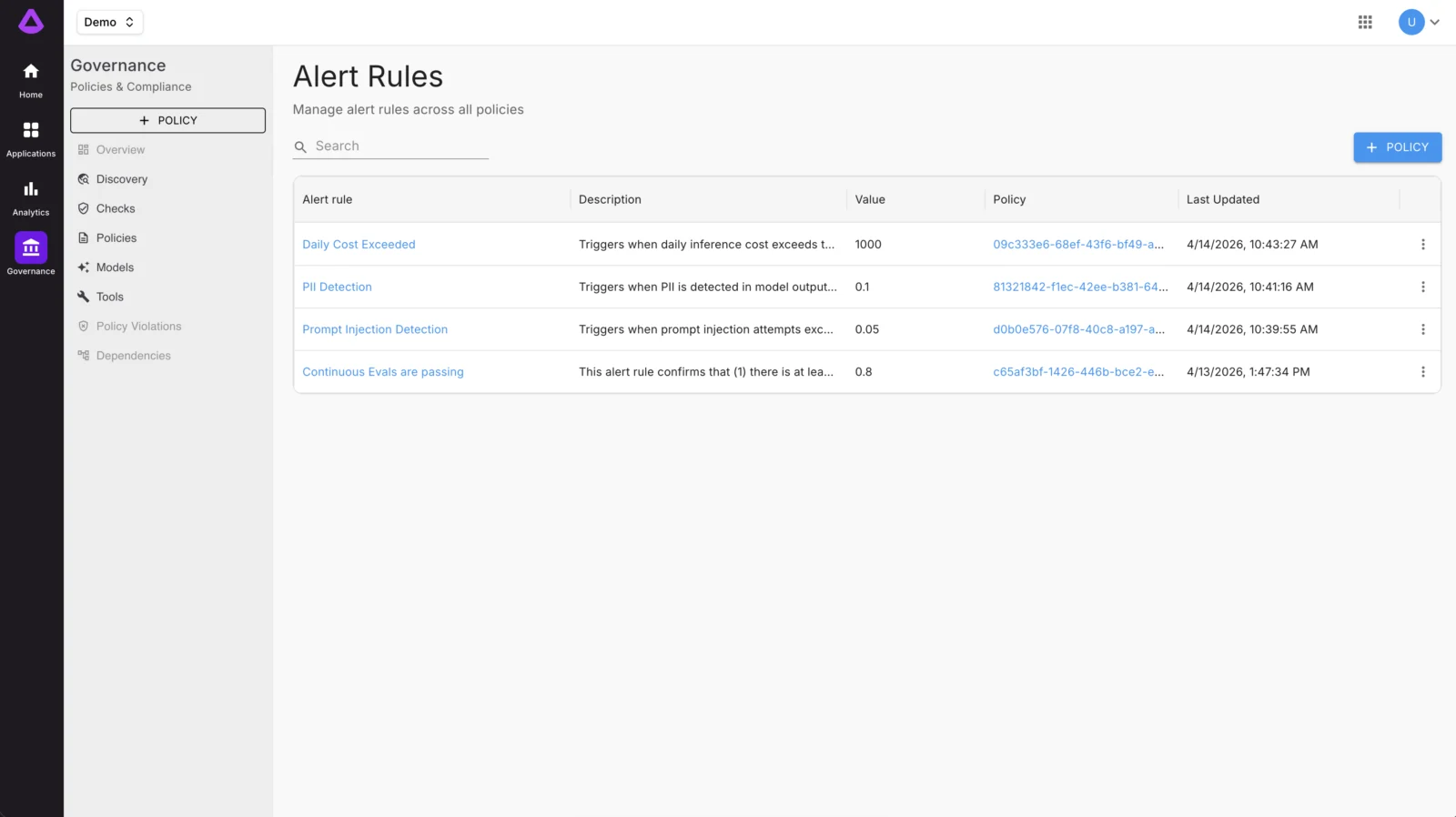
Arthur provides tools for monitoring, evaluating, and governing AI applications. Its documentation covers model and agent observability, agent discovery, alerts, policy workflows, and analytics.
Teams can instrument AI applications through SDKs and integrations, then inspect traces and metrics in the platform. Arthur also documents discovery connectors that draw agent information from cloud platforms, employee endpoints, and security telemetry systems.
A quick way to understand who this product may suit, where its limits matter, and which facts are most relevant before you compare alternatives.
Organizations that need a shared inventory, observability, evaluation, and governance workflows for production AI models or agents.
Teams seeking only a lightweight open-source tracing tool may prefer a self-managed product such as Arize Phoenix or Langfuse, which publish open-source deployment options, and should evaluate alternatives such as LangSmith or Arize Phoenix instead.
API, AWS, Google Cloud, Python, Web
7.2/10
These are the product-specific differences that may matter when deciding whether the software fits your workflow. They are based on documented evidence rather than a universal ranking.
These are documented constraints or practical friction points that may matter before you adopt the product.
Teams should compare expected trace, inference, evaluation, and retention needs against the listed plan limits before rollout.
Evidence source ↗Buyers should clarify which components they intend to host, what their preferred deployment model is, and whether Enterprise infrastructure is required.
Evidence source ↗Includes core model performance monitoring, cloud data connector integrations, up to four monitored use cases, and unlimited seats.
Check current pricing →Adds customizable performance metrics and dashboards, custom alerting and webhook integrations, and monitoring for up to 100 use cases.
Check current pricing →Lists dedicated or managed VPC options, custom data and evaluation needs, advanced monitoring, SSO, SLAs, and a dedicated customer success manager.
Check current pricing →Pricing may change. Verify current plans on the vendor's website.
Compare similar products directly, then see which alternatives may make more sense when your requirements differ.
| Decision factor | Arthur AI | LangSmith | Arize Phoenix |
|---|---|---|---|
| Pricing model | Arthur lists Free at $0/mo, Premium at $60/mo, and Enterprise at custom pricing. | LangSmith lists a $0-per-seat Developer tier with 5,000 base traces monthly, then pay-as-you-go; Plus is $39 per seat monthly, then pay-as-you-go. Source ↗ | Arize describes Phoenix as free and open source, with user-managed ingestion, projects, spans, and retention. Source ↗ |
| Primary workflow | Arthur documents agent discovery, monitoring, evaluation, and governance policies across AI applications. | LangSmith describes a platform for developing, testing, deploying, and monitoring agents, with trace allowances and deployment features. Source ↗ | Phoenix documents tracing, evaluation, datasets, experiments, and prompt management for AI and LLM applications. Source ↗ |
| Deployment model | Arthur lists SaaS and Enterprise dedicated or managed VPC options; its GenAI Engine also has a Docker deployment guide. | LangSmith lists self-hosted and hybrid deployment options on Enterprise. Source ↗ | Phoenix is self-hostable, with documented Docker and Kubernetes deployment paths. Source ↗ |
Only factors supported by the available research are shown. The comparison is descriptive, not a ranking.
These products address broadly similar requirements. The descriptions focus on documented reasons a buyer might compare them with Arthur AI.




| Access | Web platform |
|---|---|
| API and SDK | API documentation and Python SDK |
| Data retention | Free: 7 days; Premium: 30 days; Enterprise: unlimited, as listed on pricing page |
| Plan limits | Free: 5,000 jobs, 300,000 spans, 12,000 inferences, 3,000 evaluations; Premium: 20,000 jobs, 1.2 million spans, 100,000 inferences, 75,000 evaluations |
| Deployment | SaaS and Enterprise VPC options; Docker deployment documented for GenAI Engine |
| Data connectors | BigQuery, Google Cloud Storage, and Amazon S3 are listed in connector documentation |
| Free trial or free plan | Free plan listed at $0/mo; no separate time-limited trial terms verified |
Verified installation, hosting, administration, or environment details that can affect implementation.
| SaaS and dedicated infrastructure | The pricing page lists a multi-tenant SaaS deployment and dedicated or managed VPC options for Enterprise. Source ↗ |
|---|---|
| Local engine deployment | Arthur documents running its GenAI Engine locally using Docker Compose. Source ↗ |
Documented portability, standards, export, or switching considerations. No switching-cost score is shown unless the evidence supports one.
The documentation describes SDK-based tracing and connectors for model frameworks, data warehouses, and cloud storage; it does not publish a general migration service or migration guarantee.
Evidence source ↗A proprietary editorial score based on product capabilities, usability, value, performance, support and user sentiment evidence.
Arthur documents model and agent monitoring, tracing, evaluations, governance policies, connectors, and a free plan. Public review evidence is sparse, and no independent performance testing was found.
Methodology v1.0. The assessment weighs feature coverage (25%), ease of use (15%), value for money (20%), performance (15%), support (10%) and user sentiment (15%), using researched product evidence and verified review evidence where available. It is a TechZella editorial assessment, not a direct user-review average.
Key claims are linked to the sources used to verify them. This evidence record is separate from third-party user ratings.
TechZella evaluates software using documented product capabilities, pricing information, usability and value considerations, independent user evidence where available, and competitive context. The assessment is an editorial review, not a hands-on test unless one is explicitly identified. Our editorial assessment is based on 7 documented sources.
Arthur's documentation describes these capabilities and the workflows they support.
View source ↗Verified 2026-11-12The official pricing page lists Free at $0/mo, Premium at $60/mo, and Enterprise at custom pricing.
View source ↗Verified 2026-11-12Arthur's integration reference lists these integrations and describes sending OpenTelemetry-compatible traces to its engine.
View source ↗Verified 2026-11-12The supported connectors documentation identifies these cloud data sources and describes required permissions.
View source ↗Verified 2026-11-12The integration guide lists sources such as Google Cloud Vertex AI, Amazon Bedrock, Jamf Pro, Splunk Enterprise, and Elastic Security.
View source ↗Verified 2026-11-12Arthur's LinkedIn company page lists a 2018 founding year and New York headquarters.
View source ↗Verified 2026-11-12The Arthur G2 product page explicitly states that it does not have enough reviews to provide buying insight.
View source ↗Verified 2026-11-12See the FAQ entries below for verified answers about Arthur’s pricing, free access, integrations, API, and deployment options.
No reviews yet. Be the first to share your experience.
Please log in to submit a review.