
Automated pruning is not enabled by default.
Removing a resource from Git does not automatically delete it from the cluster unless pruning is configured; buyers should decide how to handle deletions safely.
Evidence source ↗
Argo CD is an open-source, Kubernetes-native continuous delivery tool that reconciles applications in Kubernetes clusters with configurations stored in Git.
Official documentation describes Git-based deployment, drift detection, sync controls, multiple manifest tools, a web UI, CLI, API, SSO, and multi-cluster management. Argo CD is free software, but teams operate it on Kubernetes and configure production availability themselves. No verified review-platform ratings or review themes were found.
This profile combines documented product information and independent evidence where available. It is not a hands-on test unless TechZella explicitly identifies one.
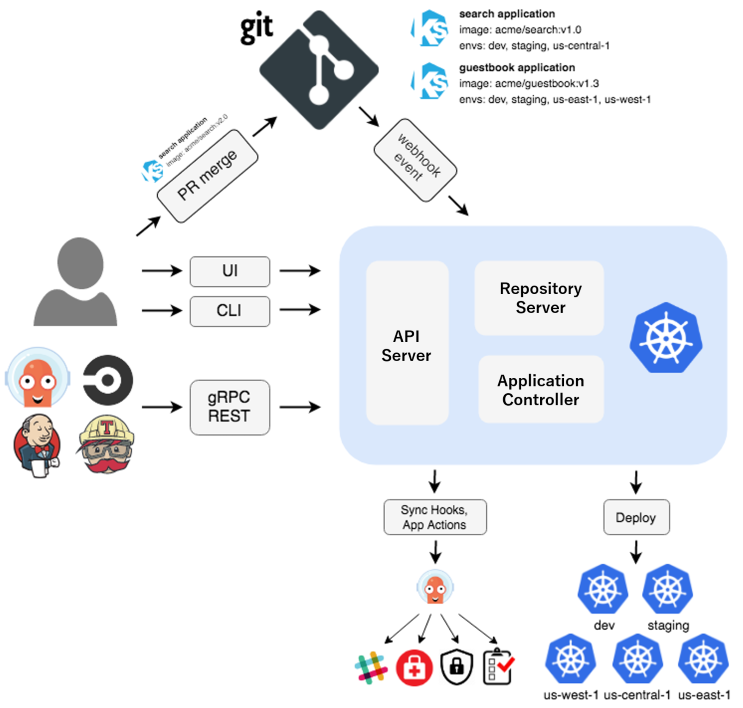
Argo CD is a Kubernetes-native continuous delivery tool built around GitOps. Teams define desired application configuration in Git, then Argo CD compares that configuration with deployed resources and reports differences.
It can deploy to multiple clusters and supports a web interface, CLI, and API. Unlike a hosted deployment service, Argo CD is installed and operated by the adopting organization.
A quick way to understand who this product may suit, where its limits matter, and which facts are most relevant before you compare alternatives.
Platform and software teams that already operate Kubernetes and want Git repositories to define, deploy, and track application configuration across clusters.
Teams seeking a vendor-hosted deployment service, a general-purpose release platform for non-Kubernetes environments, or managed operations and support included with the software, and should evaluate alternatives such as Flux CD instead.
Linux, macOS, Self-hosted, Web, Windows
6.8/10
These are the product-specific differences that may matter when deciding whether the software fits your workflow. They are based on documented evidence rather than a universal ranking.
These are documented constraints or practical friction points that may matter before you adopt the product.
Removing a resource from Git does not automatically delete it from the cluster unless pruning is configured; buyers should decide how to handle deletions safely.
Evidence source ↗The documented HA manifests use more containers and require at least three nodes, increasing operational and infrastructure planning needs.
Evidence source ↗Administrators should restrict plugin sources and assess their behavior before installation, since plugins receive a trusted role in the Argo CD system.
Evidence source ↗No Argo CD license price is listed. Users install and operate the software and provide their own Kubernetes infrastructure.
Check current pricing →Pricing may change. Verify current plans on the vendor's website.
Compare similar products directly, then see which alternatives may make more sense when your requirements differ.
| Decision factor | Argo CD | Flux CD |
|---|---|---|
| Core scope | GitOps continuous delivery for Kubernetes applications, with a web UI, CLI, and API. | GitOps for applications and infrastructure through Kubernetes controllers and the Flux CLI. Source ↗ |
| User interface | Provides a web UI for viewing application activity, health, and sync status. | The official Flux documentation describes controller-based management and a CLI; a built-in web UI was not identified in the cited overview. Source ↗ |
| Pricing model | Open-source software with no Argo CD license price listed; users provide Kubernetes hosting and operations. | Open-source project; users deploy and operate its components in Kubernetes. Source ↗ |
Only factors supported by the available research are shown. The comparison is descriptive, not a ranking.
These products address broadly similar requirements. The descriptions focus on documented reasons a buyer might compare them with Argo CD.
| License price | Open-source; no license price listed |
|---|---|
| Deployment | Self-managed installation in Kubernetes |
| Interfaces | Web UI, CLI, API |
| Configuration formats | Helm, Kustomize, Jsonnet, plain YAML |
| Source integrations | GitHub, GitLab, Bitbucket webhooks |
| Identity integrations | OIDC and Dex connectors; documented examples include Microsoft, Google, Okta, and Keycloak |
| High availability | HA manifests available; documentation says at least three nodes are required |
Verified installation, hosting, administration, or environment details that can affect implementation.
| Installation or hosting | Self-managed Kubernetes installation. The project documents standard, core, and high-availability installation options; no Argo CD-hosted SaaS plan was verified. Source ↗ |
|---|
Documented portability, standards, export, or switching considerations. No switching-cost score is shown unless the evidence supports one.
Applications are described declaratively using Kubernetes resources, commonly with their desired configuration held in Git. No dedicated migration service or automated migration process was verified.
Evidence source ↗A proprietary editorial score based on product capabilities, usability, value, performance, support and user sentiment evidence.
Official documentation describes Git-based deployment, drift detection, sync controls, multiple manifest tools, a web UI, CLI, API, SSO, and multi-cluster management. Argo CD is free software, but teams operate it on Kubernetes and configure production availability themselves. No verified review-platform ratings or review themes were found.
Methodology v1.0. The assessment weighs feature coverage (25%), ease of use (15%), value for money (20%), performance (15%), support (10%) and user sentiment (15%), using researched product evidence and verified review evidence where available. It is a TechZella editorial assessment, not a direct user-review average.
Key claims are linked to the sources used to verify them. This evidence record is separate from third-party user ratings.
TechZella evaluates software using documented product capabilities, pricing information, usability and value considerations, independent user evidence where available, and competitive context. The assessment is an editorial review, not a hands-on test unless one is explicitly identified. Our editorial assessment is based on 4 documented sources.
The official documentation presents it as declarative GitOps continuous delivery for Kubernetes and lists automated deployments to target environments.
View source ↗Verified 2026-11-08The documentation lists Kustomize, Helm, Jsonnet, and plain YAML as supported configuration or templating approaches.
View source ↗Verified 2026-11-08The official feature list describes a web UI, CLI, API access tokens, multi-cluster deployment, and configuration drift detection and visualization.
View source ↗Verified 2026-11-08The user-management documentation describes a bundled Dex option and existing OIDC providers, including Microsoft, Google, Okta, and Keycloak.
View source ↗Verified 2026-11-08CNCF states the Argo project was created and open sourced in 2017 and graduated on December 6, 2022.
View source ↗Verified 2026-11-08The official API guide says Swagger documentation is available at the Argo CD instance's /swagger-ui path.
View source ↗Verified 2026-11-08Answers begin with the clearest available response, followed by the context that helps you act on it.
/swagger-ui path.No reviews yet. Be the first to share your experience.
Please log in to submit a review.