
A Grav 1.x to Grav 2 migration is a separate process.
Existing sites should assess the migration instructions and plugin or theme compatibility before planning an upgrade.
Evidence source ↗
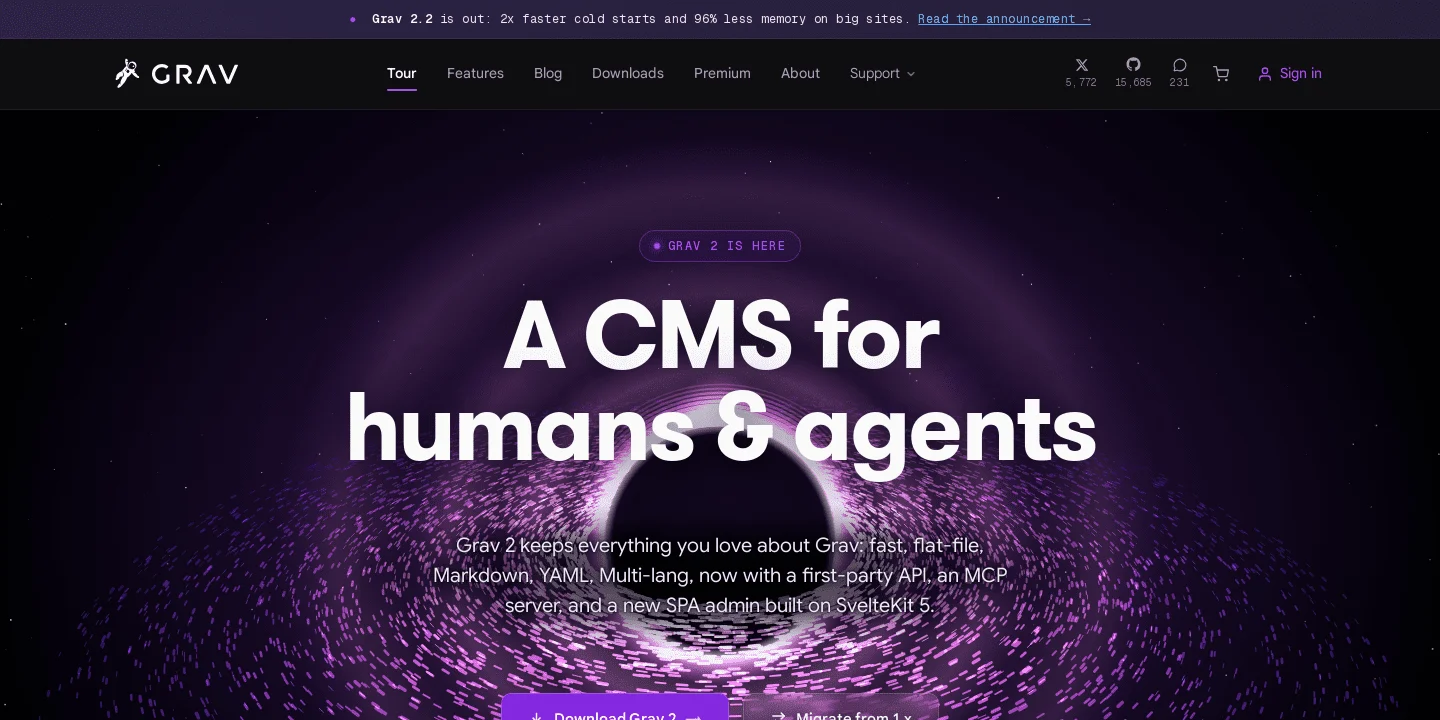
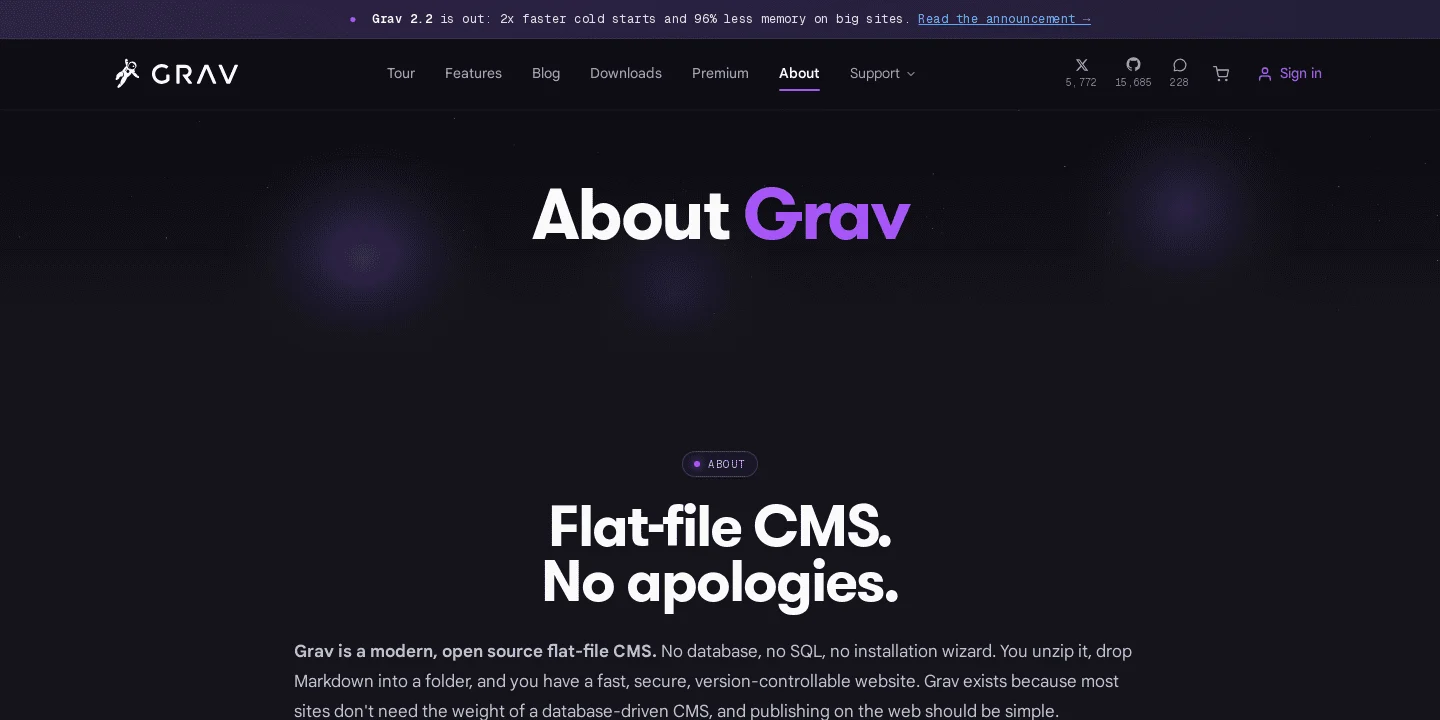
Grav is an open-source, flat-file CMS that stores content in files rather than a database. Grav 2 adds a REST API, an administrative interface, and an MCP server.
Grav provides file-based content, a plugin and theme ecosystem, and, in version 2, a REST API and administrative interface. The core is free; paid add-ons and optional services have separate costs. Public review evidence found was limited to one G2 review, so sentiment and support scores have low co
This profile combines documented product information and independent evidence where available. It is not a hands-on test unless TechZella explicitly identifies one.
A quick way to understand who this product may suit, where its limits matter, and which facts are most relevant before you compare alternatives.
Developers and technical publishing teams that want a self-hosted CMS with Markdown content stored as files, Git-based workflows, and optional API-driven or headless publishing.
Teams seeking a hosted CMS with vendor-managed infrastructure by default, or those unable to maintain a PHP 8.3-or-newer environment for Grav 2.
API, Cloud, PHP, Self-hosted, Web
7.6/10
Grav is an open-source CMS that stores site content in files instead of a database. Its project history dates the original idea to 2014 and the first stable release to September 2015.
Grav 2.0 became stable on June 20, 2026. It adds a first-party REST API, a rebuilt admin interface, and an MCP server. The file-based CMS model remains central, while the API supports headless and automated workflows.
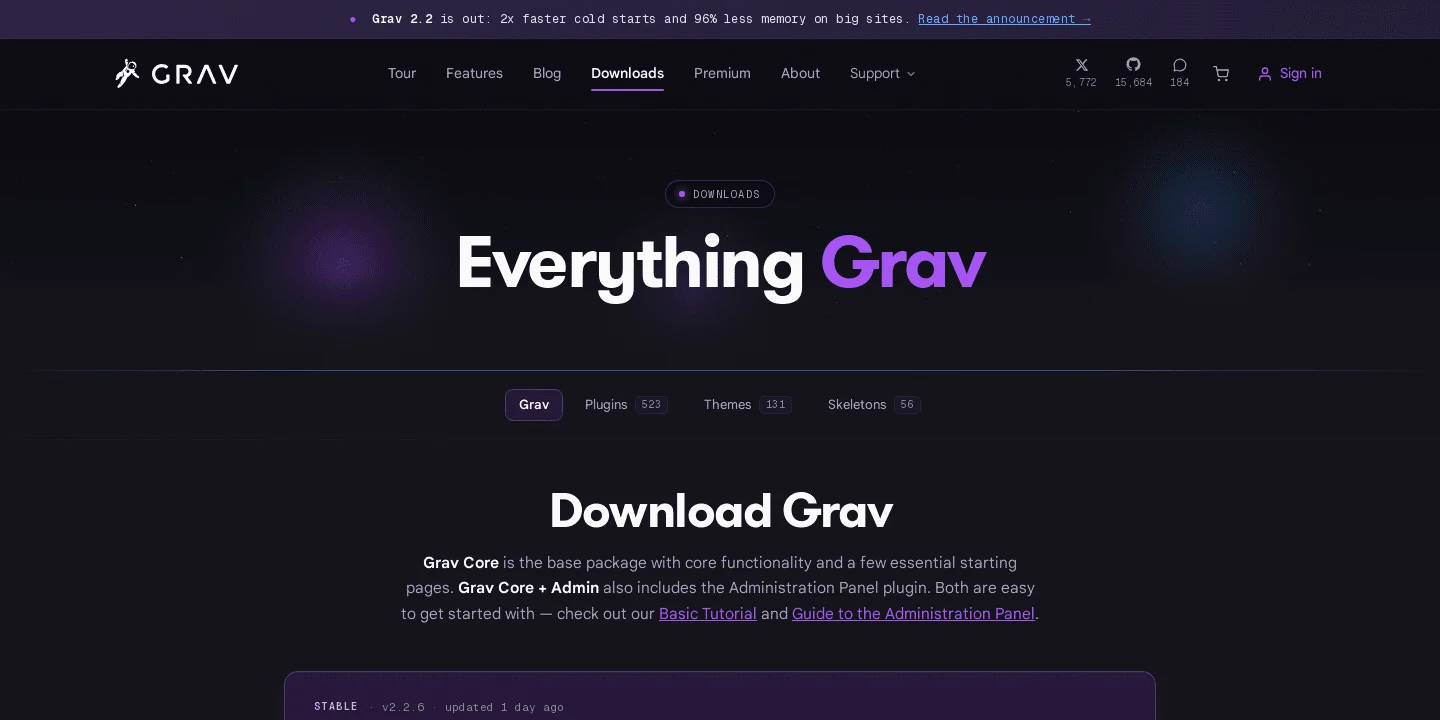
Grav is suited to teams comfortable managing a PHP-based website. It can be installed on a web server, and Trilby Media also advertises managed hosting.
These are the product-specific differences that may matter when deciding whether the software fits your workflow. They are based on documented evidence rather than a universal ranking.
These are documented constraints or practical friction points that may matter before you adopt the product.
Existing sites should assess the migration instructions and plugin or theme compatibility before planning an upgrade.
Evidence source ↗A buyer must confirm that the intended hosting environment supports the required PHP version.
Evidence source ↗Teams deploying the same paid component on multiple production sites should review licensing before purchase.
Evidence source ↗Free and open-source CMS core. Hosting and any separately purchased premium components are not included.
Check current pricing →Premium Grav theme; the official product page lists this price.
Check current pricing →Bundle listed with Helios, Editor Pro, and Revisions Pro.
Check current pricing →Pricing may change. Verify current plans on the vendor's website.
Grav is a fit for buyers who want a file-based, self-hostable CMS. No sufficiently researched product-to-product comparison is included here; buyers should compare hosting responsibilities, content storage, API requirements, and migration needs when evaluating other CMS options.
| License | MIT |
|---|---|
| Content storage | Flat files; database not required by the core |
| PHP requirement | PHP 8.3 or later for Grav 2 |
| API | First-party REST API in Grav 2 |
| Deployment | Self-hosted; managed hosting is also advertised by Trilby Media |
| Free trial | No trial offer verified; CMS core is free |
Verified installation, hosting, administration, or environment details that can affect implementation.
| Installation or hosting | Download and install Grav on a web server, or use the managed hosting service advertised by Trilby Media. Source ↗ |
|---|---|
| Runtime | Grav 2 requires PHP 8.3 or later. Source ↗ |
| Content storage | The CMS core stores content in files and does not require a database. Source ↗ |
Documented portability, standards, export, or switching considerations. No switching-cost score is shown unless the evidence supports one.
The project provides a dedicated migration path for Grav 1.x sites moving to Grav 2.0; the usual self-upgrade command does not complete that major-version migration.
Evidence source ↗Grav describes its content as files that can be version-controlled with Git. That supports file-based content workflows, but does not itself verify a complete migration process to another CMS.
Evidence source ↗A proprietary editorial score based on product capabilities, usability, value, performance, support and user sentiment evidence.
Grav provides file-based content, a plugin and theme ecosystem, and, in version 2, a REST API and administrative interface. The core is free; paid add-ons and optional services have separate costs. Public review evidence found was limited to one G2 review, so sentiment and support scores have low confidence.
Methodology v1.0. The assessment weighs feature coverage (25%), ease of use (15%), value for money (20%), performance (15%), support (10%) and user sentiment (15%), using researched product evidence and verified review evidence where available. It is a TechZella editorial assessment, not a direct user-review average.
Key claims are linked to the sources used to verify them. This evidence record is separate from third-party user ratings.
TechZella evaluates software using documented product capabilities, pricing information, usability and value considerations, independent user evidence where available, and competitive context. The assessment is an editorial review, not a hands-on test unless one is explicitly identified. Our editorial assessment is based on 6 documented sources.
The official About page describes Grav as open source, says it does not require a database, and states that Grav is free.
View source ↗Verified 2026-10-12The official product overview describes these Grav 2 components and identifies the API as the interface used by the admin.
View source ↗Verified 2026-10-12The project repository lists PHP 8.3 or higher among its requirements.
View source ↗Verified 2026-10-12The Grav API documentation describes these resources and identifies headless clients as a use case.
View source ↗Verified 2026-10-12The official project history identifies 2014 as the idea's origin and September 2015 as the Grav 1.0 stable release.
View source ↗Verified 2026-10-12The official release announcement is dated June 20, 2026, and announces Grav 2.0 stable.
View source ↗Verified 2026-10-12The published Grav Premium standard license states that a license is intended for one production site, with associated development, testing, and staging environments permitted.
View source ↗Verified 2026-10-12No reviews yet. Be the first to share your experience.
Please log in to submit a review.
Is Grav free? The CMS core is free and open source. Premium themes and plugins are sold separately.
Does Grav require a database? The core CMS uses file-based content and does not require a database.
Does Grav have an API? Grav 2 includes a first-party REST API for headless clients and other integrations.
What does Grav 2 require? The project lists PHP 8.3 or later as a requirement.
Is there a free trial? No trial offer was verified. The core is available free, while premium components are sold separately.
Can Grav 1.x sites upgrade directly to Grav 2? The project documents a dedicated migration process; its standard self-upgrade command does not cross the 1.x-to-2.0 boundary.