
A ZenML stack must include an orchestrator and an artifact store.
Teams need to select, configure, and support the services that execute pipelines and store their outputs.
Evidence source ↗
ZenML is an open-source MLOps framework for building and running machine-learning and AI pipelines across local and cloud infrastructure.
Documentation describes pipeline orchestration, artifacts, lineage, integrations, and multiple deployment options. G2 reports too few reviews for buying insight, so user sentiment and service quality cannot be assessed confidently.
This profile combines documented product information and independent evidence where available. It is not a hands-on test unless TechZella explicitly identifies one.
ZenML is a Python framework for building and operating machine-learning and AI pipelines. Its stack model connects pipeline code to orchestrators, artifact stores, and other MLOps components.
The free Open Source edition is self-hosted. Paid Scale and Enterprise plans add managed control-plane features, with Enterprise also listing governance and air-gapped deployment options.
A quick way to understand who this product may suit, where its limits matter, and which facts are most relevant before you compare alternatives.
ML and AI engineering teams that want reproducible Python pipelines while retaining control of their orchestrators, artifact stores, and compute infrastructure.
Teams seeking a turnkey managed compute platform may find ZenML’s infrastructure model unsuitable: the customer provides and configures the underlying compute and storage, and should evaluate alternatives such as Dagster or Prefect instead.
AWS, Azure, Google Cloud, Kubernetes, Python
7.1/10
These are the product-specific differences that may matter when deciding whether the software fits your workflow. They are based on documented evidence rather than a universal ranking.
These are documented constraints or practical friction points that may matter before you adopt the product.
Teams need to select, configure, and support the services that execute pipelines and store their outputs.
Evidence source ↗Buyers should estimate run volume and check the selected tier’s limits; the vendor says occasional overages do not trigger an immediate cutoff.
Evidence source ↗This architecture can suit teams keeping workloads in their own environment, but buyers should verify what metadata their policies permit reaching the control plane.
Evidence source ↗Self-hosted framework with pipeline and flow orchestration, artifact management, basic model registry, and community support.
Check current pricing →Managed SaaS plan with execution-based tiers. The pricing page shows a $399 starting tier and additional tiers according to monthly pipeline executions.
Check current pricing →Custom-priced plan with unlimited executions and projects; listed additions include SSO, custom-role RBAC, audit logs, and air-gapped deployment.
Check current pricing →Pricing may change. Verify current plans on the vendor's website.
Compare similar products directly, then see which alternatives may make more sense when your requirements differ.
| Decision factor | ZenML | Dagster | Prefect |
|---|---|---|---|
| Open-source and self-hosted option | ZenML offers a free, self-hosted Open Source plan. | Dagster offers an open-source edition and paid Dagster+ plans. Source ↗ | Prefect lists open-source self-hosting and a free Hobby cloud tier. Source ↗ |
| Published entry paid plan | ZenML Scale starts at $399 per month, with execution-based tiers. | Dagster+ Solo is $10 per month plus $0.040 per credit. Source ↗ | Prefect Starter is listed at $100 per month. Source ↗ |
| Primary workflow orientation | ZenML provides a Python framework for reproducible ML and AI pipelines, with configurable MLOps stack components. | Dagster+ lists asset-based and workflow-based orchestration, data quality, and asset lineage features. Source ↗ | Prefect describes its product as workflow orchestration for data pipelines and AI agents. Source ↗ |
Only factors supported by the available research are shown. The comparison is descriptive, not a ranking.
These products address broadly similar requirements. The descriptions focus on documented reasons a buyer might compare them with ZenML.
| License | Apache License 2.0 |
|---|---|
| Primary language | Python |
| Supported Python versions | 3.10, 3.11, 3.12, 3.13 |
| Deployment | Local, self-hosted, SaaS; Enterprise lists air-gapped deployment |
| API | Python SDK and documented OSS and Pro API endpoints |
| Cloud and orchestration integrations | AWS SageMaker, Google Vertex AI, AzureML, Kubernetes, Kubeflow, Airflow |
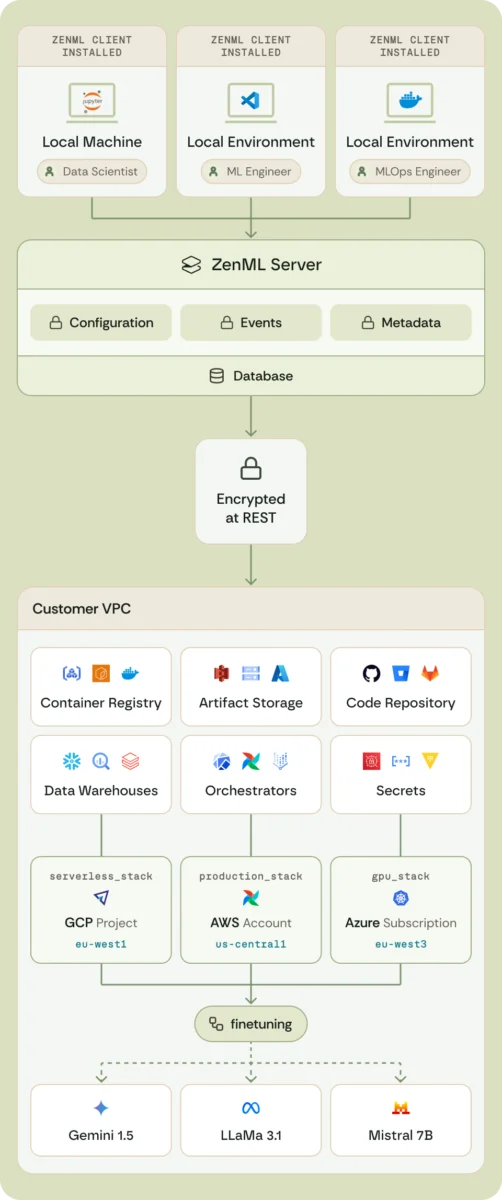
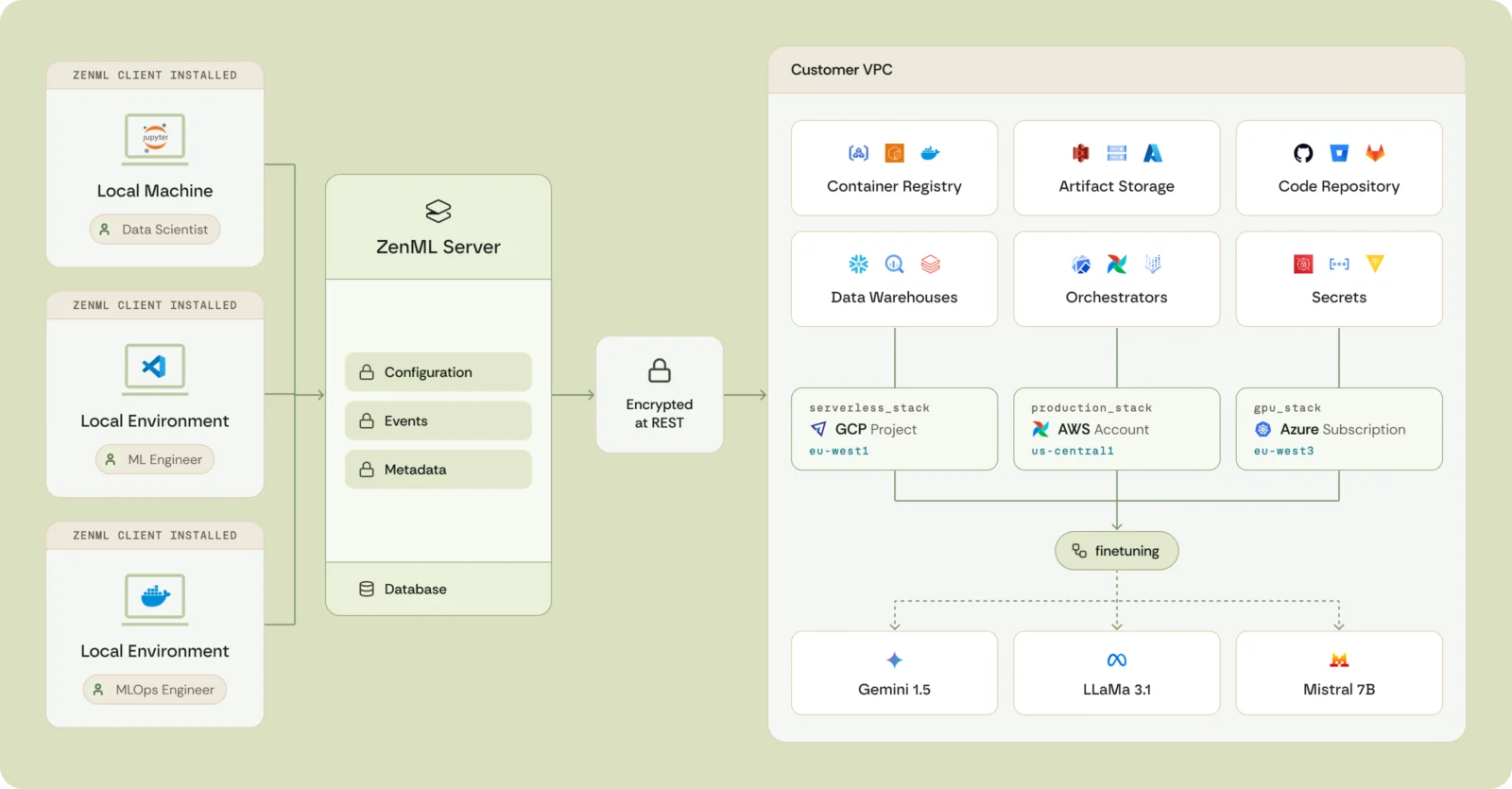
| Data and compute | Vendor describes the control plane as receiving metadata while customer data, artifacts, and compute remain in the customer's VPC. |
| Free trial | A free Pro account is available for assessing ZenML Pro; a fixed trial duration was not verified. |
Verified installation, hosting, administration, or environment details that can affect implementation.
| Open-source installation | Install the Python package locally; a local server and dashboard are available through optional package extras. ZenML also documents Docker-based installation. Source ↗ |
|---|---|
| Managed deployment | Scale is offered as SaaS. The pricing page describes Enterprise options including self-hosted and air-gapped deployment. Source ↗ |
| Compute and data location | ZenML describes itself as a metadata layer; customer data, artifacts, and compute remain in the customer’s VPC. Source ↗ |
Documented portability, standards, export, or switching considerations. No switching-cost score is shown unless the evidence supports one.
ZenML stacks let teams change infrastructure and MLOps components separately from pipeline code; supported integrations include multiple orchestrators and cloud providers.
Evidence source ↗The documentation supports exporting dependency requirements for integrations and stacks. No general-purpose migration service or automated import from competing platforms was verified.
Evidence source ↗A proprietary editorial score based on product capabilities, usability, value, performance, support and user sentiment evidence.
Documentation describes pipeline orchestration, artifacts, lineage, integrations, and multiple deployment options. G2 reports too few reviews for buying insight, so user sentiment and service quality cannot be assessed confidently.
Methodology v1.0. The assessment weighs feature coverage (25%), ease of use (15%), value for money (20%), performance (15%), support (10%) and user sentiment (15%), using researched product evidence and verified review evidence where available. It is a TechZella editorial assessment, not a direct user-review average.
Key claims are linked to the sources used to verify them. This evidence record is separate from third-party user ratings.
TechZella evaluates software using documented product capabilities, pricing information, usability and value considerations, independent user evidence where available, and competitive context. The assessment is an editorial review, not a hands-on test unless one is explicitly identified. Our editorial assessment is based on 7 documented sources.
The project repository identifies the Apache 2.0 license, and the pricing page lists Open Source as free.
View source ↗Verified 2026-11-11The official installation guide specifies the supported Python versions and package installation methods.
View source ↗Verified 2026-11-11The stack documentation identifies those required components and describes optional components such as experiment trackers, model deployers, and feature stores.
View source ↗Verified 2026-11-11The artifact guide describes automatic artifact storage and lineage across steps and runs.
View source ↗Verified 2026-11-11The API reference covers OSS and Pro API endpoints and describes management and automation use cases.
View source ↗Verified 2026-11-11The current pricing page describes execution-based Scale tiers and custom Enterprise pricing.
View source ↗Verified 2026-11-11The company contact page gives the office address at Schellingstr. 36, 80799 Munich, Germany.
View source ↗Verified 2026-11-11ZenML is free to use as self-hosted Open Source software. Its paid Scale plan is managed SaaS, while Enterprise has custom pricing.
ZenML provides a Python SDK and documents OSS and Pro API endpoints. Its integrations cover multiple orchestrators, cloud providers, and MLOps tools.
No reviews yet. Be the first to share your experience.
Please log in to submit a review.