Editorial overview
Aggregated Overview
Product documentation verifies asset orchestration, integrations, deployment choices, and tiered usage pricing. Public G2 coverage is limited to two reviews, too few for a reliable sentiment estimate.
This profile combines documented product information and independent evidence where available. It is not a hands-on test unless TechZella explicitly identifies one.
Overview
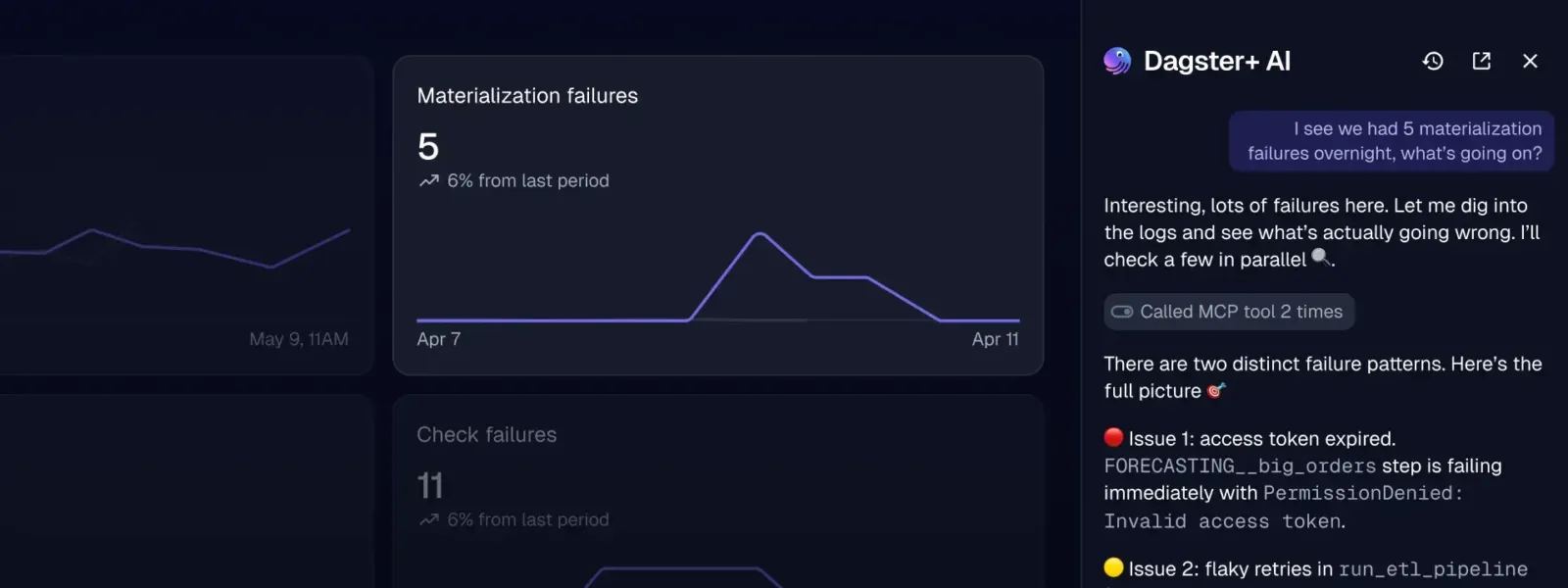
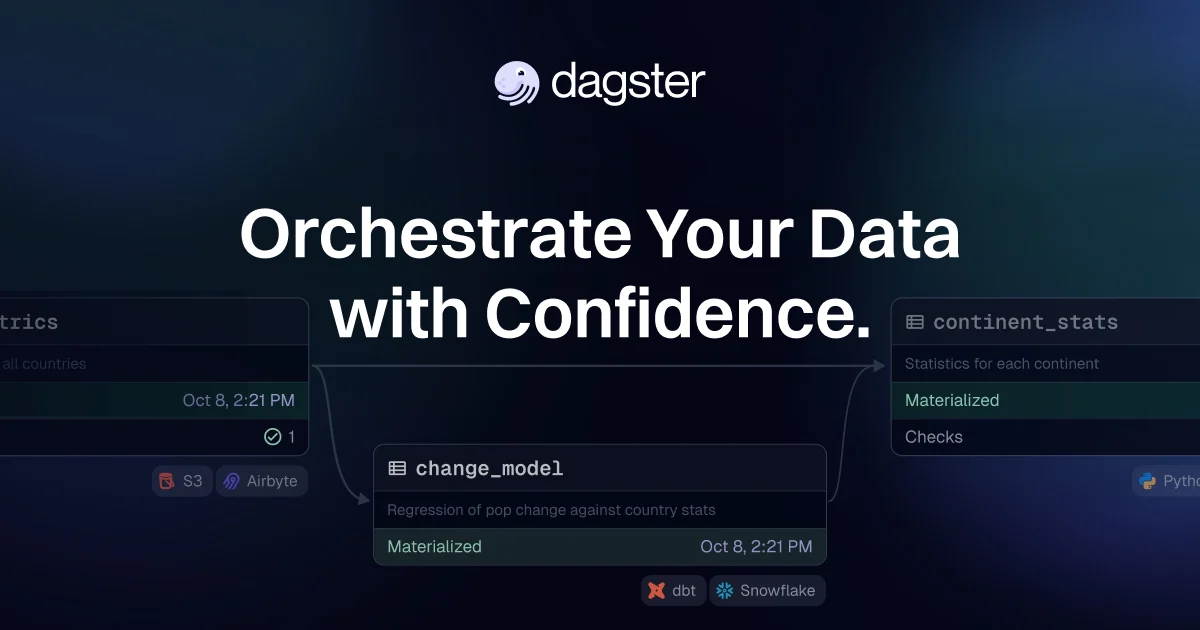
Dagster is an open-source orchestrator for developing, running, and observing data assets. Its asset-oriented model connects produced data, dependencies, and executions, rather than representing pipeline work only as a sequence of tasks.
Teams can use Dagster locally or self-host it, while Dagster+ adds hosted serverless and hybrid deployment. Dagster’s official integration catalog includes dbt, Snowflake, Fivetran, Databricks, AWS, and other data tools.
Prefect announced its acquisition of Dagster Labs on July 13, 2026. The announcement said Dagster would remain supported under its own name and open-source license.
Dagster Decision Snapshot
A quick way to understand who this product may suit, where its limits matter, and which facts are most relevant before you compare alternatives.
Best suited toPython-oriented data teams coordinating dbt, ingestion, machine-learning, and warehouse assets that need explicit dependencies, lineage, checks, and operational visibility.
Look elsewhere ifTeams seeking a simple, non-code scheduler may find Dagster's Python-oriented asset model and self-managed deployment responsibilities a poor match. Dagster+ usage charges also require teams to estimate asset and operation activity, and should evaluate alternatives such as Prefect or Apache Airflow instead.
PlatformsAWS, Cloud, Docker, Kubernetes, Python
TechZella assessment7.7/10
Dagster — What Sets It Apart?
These are the product-specific differences that may matter when deciding whether the software fits your workflow. They are based on documented evidence rather than a universal ranking.
- The asset model represents tables, models, and other data outputs directly, with dependency and lineage views connected to execution.
- Its dbt integration maps individual dbt models, seeds, and snapshots into Dagster assets that can be selected and monitored.
- Dagster+ offers serverless hosting or a hybrid arrangement where the orchestration backend is hosted and code executes in the customer environment.
Editorial assessmentDagster Pros & Cons
Pros
- Apache 2.0 open-source project supports self-hosting.
- Asset-centric orchestration links data outputs with dependencies and lineage.
- Official integration libraries cover dbt and numerous data infrastructure tools.
- Dagster+ offers both serverless and hybrid deployment models.
Cons
- Dagster+ Solo and Starter combine subscription fees with usage-based credit charges.
- Serverless compute adds a per-minute charge; hybrid requires customer-operated infrastructure.
- The GraphQL API is evolving and may include breaking changes.
- G2 reports insufficient review volume for purchasing insight.
Dagster Gotchas & Operational Limits
These are documented constraints or practical friction points that may matter before you adopt the product.
Dagster+ Solo and Starter usage is metered by credits, with an additional per-minute fee for serverless compute.
Credit use depends on asset materializations and operation executions, so projected workflow activity affects recurring spend.
Evidence source ↗The GraphQL API is still evolving and can include breaking changes.
Teams building external automation against it should review version changes and avoid assuming every endpoint is a stable public contract.
Evidence source ↗Dagster Labs was acquired by Prefect in 2026, while Dagster and Dagster+ were stated to remain supported under their existing names.
Buyers should track future ownership communications while noting that the announcement said no immediate migration or deployment change was required.
Evidence source ↗Dagster Pricing & Plans
Open source
$0
one-time
Dagster's core repository is Apache 2.0 licensed and can be self-hosted. Infrastructure and operations are the user's responsibility.
Check current pricing →Solo
$10
month
One user, one code location, and one deployment. Includes usage charges of $0.040 per credit; serverless compute is $0.010 per minute.
Check current pricing →Starter
$100
month
Up to three users, five code locations, and one deployment. Includes usage charges of $0.035 per credit; serverless compute is $0.010 per minute.
Check current pricing →Pro
Contact Sales
custom
Enterprise plan with custom serverless compute, unlimited code locations and deployments, personalized onboarding, and uptime SLAs.
Check current pricing →Pricing may change. Verify current plans on the vendor's website.
Cost contextTotal Cost & Hidden Costs
Additional costs or implementation requirements that are documented in the available evidence.
Dagster+ usage
Solo is $10 per month plus $0.040 per credit; Starter is $100 per month plus $0.035 per credit. A credit counts asset materializations and operations executed.
Evidence source ↗Serverless compute
Dagster+ lists serverless compute at $0.010 per minute for Solo and Starter. Hybrid deployments have no Dagster compute charge, but require customer-operated infrastructure.
Evidence source ↗Implementation and infrastructure
Dagster+ Pro includes personalized onboarding support; public pricing does not state implementation hours or fees. Self-hosted infrastructure costs are not priced on the reviewed product pages.
Evidence source ↗Dagster Competitors & Alternatives
Compare similar products directly, then see which alternatives may make more sense when your requirements differ.
At a glance
Workflow AutomationOnly factors supported by the available research are shown. The comparison is descriptive, not a ranking.
Direct competitors
These products address broadly similar requirements. The descriptions focus on documented reasons a buyer might compare them with Dagster.
CapabilitiesDagster Features
Orchestration
- Asset-based and workflow-based orchestration
- Partitions and backfills
- Declarative automation
- Branch deployments
Data quality and observability
- Asset checks
- Freshness policies
- Asset-level lineage
- Asset health and metadata
- Pipeline and platform metrics
Integrations and API
- dbt integration
- Guides and libraries for Snowflake, Fivetran, Databricks, AWS, Azure, and Kubernetes
- GraphQL API for querying runs and launching executions
Dagster+ hosting
- Serverless deployments
- Hybrid deployments with customer-operated agents
- Email, Slack, and Microsoft Teams alerts
Dagster Specifications
| License | Apache 2.0 for open-source repository |
|---|
| API | GraphQL; documented as evolving |
|---|
| Primary development language | Python |
|---|
| Hosted deployment | Dagster+ serverless or hybrid |
|---|
| Hybrid agent environments | ECS, Docker, Kubernetes, local |
|---|
| Free trial | 30 days for Dagster+ |
|---|
| Usage metric | Credits based on asset materializations and operations executed |
|---|
| Integrations | dbt, Snowflake, Fivetran, Databricks, AWS, Azure, Airbyte, and others |
|---|
Exit planningMigration & Lock-In
Documented portability, standards, export, or switching considerations. No switching-cost score is shown unless the evidence supports one.
Airflow coexistence and migration
Dagster describes Airlift capabilities for viewing Airflow execution alongside Dagster workflows and converting existing Airflow DAGs into Dagster assets.
Evidence source ↗Data portability
Dagster+ lists data portability in its plan comparison; the reviewed public page does not specify export formats or migration procedures.
Evidence source ↗Our evidence-based assessmentTechZella Score
A proprietary editorial score based on product capabilities, usability, value, performance, support and user sentiment evidence.
7.7/10Moderate confidence
Product documentation verifies asset orchestration, integrations, deployment choices, and tiered usage pricing. Public G2 coverage is limited to two reviews, too few for a reliable sentiment estimate.
Methodology v1.0. The assessment weighs feature coverage (25%), ease of use (15%), value for money (20%), performance (15%), support (10%) and user sentiment (15%), using researched product evidence and verified review evidence where available. It is a TechZella editorial assessment, not a direct user-review average.
Editorial transparency
Our Review Methodology
Key claims are linked to the sources used to verify them. This evidence record is separate from third-party user ratings.
TechZella evaluates software using documented product capabilities, pricing information, usability and value considerations, independent user evidence where available, and competitive context. The assessment is an editorial review, not a hands-on test unless one is explicitly identified. Our editorial assessment is based on 5 documented sources.
What TechZella adds- The asset model represents tables, models, and other data outputs directly, with dependency and lineage views connected to execution.
- Its dbt integration maps individual dbt models, seeds, and snapshots into Dagster assets that can be selected and monitored.
- Dagster+ offers serverless hosting or a hybrid arrangement where the orchestration backend is hosted and code executes in the customer environment.
Important limitations- Dagster+ Solo and Starter bills include both a monthly plan fee and usage-based credits; serverless deployments add a per-minute compute charge.
- The GraphQL API documentation warns that the API is evolving and that much of it primarily serves internal webserver use.
- Only two public G2 reviews were visible, and G2 says there is not enough review volume to provide buying insight.
Evidence-backed claimsDagster's open-source repository uses the Apache 2.0 license.The official repository identifies the Apache-2.0 license.
View source ↗Verified 2026-11-11Dagster+ Solo is listed at $10 per month and Starter at $100 per month, with credit-based usage fees.The official pricing page lists monthly plan fees, per-credit rates, and serverless compute pricing.
View source ↗Verified 2026-11-11Dagster+ offers a 30-day free trial.The pricing page lists a 30-day trial for Solo and Starter and states a 30-day trial is available.
View source ↗Verified 2026-11-11Dagster provides documented integration guides and libraries for tools including dbt, Fivetran, Snowflake, Databricks, AWS, Azure, and Kubernetes.The official integrations page lists these integration guides and libraries.
View source ↗Verified 2026-11-11Dagster exposes a GraphQL API for programmatic interaction with runs, repositories, jobs, and execution launches.Official documentation describes supported queries and mutations and cautions that the API is evolving.
View source ↗Verified 2026-11-11Prefect announced its acquisition of Dagster Labs on July 13, 2026.The official Dagster announcement says Dagster remains a supported product and its open-source project keeps its existing license.
View source ↗Verified 2026-11-11 Common questionsDagster FAQs
Answers begin with the clearest available response, followed by the context that helps you act on it.
Does Dagster offer a free trial?
Yes. Dagster+ lists a 30-day free trial.
How does Dagster+ calculate usage?
Credits count asset materializations and operations executed. Serverless compute is separately priced per minute on Solo and Starter.
Can Dagster run in a customer's infrastructure?
Yes. Dagster+ Hybrid runs customer code through an agent in the customer's environment, with documented ECS, Docker, Kubernetes, and local agent options.
Does Dagster integrate with dbt?
Yes. Its dbt integration represents individual models, seeds, and snapshots as Dagster assets.
Community feedback
Reviews
No reviews yet. Be the first to share your experience.
Write a Review
Please log in to submit a review.
Recently added Workflow Automation