
Redash's hosted service at app.redash.io shut down on November 30, 2021.
New teams must arrange their own hosting rather than signing up for the former managed Redash service.
Evidence source ↗
Redash is an open-source tool for querying data from multiple sources and building visualizations, dashboards, and alerts. Its hosted service ended in 2021; the available edition is self-hosted.
Redash offers a broad data-source catalog, SQL querying, visualizations, dashboards, alerts, and an API. Its no-license-fee self-hosted model avoids subscription charges but requires teams to operate the service. G2's 44-review aggregate is positive, while its summary notes interface usability concerns.
This profile combines documented product information and independent evidence where available. It is not a hands-on test unless TechZella explicitly identifies one.
Redash is an open-source application for connecting data sources, running queries, and turning results into visualizations and dashboards. Its hosted service ended on November 30, 2021, so new users need to self-host the available open-source edition.
The project suits teams comfortable operating their own analytics software. Its documentation covers a broad set of database, warehouse, API, and operational data connectors, with dashboards and alerts for sharing query results.
A quick way to understand who this product may suit, where its limits matter, and which facts are most relevant before you compare alternatives.
Teams with SQL skills that want to query multiple databases and share internal dashboards while controlling their own hosting.
Organizations seeking a currently vendor-hosted Redash service, turnkey support, or an embedded analytics product suited to untrusted users and modifiable dashboard parameters, and should evaluate alternatives such as Metabase or Apache Superset instead.
AWS, Docker, Linux, Self-hosted, Web
7.8/10
These are the product-specific differences that may matter when deciding whether the software fits your workflow. They are based on documented evidence rather than a universal ranking.
These are documented constraints or practical friction points that may matter before you adopt the product.
New teams must arrange their own hosting rather than signing up for the former managed Redash service.
Evidence source ↗Teams relying on query parameters need a different alerting approach or separate non-parameterized scheduled queries.
Evidence source ↗The documented behavior can make Redash unsuitable where embedded analytics must enforce strict parameter controls.
Evidence source ↗Free open-source edition. Buyers provide hosting and operate the deployment. Redash's former hosted service is discontinued.
Check current pricing →Pricing may change. Verify current plans on the vendor's website.
Compare similar products directly, then see which alternatives may make more sense when your requirements differ.
| Decision factor | Redash | Metabase | Apache Superset |
|---|---|---|---|
| Self-hosted open-source option | Redash's open-source edition is self-hosted and free of charge. | Metabase offers a free open-source edition and separate paid plans. Source ↗ | Apache Superset is an open-source data exploration and visualization platform. Source ↗ |
| Query workflow | Redash's documented workflow connects a data source, runs a query, then adds visualizations and dashboards. | Metabase supports SQL and a click-based question exploration workflow. Source ↗ | Superset provides SQL Lab alongside a no-code chart builder and dashboards. Source ↗ |
| Data-source breadth | Redash documents connectors across SQL databases, cloud warehouses, APIs, and other systems. | Metabase lists more than 20 supported data sources on its pricing page. Source ↗ | Not documented |
| Managed hosting | Redash's hosted service has ended; users must self-host the open-source edition. | Metabase offers cloud deployment in addition to self-hosting. Source ↗ | Not documented |
| Visualization and exploration | Redash supports visualizations, dashboard filters, and query-based analysis. | Not documented | Superset documents more than 40 built-in visualization types, virtual datasets, and cross-filters. Source ↗ |
| Data-source approach | Redash publishes a named connector list that includes SQL and non-SQL sources such as JSON APIs and Elasticsearch. | Not documented | Superset connects to SQL-speaking databases through compatible drivers and dialects. Source ↗ |
Only factors supported by the available research are shown. The comparison is descriptive, not a ranking.
These products address broadly similar requirements. The descriptions focus on documented reasons a buyer might compare them with Redash.




| License | BSD-2-Clause |
|---|---|
| Deployment | Self-hosted; Docker and Docker Compose installation documented for Linux |
| Supported environments | Linux; setup guidance references AWS and Google Cloud images |
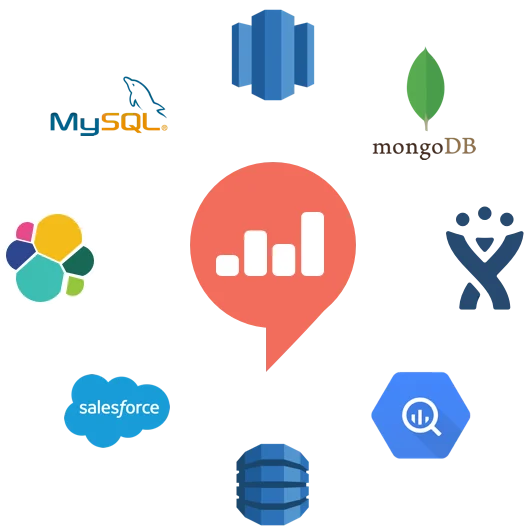
| Data sources | Includes PostgreSQL, MySQL, BigQuery, Databricks, MongoDB, Salesforce, and JSON APIs |
| API | API keys and endpoints documented; user keys and query keys have different scopes |
| Hosted service status | Ended November 30, 2021 |
| Alert limitation | Alerts do not work for parameterized queries |
Verified installation, hosting, administration, or environment details that can affect implementation.
| Installation or hosting | The current open-source edition is self-hosted. The official setup repository describes Docker and Docker Compose on a Linux server and references AWS and Google Cloud images. Source ↗ |
|---|---|
| Scale considerations | For larger deployments, the setup guidance recommends separating the database and likely Redis, using at least two Redash servers for redundancy, and adjusting worker counts. Source ↗ |
Documented portability, standards, export, or switching considerations. No switching-cost score is shown unless the evidence supports one.
Redash documented a migration tool for moving hosted queries, dashboards, and alerts to an open-source deployment. The hosted service ended in 2021, and the documented migration deadline has passed.
Evidence source ↗A proprietary editorial score based on product capabilities, usability, value, performance, support and user sentiment evidence.
Redash offers a broad data-source catalog, SQL querying, visualizations, dashboards, alerts, and an API. Its no-license-fee self-hosted model avoids subscription charges but requires teams to operate the service. G2's 44-review aggregate is positive, while its summary notes interface usability concerns.
Methodology v1.0. The assessment weighs feature coverage (25%), ease of use (15%), value for money (20%), performance (15%), support (10%) and user sentiment (15%), using researched product evidence and verified review evidence where available. It is a TechZella editorial assessment, not a direct user-review average.
Key claims are linked to the sources used to verify them. This evidence record is separate from third-party user ratings.
TechZella evaluates software using documented product capabilities, pricing information, usability and value considerations, independent user evidence where available, and competitive context. The assessment is an editorial review, not a hands-on test unless one is explicitly identified. Our editorial assessment is based on 6 documented sources.
Redash's end-of-life page states that the hosted service shut down on that date and that new sign-ups were not allowed.
View source ↗Verified 2026-11-06The official GitHub repository identifies the project's license as BSD-2-Clause.
View source ↗Verified 2026-11-06The official supported-data-sources page lists these integrations and distinguishes hosted from self-hosted availability.
View source ↗Verified 2026-11-06Official API documentation describes user keys with the owner's permissions and query keys scoped to a query and its results.
View source ↗Verified 2026-11-06The setup repository documents Docker and Docker Compose deployment and recommends additional infrastructure for larger deployments.
View source ↗Verified 2026-11-06The public G2 listing showed the aggregate rating, review count, and a summary mentioning praise for data-source connections and dashboards alongside interface usability concerns.
View source ↗Verified 2026-11-06Answers begin with the clearest available response, followed by the context that helps you act on it.
No reviews yet. Be the first to share your experience.
Please log in to submit a review.