
Ghost(Pro) Starter does not include paid subscriptions, custom themes or Admin API access.
A publisher who needs those functions must budget for a higher plan or self-host and manage the required infrastructure.
Evidence source ↗
Ghost is an open-source publishing CMS with website, newsletter, membership and subscription features. It can run on Ghost(Pro) or on infrastructure managed by the customer.
Assessment reflects verified publishing, newsletter, membership, API and hosting options, current plan boundaries, and a public G2 aggregate. It is not based on hands-on testing.
This profile combines documented product information and independent evidence where available. It is not a hands-on test unless TechZella explicitly identifies one.
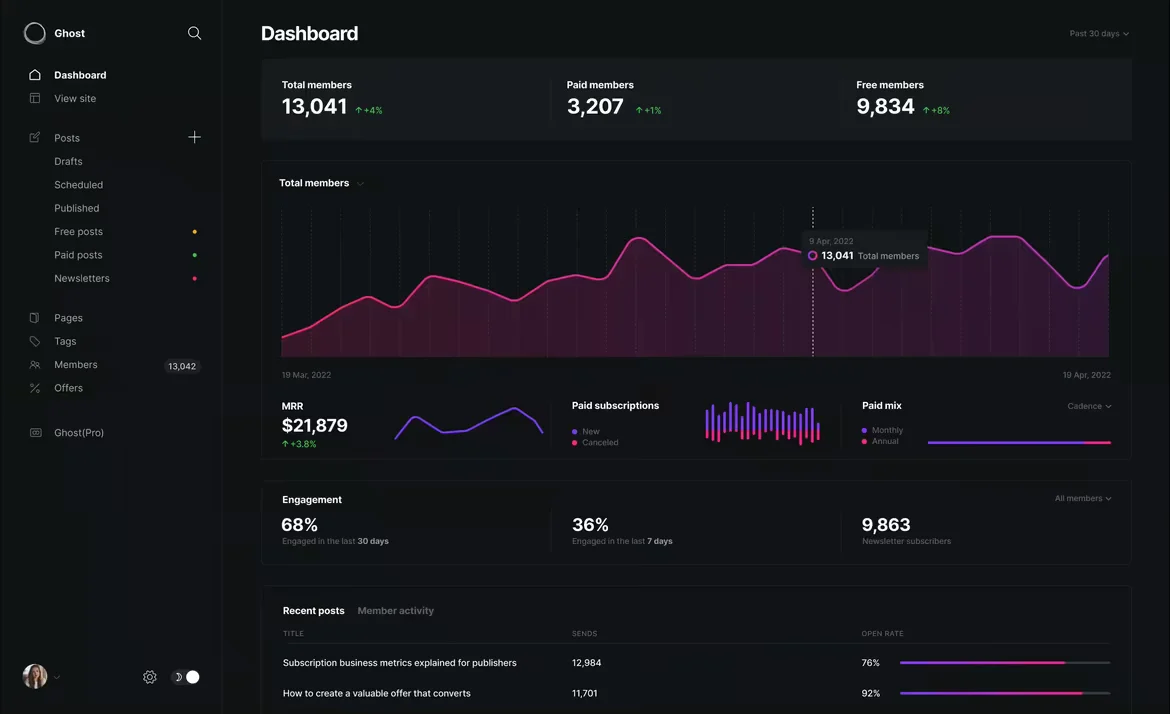
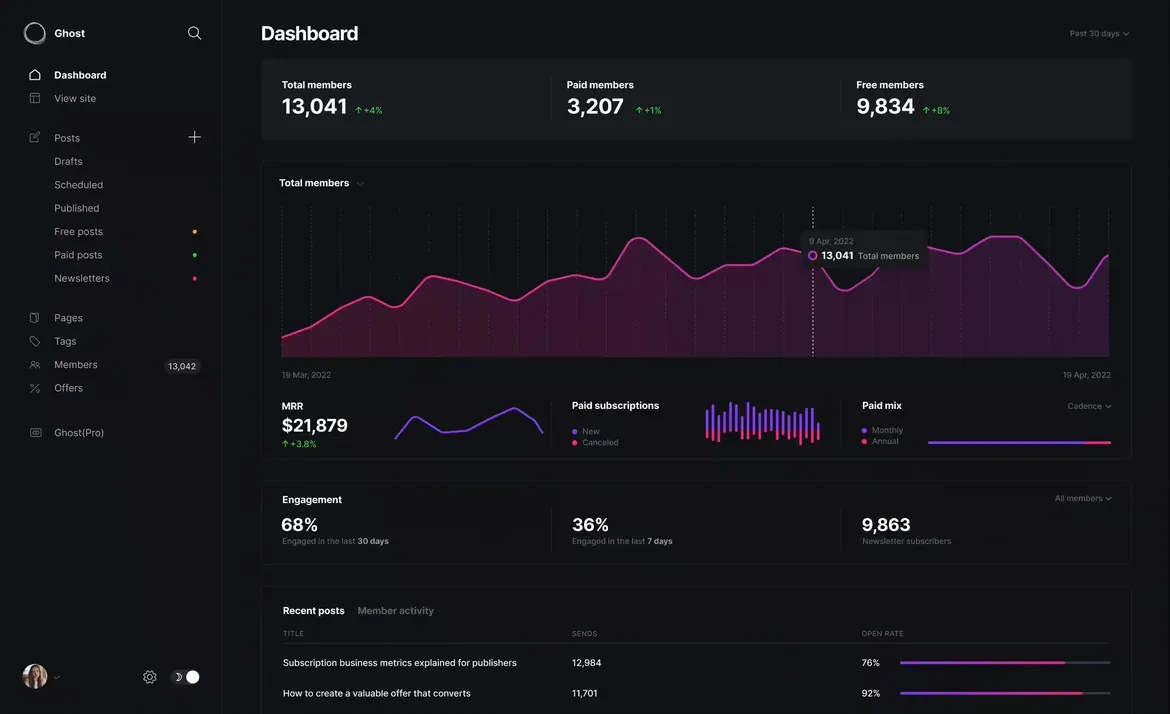
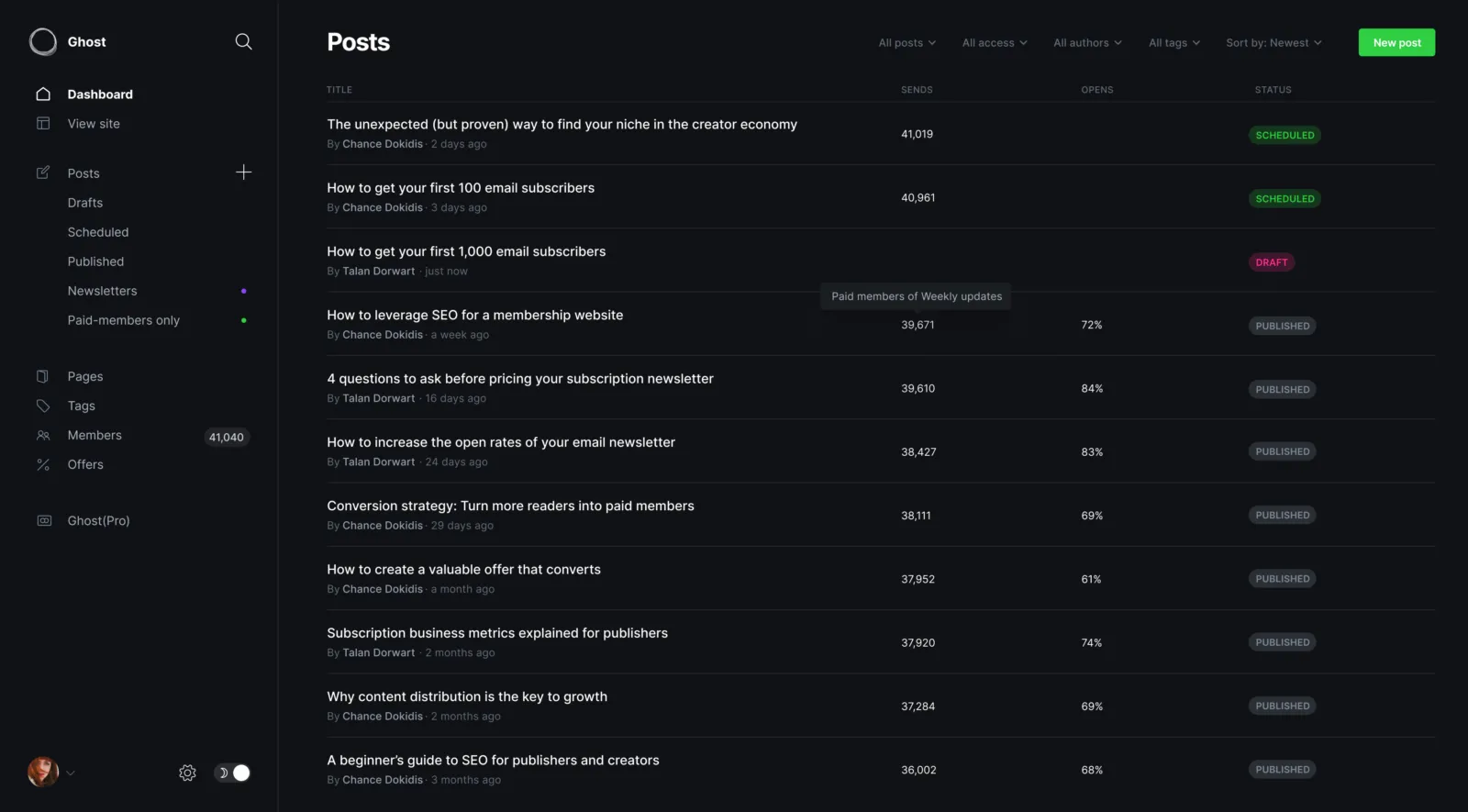
Ghost is an open-source content management system focused on digital publishing. Writers and teams can publish websites and email newsletters, manage members, and offer paid subscriptions.
Customers can use Ghost(Pro), the Foundation’s managed hosting service, or operate a self-hosted installation. Its Content API also supports delivering published content to custom front ends.
A quick way to understand who this product may suit, where its limits matter, and which facts are most relevant before you compare alternatives.
Independent publishers, writers and content teams that want one publishing system for a public website, newsletters and optional paid memberships.
Teams needing broad plugin-based functionality or complex custom content modeling may need a different CMS or additional development; self-hosting also requires server and service administration, and should evaluate alternatives such as WordPress or Substack instead.
Docker, SaaS, Self-hosted, Ubuntu, Web
8.2/10
These are the product-specific differences that may matter when deciding whether the software fits your workflow. They are based on documented evidence rather than a universal ranking.
These are documented constraints or practical friction points that may matter before you adopt the product.
A publisher who needs those functions must budget for a higher plan or self-host and manage the required infrastructure.
Evidence source ↗Large video, audio or other media files may need to be hosted through a separate service.
Evidence source ↗Organizations that need a site at a path such as example.com/blog should account for added infrastructure and maintenance.
Evidence source ↗Ghost(Pro) plan for an individual publication; includes a website, newsletter, design settings and 1,000 members. The pricing page lists a 5 MB individual file upload limit and excludes paid subscriptions and custom themes.
Check current pricing →Includes three staff users, custom themes, paid subscriptions, advanced analytics and integrations; the pricing comparison lists 1,000 members and 100 MB individual file uploads.
Check current pricing →Includes 15 staff users, priority support and higher usage limits; the pricing comparison lists 10,000 members and 250 MB individual file uploads.
Check current pricing →For more complex configurations; listed with unlimited staff and members, a dedicated IP address and a 99.9% uptime SLA.
Check current pricing →The open-source application can be self-hosted. The operator manages installation, server upkeep and additional services such as email delivery and analytics.
Check current pricing →Pricing may change. Verify current plans on the vendor's website.
Compare similar products directly, then see which alternatives may make more sense when your requirements differ.
These products address broadly similar requirements. The descriptions focus on documented reasons a buyer might compare them with Ghost.



| License model | Open-source core software; Ghost(Pro) is a paid managed service |
|---|---|
| Managed hosting | Ghost(Pro) |
| Self-hosting | Supported; official recommended stack includes Ubuntu 24, Node.js 22 LTS, MySQL 8.0, NGINX and Systemd |
| Container deployment | Docker Compose installation path documented |
| API | Content API and Admin API; Ghost(Pro) plan access differs |
| API style | REST |
| Free trial | 14 days for new Ghost(Pro) accounts |
| Payment processing | Stripe integration; payment processor fees apply |
| Data export | JSON, CSV and ZIP options depending on data type; media export available on Ghost(Pro) |
| Ghost(Pro) pricing basis | Monthly or annual billing; displayed plan rates include yearly billing |
Verified installation, hosting, administration, or environment details that can affect implementation.
| Managed hosting | Ghost(Pro) manages hosting, weekly updates, backups, SSL and CDN services. Source ↗ |
|---|---|
| Self-hosting | Ghost can be installed on a customer-managed server; the official recommended stack includes Ubuntu 24, Node.js 22 LTS, MySQL 8.0, NGINX and Systemd. Source ↗ |
| Container deployment | Docker Compose is documented as a deployment path; Ghost's move toward Compose-based tooling began with a developer preview for Ghost 6.0. Source ↗ |
Documented portability, standards, export, or switching considerations. No switching-cost score is shown unless the evidence supports one.
Ghost Admin can export content and settings as JSON, members and post analytics as CSV, themes as ZIP files, and redirects and routes. Media export is available on Ghost(Pro).
Evidence source ↗Ghost documentation includes importing content, members and payments from other platforms.
Evidence source ↗A proprietary editorial score based on product capabilities, usability, value, performance, support and user sentiment evidence.
Assessment reflects verified publishing, newsletter, membership, API and hosting options, current plan boundaries, and a public G2 aggregate. It is not based on hands-on testing.
Methodology v1.0. The assessment weighs feature coverage (25%), ease of use (15%), value for money (20%), performance (15%), support (10%) and user sentiment (15%), using researched product evidence and verified review evidence where available. It is a TechZella editorial assessment, not a direct user-review average.
Key claims are linked to the sources used to verify them. This evidence record is separate from third-party user ratings.
TechZella evaluates software using documented product capabilities, pricing information, usability and value considerations, independent user evidence where available, and competitive context. The assessment is an editorial review, not a hands-on test unless one is explicitly identified. Our editorial assessment is based on 6 documented sources.
Ghost's About page identifies the founding month, year and founders.
View source ↗Verified 2026-10-12The official pricing page lists these plans and prices as billed yearly; Custom pricing is quote-based.
View source ↗Verified 2026-10-12Ghost's subscription help page states that new accounts receive a 14-day trial and are not billed automatically when it expires.
View source ↗Verified 2026-10-12Ghost's hosting documentation compares its official managed service with customer-managed installation.
View source ↗Verified 2026-10-12The API documentation describes access to published content and lists posts, pages, tags, authors, tiers and settings endpoints.
View source ↗Verified 2026-10-12The export guide specifies supported formats and which data can be included in exports.
View source ↗Verified 2026-10-12Answers begin with the clearest available response, followed by the context that helps you act on it.
No reviews yet. Be the first to share your experience.
Please log in to submit a review.
This history records material data changes detected when TechZella re-researched the profile.