Most “cheapest AI writer” lists compare monthly prices. So, we took a different approach. We tracked what each published article actually cost us, and here’s our real hands-on findings!
Quick Answer: An API Was Cheapest, and SEOWRITING Led the No-Code Tools
- The Mistral Large 4 API gave us the cheapest published article, at about $0.009. Gemini 3.8 Flash came second at $0.012. GPT-5.4 mini followed in third at $0.025.
- But not everyone wants to write code. If that’s you, SEOWRITING was the cheapest at $0.70. It was also the cheapest tool that needed under 40 minutes of hands-on work.
Key Takeaways
Here’s what stood out in our test:
- Cheapest published article: Mistral Large 4 API, about $0.009
- Cheapest no-code tool: SEOWRITING, $0.70 after one regeneration
- Cheapest chat subscription: Claude Pro on annual billing, $1.67
- Median real cost (16 ranked tools): $1.86
- Hidden costs: 5 of 16 tools cost more than their listed price
- Hands-on time: averaged 43.9 minutes, ranging from 35 to 76
- Fake or broken sources: 5 of 16 tools
- Low price, high effort: Rytr ranked 5th on cost but needed the most work
Here’s a quick visual overview of these tools and associated cost-per-article, as we found in our personal hands-on test:
Real cost per published article, 2026
Real test data. Linear scale, from $0.009 to $9.90.
API Chat app or no-code tool
Real Cost per Article = Everything You Paid ÷ Articles Published
One article’s real cost is everything you paid, divided by the articles you published. It’s often higher than the listed price. For example, ContentBot’s $0.90 per article became $1.82 in our test.
Similarly, SEOWRITING’s $0.35 rate turned into $0.70.
To keep things fair, we used one formula for every tool:
Real cost per published article = total tool spend (fees + regenerations + top-ups + add-ons) ÷ articles actually published
Here’s what each part covers:
- Total tool spend: the API tokens, per-article fees, or monthly fee you paid.
- Regenerations: extra drafts that used credits or tokens.
- Top-ups and add-ons: extra words or credits, plagiarism checks, and thinking tokens.
- Articles published: only the articles that passed review, not every draft.
We tracked editing time separately, in minutes. It shows how much work each tool left for you. After all, a cheap tool that needs 76 minutes of fixes may not fit a busy week.
How to Calculate Your Own Cost
If you’d like to check your own numbers, you can follow these steps:
- Pick one real brief from your content backlog.
- Run it through the tool, allowing one regeneration.
- Note every credit, token, or word the tool used.
- Add any top-ups or add-ons you needed that month.
- Divide the month’s total spend by the articles you published.
- If you like, log your editing minutes in a separate column.
Now, here’s how evulated each tool in this list:
How We Tested 18 Tools on One Composting Article
We gave every tool the same 1,500-word brief and logged every cost. The brief was “How to Start Composting at Home: A Beginner’s Guide.” We chose composting because university extension guides make the facts easy to check.
Here’s the process we followed:
- One brief, seven required H2s: what composting is, greens vs. browns, choosing a bin, setup steps, what not to compost, common problems, and an FAQ.
- A built-in trap: we asked for two statistics with sources, to catch made-up citations.
- Default settings: each tool used its default model, with one regeneration allowed.
- API settings: we set reasoning to “none” or “low.”
- Usage logs: we recorded credits, tokens, words, and add-ons used.
- Subscription basis: we divided monthly fees by 10 articles, a typical solo-blogger pace.
- Time logs: the same editor timed prompting and editing with a stopwatch.
- Fact checks: we checked every claim against extension publications.
The Facts We Checked Drafts Against
To judge accuracy, we compared each draft with these extension facts:
- Carbon-to-nitrogen ratio: according to University of Maryland Extension, microbes work well at C:N ratios from 25:1 to 40:1. It calls 30:1 ideal.
- Timing: the same guide says a well-built hot pile can be ready in six to eight weeks. A cold pile, on the other hand, takes longer.
- Meat and dairy: Nebraska Extension advises against them, since they can attract rodents.
- Pet waste and glossy paper: Colorado State University Extension warns that pet feces may spread disease. It also advises against glossy magazines because of their inks.
In total, we tested 18 tools and ranked 16 in this list. Also, we tested Grammarly as an editing step, not as a writer. We also skipped COPY.AI, since it doesn’t offer a budget self-serve writing plan.
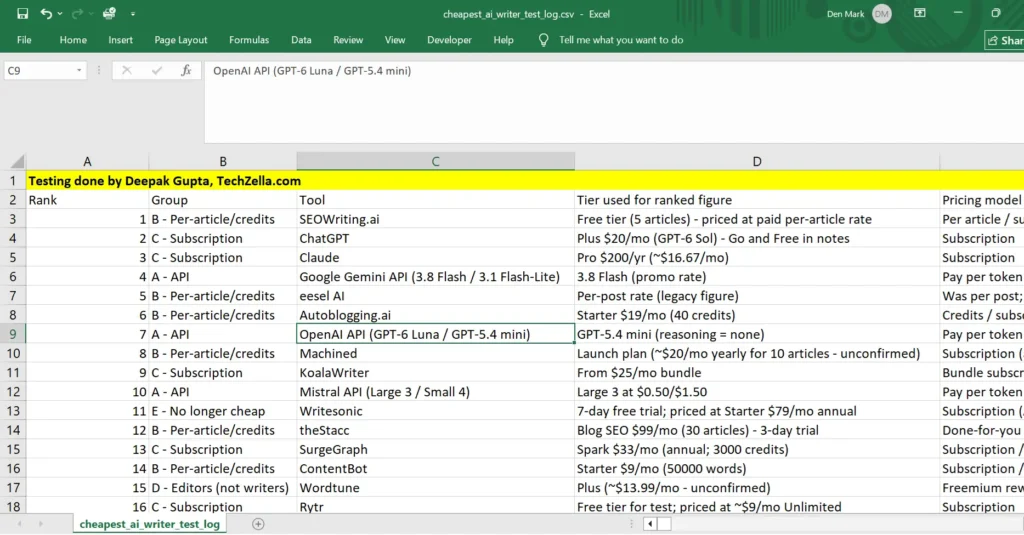
Want to check our numbers yourself? You can download the full test log as a CSV file from here. It lists each tool, the usage we recorded and the minutes spent editing each draft.
The Full Ranking: 16 AI Writers by Real Cost per Published Article
Three APIs cost under 4 cents per article. No-code tools ranged from $0.70 to $9.90. Since cost isn’t everything, the table also shows hands-on time and errors.
That way, you can weigh price against effort.
| Rank | Tool | Plan tested | Listed cost/article | Hidden cost found | Real cost | Hands-on min | Errors | Bad sources (of 2) |
|---|---|---|---|---|---|---|---|---|
| 1 | Mistral API | Large 4 | $0.0044 | Regeneration | $0.009 | 45 | 2 | 1 |
| 2 | Gemini API | 3.8 Flash | $0.0113 | Thinking tokens | $0.012 | 40 | 1 | 0 |
| 3 | OpenAI API | GPT-5.4 mini | $0.0124 | Regeneration | $0.025 | 42 | 1 | 1 |
| 4 | SEOWRITING | Per-article rate | $0.35 | Regeneration | $0.70 | 36 | 1 | 1 |
| 5 | Rytr | Paid (~$9/mo) | $0.90 | None | $0.90 | 76 | 3 | 2 |
| 6 | Wordtune | Plus (unconfirmed) | $1.40 | None | $1.40 | 69 | 1 | 0 |
| 7 | Claude | Pro, annual ($200/yr) | $1.67 | Annual commitment | $1.67 | 37 | 1 | 0 |
| 8 | ContentBot | Starter ($9/mo) | $0.90 | Plagiarism top-up | $1.82 | 51 | 2 | 1 |
| 9 | AUTOBLOGGING | Starter ($19/mo) | $1.90 | None at 10 articles | $1.90 | 39 | 2 | 0 |
| 10 | ChatGPT | Plus ($20/mo) | $2.00 | None | $2.00 | 36 | 1 | 0 |
| 11 | Machined | Launch (unconfirmed) | $2.00 | None | $2.00 | 40 | 2 | 0 |
| 12 | KoalaWriter | From $25/mo bundle | $2.50 | 2x word multiplier | $2.50 | 40 | 2 | 0 |
| 13 | SurgeGraph | Spark ($33/mo, annual) | $3.30 | Annual commitment | $3.30 | 46 | 2 | 0 |
| 14 | eesel AI | Legacy $4/post | $4.00 | None | $4.00 | 35 | 1 | 0 |
| 15 | Writesonic | Starter, annual ($79/mo) | $7.90 | Annual commitment | $7.90 | 35 | 1 | 0 |
| 16 | theStacc | Blog SEO ($99/mo) | $9.90 | 20 unused slots | $9.90 | 35 | 1 | 0 |
| n/a | Grammarly | Free | $0 | n/a | Editor only | n/a | n/a | n/a |
| n/a | COPY | No budget plan | n/a | n/a | Not tested | n/a | n/a | n/a |
Hands-on min = prompting + assembling + editing. Subscription costs assume 10 published articles per month.
The Cheapest Tools That Also Kept Hands-On Time Under 40 Minutes
SEOWRITING was the cheapest tool that needed under 40 minutes of work.
So if you’re short on time, this shortlist may matter more than the full ranking.
| Tool | Real cost | Hands-on min |
|---|---|---|
| SEOWRITING | $0.70 | 36 |
| Claude Pro (annual) | $1.67 | 37 |
| AUTOBLOGGING | $1.90 | 39 |
| ChatGPT Plus | $2.00 | 36 |
| eesel AI | $4.00 | 35 |
Tool-by-Tool Results
Each review covers the current price, our test results, and who the tool may suit. We’ve listed them in ranking order, starting with the cheapest.
1. Mistral API: Cheapest Article, Stiffest Prose
Price: Large 4 costs $0.70/$2.1 per million input/output tokens.
What we found: The first draft came back as bullet lists under every heading. So we used our regeneration, which doubled the cost to about $0.009.
Even then, editing took 41 minutes, the longest of the three APIs.
- Best for: bulk drafts when you’ve set aside time for editing.
- Watch out for: conflicting prices across trackers.
2. Google Gemini API: Fastest Draft, Price Rise Coming
Price: 3.8 Flash costs $0.75/$3.75 per million tokens until December 31, 2026. From January 1, 2027, it rises to $1.50/$7.50. Meanwhile, 3.1 Flash-Lite costs $0.25/$1.50.
What we found: Gemini returned the full draft in under 30 seconds. However, the “low” thinking setting added 190 billed output tokens. As a result, the cost rose from $0.0113 to $0.012.
Accuracy was mostly solid, but it credited one statistic to the wrong agency. Once the price rises, this article would cost about $0.024.
- Best for: developers and teams that publish at volume.
- Watch out for: the promo price ending on December 31.
3. OpenAI API: The Most Convincing Fake Citation
Price: GPT-5.4 mini costs $0.75/$4.50 per million tokens. GPT-6 Luna, by contrast, costs $0.10/$0.50.
What we found: the first draft ran 900 words short, so we regenerated. That doubled the cost to $0.025. More worrying, one source used a real university domain, but the page didn’t exist.
Fakes like this are the hardest to spot. That’s why you may want to open every link, even official-looking ones.
- Best for: developers who already use the OpenAI API.
- Watch out for: realistic-looking URLs that lead nowhere.
4. SEOWRITING: Cheapest No-Code Tool at $0.70
Price: a free tier with 3 articles, then about $0.31 to $0.38 per article (to be reconfirmed). It also supports bring-your-own-key.
What we found: the first draft skipped the FAQ section. Since our regeneration used a second article credit, the cost doubled to $0.70. Thankfully, the second draft followed all seven required H2s.
It still had a couple of slips, though. It claimed a cold pile is ready in two to three weeks, which isn’t right. On top of that, one statistic linked to a 404 page.
- Best for: bloggers who want fast drafts with WordPress publishing.
- Watch out for: regenerations, which cost a full article each.
5. Rytr: Fifth Cheapest, Most Work Needed
Price: the free tier gives you 10,000 characters a month. Paid plans cost about $7.50 to $9 a month (to be reconfirmed).
What we found: Rytr writes section by section, so assembling the article took 18 minutes. Even then, the draft came in 24% short. Worse, both statistics had invented sources.
Accuracy was also the weakest in our test, with three factual errors. It gave a C:N ratio of 10:1 and approved glossy magazines. It also said compost is ready in two weeks.
- Best for: short social posts and product blurbs.
- Watch out for: 76 minutes of hands-on time per long article.
6. Wordtune: A Rewriter, Not an Article Writer
Price: a free tier plus paid plans. The paid price still needs confirming.
What we found: Wordtune can’t generate a full article on its own. Instead, we wrote skeleton paragraphs and expanded them with its suggestions. That alone took 47 minutes before editing even started.
- Best for: polishing sentences you’ve already written.
- Watch out for: treating it as a one-click article writer.
7. Claude: Refused to Invent Sources
Price: Free, Pro at $20/month or $200/year, Max at $100 and Ultra at $200.
What we found: Claude declined to make up citations. Instead, it asked us for links to verify. That’s safer, but it meant we had to find both statistics ourselves.
It did slip on one fact. It gave the C:N target as 20:1, while most extension guides suggest about 30:1. Also, the $1.67 cost only applies with annual billing. On monthly billing, it’s $2.00.
- Best for: writers who’d rather see a gap than a fake citation.
- Watch out for: extra research time when briefs ask for statistics.
8. ContentBot: The Plagiarism Check Doubled the Cost
Price: Starter costs $9/month for 50,000 words. Premium is $29 for 150,000, and Premium+ is $49 for 400,000. Prepaid words cost $0.50 per 1,000.
What we found: the plagiarism check uses three times the article’s word count. So each checked article used 6,840 words of our allowance. As a result, Starter covered only 7 articles.
To reach 10 articles, we needed 18,400 extra words. That top-up cost $9.20. In total, the month came to $18.20, or $1.82 per article.
- Best for: short-form copy that doesn’t need plagiarism checks.
- Watch out for: the old “$1 per 1,000 words” figure, which is outdated.
9. AUTOBLOGGING: Cheap Credits, Risky Facts
Price: from $19/month for 40 credits. Each credit equals one article.
What we found: it merged two required sections into one. It also said meat and dairy are fine in a tumbler and called newspaper ink toxic. Both claims needed fixing.
Your cost depends heavily on how many credits you use. At 10 articles, each one costs $1.90. However, if you use all 40 credits, it falls to $0.48. We didn’t test the vendor’s $0.13 Enterprise claim.
- Best for: high-volume publishers who use their full allowance.
- Watch out for: confident food-safety errors.
10. ChatGPT: Plus Needed Less Work Than Go or Free
Price: Free $0, Go $8/month, Plus $20/month, Pro $100 to $500/month.
What we found: Plus gave us a clean, well-ordered draft. That said, it overstated that onions and citrus “must never” be composted. Copy-pasting and reformatting also added about six minutes per article.
The cheaper plans needed more work. Go cost $0.80 per article but took 47 minutes and invented a source. Meanwhile, Free cost nothing but showed ads and needed 50 minutes.
- Best for: solo writers publishing up to about 50 articles a month.
- Watch out for: copy-paste time, which adds up at volume.
11. Machined: Replaced Our Outline With Its Own
Price: a 7-day free trial of the Launch plan. Paid prices still need confirming.
What we found: Machined built its own cluster-based outline and dropped two required sections. So we added them back by hand. It also said dog waste is fine for home compost, which extension guides advise against.
- Best for: planning topic clusters rather than following a fixed brief.
- Watch out for: pet-waste and safety claims.
12. KoalaWriter: The Premium Model Doubled Word Use
Price: from $25/month, sold as a bundle of six Koala products. Even so, several roundups still list $9.
What we found: our 2,060-word article was charged as 4,120 words. That’s because the premium model applies a 2x multiplier. On the plus side, Koala added two useful H2s from live search results.
However, it described bokashi as aerobic composting. In fact, bokashi is anaerobic fermentation.
- Best for: users who want search data built into drafts.
- Watch out for: your allowance running out twice as fast. If you need a higher plan, you may want to recalculate your cost.
13. SurgeGraph: Off-Topic Padding
Price: Spark costs $33/month, Scale $66, and Signature $108, all billed annually. Pricing changed on November 3, 2026.
What we found: the draft ran 49% over length. Three sections pulled from search results drifted into soil testing. Also, the old $14.69 deal on a 36-month plan is gone.
- Best for: teams that also want AI visibility features.
- Watch out for: older roundups that still quote $14.69.
14. eesel AI: Overshot the Length by 30%
Price: previously $4 per post. However, the vendor page now shows one fixed monthly price, which needs confirming.
What we found: eesel delivered 1,950 words against a 1,500-word brief. As a result, trimming took about 10 of our 30 edit minutes. It also added a comparison table we didn’t ask for.
- Best for: teams that prefer cutting text to adding it.
- Watch out for: the pricing change. You may want to redo the math once it’s confirmed.
15. Writesonic: Good Draft, No Longer a Budget Writer
Price: Starter costs $79/month billed annually or $99 monthly. Higher plans run up to $499.
What we found: The draft quality was good, with a 30-minute edit. However, it dropped the FAQ section. Keep in mind that the subscription now mainly pays for AI search visibility tracking.
- Best for: brands tracking how they appear in AI search.
- Watch out for: article caps. Unused slots raise your cost per article.
16. theStacc: Least Editing, Highest Cost at Low Volume
Price: Blog SEO costs $99/month for 30 articles. There’s a 3-day free trial but no free plan.
What we found: theStacc doesn’t accept a fixed brief. Instead, we entered a keyword and notes, and it built its own outline. It covered 5 of our 7 required H2s, and the draft arrived 19 hours later.
On the upside, it had the shortest edit in the test, at 27 minutes. The catch is volume. At 10 articles, you’re paying for 20 unused slots, so each costs $9.90. At 30, it drops to $3.30.
- Best for: local businesses that want hands-off publishing.
- Watch out for: paying for 30 articles but publishing 10.
Grammarly Free: Saved Six Minutes, Missed Every Fact Error
Price: Free includes 100 AI prompts a month. Pro costs $12/month billed annually, $20 quarterly or $30 monthly.
What we found: we ran the GPT-5.4 mini draft through Grammarly Free. As a result, our edit time dropped from 38 to 32 minutes. It caught 14 grammar and clarity issues. However, it didn’t flag a single factual error.
COPY.AI: Not Tested
COPY now positions itself as a workflow platform. So we’ve included it only to correct older “cheap COPY” claims.
Cheaper Models Saved Fractions of a Cent but Added Work
In all four model families, the cheaper option needed 8 to 14 more minutes per article. That’s because the budget models wrote thinner drafts with more errors. Meanwhile, the money they saved was tiny.
| Model family | Cheaper option | Real cost | Hands-on min | Stronger option | Real cost | Hands-on min |
|---|---|---|---|---|---|---|
| OpenAI API | GPT-6 Luna | $0.0012 | 56 | GPT-5.4 mini | $0.025 | 42 |
| Google API | 3.1 Flash-Lite | $0.004 | 48 | 3.8 Flash | $0.012 | 40 |
| Mistral API | Small 4 | $0.002 | 53 | Large 4 | $0.009 | 45 |
| ChatGPT app | Free | $0 | 50 | Plus | $2.00 | 36 |
Take Luna as an example. It saved about two cents per article compared with GPT-5.4 mini. Yet it made three factual errors instead of one. So in most cases, the stronger model may be worth the extra cents.
Here are even more detailed hands-on results for the same API provider but different models:
At Every Volume, APIs Cost the Least in Cash
APIs stayed the cheapest option from 10 to 500 articles a month. Flat subscriptions do get cheaper per article as you publish more. However, chat apps become impractical at high volume.
| Monthly volume | Mistral Large 4 API | Gemini 3.8 Flash API | SEOWRITING | ChatGPT Plus | theStacc |
|---|---|---|---|---|---|
| 10 articles | $0.04 | $0.12 | $3.50 | $20 | $99 |
| 50 articles | $0.22 | $0.60 | $17.50 | $20 | Needs higher tier |
| 500 articles | $2.20 | $6.00 | $175 | Not practical | Needs higher tier |
Monthly tool spend, assuming one draft per article. API figures use November 2026 prices.
That said, editing time limits volume more than money does. Our tools averaged 43.9 hands-on minutes per article. At 500 articles, that’s over 360 hours a month.
There are a few more things to know about volume:
- Gemini batch processing can cut the 500-article cost to about $3.00.
- Gemini’s price rise on January 1, 2027, would double these figures.
- Regenerations add a full draft’s cost each time, on any per-article tool.
To understand it easily, here’s a line chart comparing monthly AI article writer spend at 10, 50, and 500 articles for API, per-article, and subscription pricing:
Monthly tool spend at 10, 50 and 500 articles
Real test data. Log scale, because the values range from $0.04 to $175.
Mistral Large 3 API Gemini 3.8 Flash API SEOWriting.ai ChatGPT Plus
| Monthly volume | Mistral Large 3 API | Gemini 3.8 Flash API | SEOWriting.ai | ChatGPT Plus |
|---|---|---|---|---|
| 10 articles | $0.04 | $0.12 | $3.50 | $20 |
| 50 articles | $0.22 | $0.60 | $17.50 | $20 |
| 500 articles | $2.20 | $6.00 | $175 | Not practical |
Hidden Costs That Raised the Per-Article Price
Five of our 16 tools cost more than listed. In most cases, the pricing page didn’t mention the extra cost. Here are eight hidden costs to watch for:
- Regenerations: a second draft doubled the cost on SEOWRITING, Mistral, and GPT-5.4 mini.
- Plagiarism checks: ContentBot’s check uses three times the article’s length.
- Premium multipliers: KoalaWriter charged double words on its premium model.
- Thinking tokens: Gemini’s “low” reasoning setting added billed output tokens.
- Unused slots: theStacc costs $9.90 per article at 10 a month, but $3.30 at 30.
- Unused credits: AUTOBLOGGING costs $1.90 per article at 10, but $0.48 at 40.
- Promo prices ending: Gemini 3.8 Flash doubles in price on January 1, 2027.
- Annual lock-in: Claude, Writesonic and SurgeGraph show lower prices only for annual billing.
Bundles can hide costs, too. For example, Koala’s $25 entry price covers six products. You may need only one of them.
How Far Free Tiers Got Us
ChatGPT Free was the only free option that handled all 10 test articles. The others hit allowance or usage limits first. Here’s how far each one got:
| Free option | Allowance | Articles completed of 10 | Hands-on min | Notes |
|---|---|---|---|---|
| ChatGPT Free | Usage limits | 10 | 50 | Ads shown, fell back to a smaller model twice |
| Claude Free | Usage limits | 6 | 41 | Hit the daily limit after 3 articles |
| SEOWRITING Free | 5 articles | 3 | 37 | Check whether the allowance renews |
| Rytr Free | 10,000 characters/month | 1 | 78 | One 1,500-word article is about 9,000 characters |
| Grammarly Free | 100 AI prompts/month | Editor only | n/a | Polishes drafts, doesn’t write them |
So if you publish only a few articles a month, a free tier may be enough. You also have the option to combine two free tools. For instance, you can draft in Claude Free and polish in Grammarly Free.
What Google Expects From Low-Cost AI Content
Google doesn’t ban AI content, but it does target mass-produced, low-value pages.
According to its spam policies, scaled content abuse means making many pages mainly to manipulate rankings. One listed example is using generative AI to create many pages without adding value.
On top of that, Google now asks for a manual fact-check. Google updated this guidance on October 1, 2026. The updated Search Central guide asks for a manual review before publishing. That review also covers titles, meta descriptions, structured data, and image alt text. You can read the full guidance on Search Central.
The good news is that most marketers already do this. Ahrefs’ 2026 survey found that 89% manually check AI content, up from 80% in 2025. However, 7% say most of what they publish is unedited AI. That’s up from 4% the year before.
Still, faster publishing hasn’t brought better results. Orbit Media’s 2026 blogger statistics report AI use rising to 93% in three years. Yet the same research found AI use doesn’t improve content performance. In fact, only 14% of bloggers report strong results.
So what does this mean for cheap AI writing? Here’s what we’d suggest:
- Fact-check every claim, including meta descriptions and alt text.
- Open every source link. After all, five of our 16 tools produced bad ones.
- Add something only you know, such as test data, photos, or customer questions.
- Publish at a pace you can review. The volume you can check is your safe volume.
A Budget Workflow That Costs Under 3 Cents per Article
A mid-tier API model plus a free editor gave us the best mix of cost and effort. Here’s the workflow we used. You can adapt it to any tool you like.
- Write a tight brief. It helps to list the required H2s, word count, audience, and banned claims.
- Generate one draft. You can use Gemini 3.8 Flash, GPT-5.4 mini, or ChatGPT Plus.
- Ask for sources marked “unverified.” That way, fake links are easier to spot.
- Fact-check against primary sources. For composting, we used university extension pages.
- Open every link. Then replace dead or invented URLs with real ones.
- Run Grammarly Free. In our test, this cut the edit by about six minutes.
- Add first-hand material. You may include photos, test notes, or customer questions.
- Check the title, meta description, and alt text. Google’s guidance covers these, too.
- Log your costs and minutes. Over time, tracking both shows which tool suits you.
In our test, GPT-5.4 mini plus Grammarly Free cost $0.025 per article. Better still, hands-on time dropped from 42 to 36 minutes.
Here’s the budget workflow that you can follow to complete your own tests:
Budget workflow: from brief to publish
Which Cheap AI Writer Fits Your Situation
The best pick depends on your volume, coding comfort, and available time. To narrow your options, you can start with the row that sounds most like you.
| Your situation | Suggested pick | Why | Real cost |
|---|---|---|---|
| Comfortable with code | Gemini 3.8 Flash or Mistral Large 4 API | Lowest cash cost per article | $0.009 to $0.012 |
| Want no-code and WordPress publishing | SEOWRITING | Cheapest tool under 40 minutes | $0.70 |
| Solo blogger, up to 10 posts a month | Claude Pro or ChatGPT Plus | Clean drafts, flat fee | $1.67 to $2.00 |
| Local business, hands-off | theStacc (using all 30 articles) | Shortest edit time | $3.30 |
| Zero budget | ChatGPT Free | Completed all 10 test articles | $0 |
| Polishing your own drafts | Grammarly Free | Saves time on grammar and clarity | $0 |
| Tracking AI search visibility | Writesonic | Built for that job now | $7.90 |
Price Changes We Tracked in 2026
Many roundups still quote prices that no longer exist. That’s why we checked each one below on November 10, 2026.
| Tool | Figure in older roundups | Current price | What changed |
|---|---|---|---|
| KoalaWriter | $9/month | From $25/month | Now a six-product bundle |
| SurgeGraph | $14.69/month (36-month deal) | Spark $33/month, annual | Changed November 3, 2026 |
| ContentBot | $1 per 1,000 words | $9/month for 50,000 words | Prepaid now $0.50 per 1,000 |
| Writesonic | Budget writer | $79 annual, $99 monthly | Now focused on AI search |
| COPY | Cheap writer | About $1,000/month (reconfirm) | Now a workflow platform |
| eesel AI | $4 per post | Fixed monthly price (confirm) | Moved to a subscription |
| Gemini 3.8 Flash | $0.75/$3.75 per 1M tokens | Same until December 31 | $1.50/$7.50 from January 1, 2027 |
Since prices shift often, we plan to update this table every quarter.
Our Verdict: Cheapest Tool Depends on Whether You Code
If you’re comfortable with an API, Mistral Large 4 or Gemini 3.8 Flash costs about a cent per article. Between the two, Gemini needed less editing, so it may be the more practical pick. Just keep in mind that its price doubles in January.
If you’d rather not code, SEOWRITING was cheapest at $0.70. Claude Pro and ChatGPT Plus cost a little more. Still, they may suit writers who prefer a chat window.
Finally, a low price didn’t mean low effort. Rytr ranked fifth on cost, but it needed 76 minutes and invented both sources. So before you commit, you can run one real brief through two or three shortlisted tools.
Frequently Asked Questions
-
What Is the Cheapest AI Article Writer in 2026?
In our test, the Mistral Large 4 API was cheapest, at about $0.009 per published article. If you’d prefer a no-code tool, SEOWRITING was cheapest at $0.70. Both prices include the regeneration we used.
-
Is There a Free AI Article Writer Good Enough to Publish?
Yes. ChatGPT Free produced publishable articles in our test, but they needed more work. Each one took 50 minutes of hands-on time. By comparison, ChatGPT Plus took 36.
-
Is an API Cheaper Than a ChatGPT Subscription?
Yes, by a wide margin. An API call cost one to three cents in our test, while ChatGPT Plus came to $2.00. Keep in mind that an API needs some setup, such as an API key and a script or connector.
-
What Hidden Costs Should I Check Before Buying?
It’s worth looking for regeneration charges, word multipliers, plagiarism check usage and annual-only pricing. In our test, these pushed five tools above their listed price. Unused credits and slots can also raise your cost per article.
-
Does Google Penalize AI-Written Articles?
Google targets low-value content at scale, not AI use itself. Its spam policy applies no matter how the content’s made. That said, its October 2026 guidance asks you to fact-check AI content manually before publishing.
-
How Long Does It Take to Edit an AI Article?
Our tools averaged 43.9 minutes of hands-on time per 1,500-word article. Times ranged from 35 minutes to 76. Section-by-section tools, as Rytr took the longest, mostly because of assembly time.
-
Are COPY and Writesonic Still Cheap?
No, not anymore. Writesonic starts at $79 a month on annual billing and now focuses on AI search tracking. COPY, meanwhile, Copy.ai works as a workflow platform as of now.