Editorial overview
Aggregated Overview
The assessment reflects documented CI/CD capabilities, published plan details, and G2's review-page rating and themes. It is not based on hands-on testing.
This profile combines documented product information and independent evidence where available. It is not a hands-on test unless TechZella explicitly identifies one.
Overview
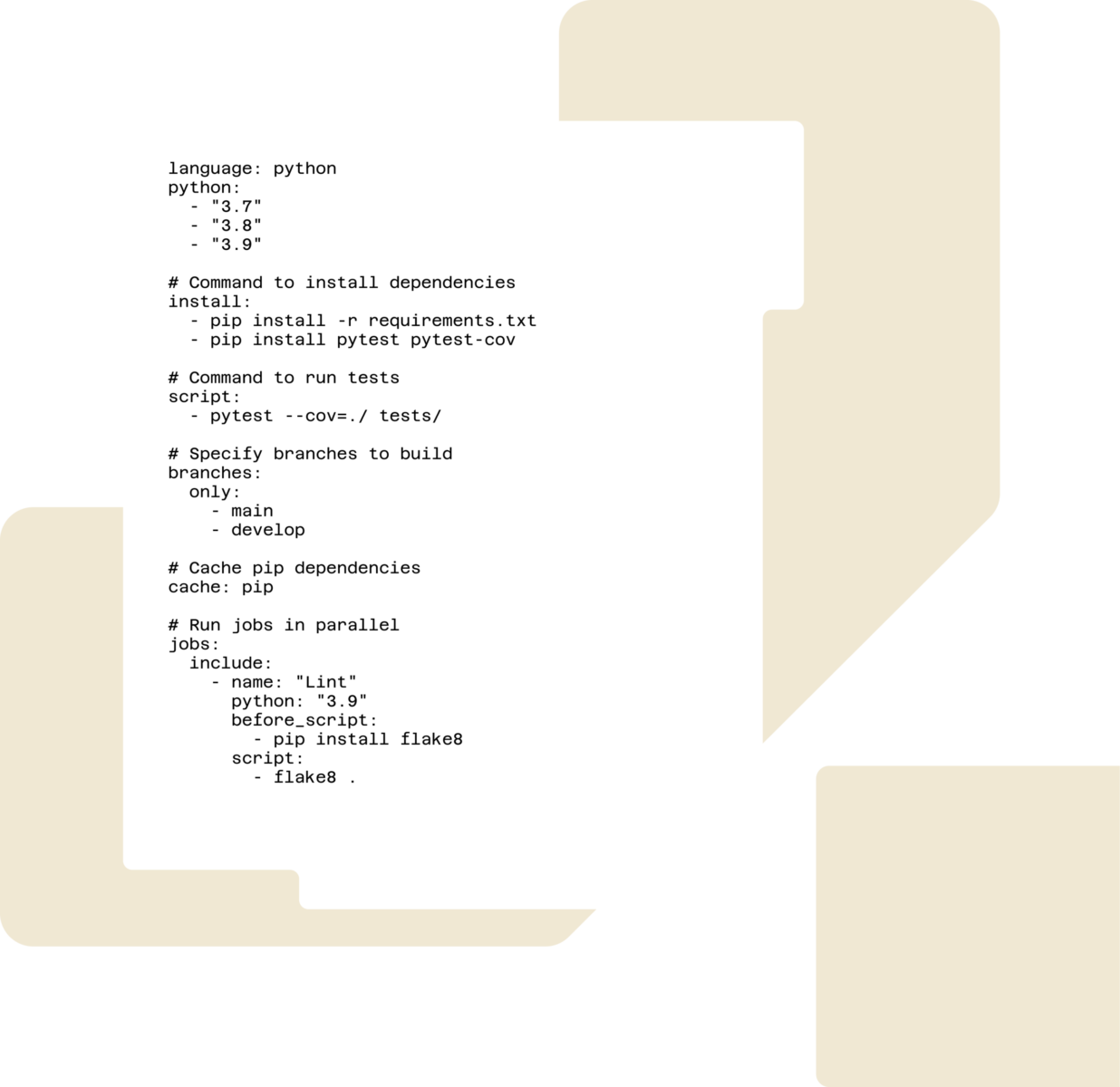
Travis CI automates software builds, tests, and deployments from connected code repositories. Teams define pipeline instructions in a repository-level .travis.yml file and can run jobs across configured environments.
The service connects with GitHub, GitLab, Bitbucket, and Assembla. Its product range includes managed cloud plans and a Server plan for on-premises or private-cloud environments. Travis CI was founded in Berlin in 2011 and became part of Idera in 2019.
Travis CI Decision Snapshot
A quick way to understand who this product may suit, where its limits matter, and which facts are most relevant before you compare alternatives.
Best suited toDevelopment teams wanting configurable build, test, and deployment pipelines across several repository providers, with parallel test matrices and hosted or self-managed deployment options.
Look elsewhere ifTeams requiring a currently available free trial, fully predictable usage-based costs without user-license charges, or documentation clearly confirming a specific hosted operating system should verify fit before adopting, and should evaluate alternatives such as CircleCI or GitHub Actions instead.
PlatformsFreeBSD, Linux, SaaS, Web, Windows
TechZella assessment7.8/10
Travis CI — What Sets It Apart?
These are the product-specific differences that may matter when deciding whether the software fits your workflow. They are based on documented evidence rather than a universal ranking.
- Supports GitHub, GitLab, Bitbucket, and Assembla repository connections, rather than only a single source-control ecosystem.
- Build matrices and sequential build stages let teams test multiple runtime configurations and gate deployment on earlier jobs.
- Offers a Server plan for on-premises or private-cloud deployments, including Perforce and Subversion CI/CD.
Editorial assessmentTravis CI Pros & Cons
Pros
- Supports repository integrations with GitHub, GitLab, Bitbucket, and Assembla.
- Build matrices can test multiple runtime or dependency combinations in parallel.
- Offers hosted service and on-premises or private-cloud deployment options.
- Provides an API, CLI, staged pipelines, and deployment configuration.
Cons
- The billing documentation currently says free trial plans are unavailable.
- Usage-based costs can depend on build duration, VM type, and unique build-triggering users.
- Build instructions use Travis-specific YAML and require adaptation when moving to another CI system.
Travis CI Gotchas & Operational Limits
These are documented constraints or practical friction points that may matter before you adopt the product.
The official billing documentation states that free trial plans are currently unavailable.
Older onboarding material still describes trial credits, so buyers should use current pricing and billing pages rather than assume a trial can be activated.
Evidence source ↗Usage-based billing accounts for both build-job minutes and unique users who trigger builds.
A build budget should account for team activity and selected VM types, not only the number of projects.
Evidence source ↗After cancellation, Travis CI says build data can be viewed or saved for one year, after which it is removed.
Teams should export build records they need to retain before that period ends.
Evidence source ↗Travis CI Pricing & Plans
Usage Based
$15
month
35,000 Linux build credits per month and 80 concurrent jobs. User-license charges and premium VM credit usage may affect total cost.
Check current pricing →Unlimited Plan
$78+
month
Unlimited build credits for non-premium VMs, collaborators, and repositories; 1 to 300 concurrent jobs.
Check current pricing →Server
$34
month
On-premises or private-cloud option; the pricing page also lists Perforce and Subversion CI/CD.
Check current pricing →Pricing may change. Verify current plans on the vendor's website.
Cost contextTotal Cost & Hidden Costs
Additional costs or implementation requirements that are documented in the available evidence.
Implementation and onboarding
The documented setup requires connecting a supported repository account, authorizing Travis CI, selecting repositories, and adding a .travis.yml file. The reviewed pages do not publish a paid onboarding fee or a guaranteed implementation duration.
Evidence source ↗Hosting and infrastructure
The cloud service supplies build infrastructure. The pricing page lists included network and storage allowances as unlimited for its displayed plans; premium VM options and some customized images are separate usage or add-on considerations.
Evidence source ↗Usage and add-ons
Usage-based billing can consume credits for build minutes and user licenses. Premium VM types have credit costs, and credit balances may be refilled or supplemented through paid credit purchases.
Evidence source ↗Travis CI Competitors & Alternatives
Compare similar products directly, then see which alternatives may make more sense when your requirements differ.
At a glance
DevOps PlatformOnly factors supported by the available research are shown. The comparison is descriptive, not a ranking.
Direct competitors
These products address broadly similar requirements. The descriptions focus on documented reasons a buyer might compare them with Travis CI.
CapabilitiesTravis CI Features
Build and test automation
- Build matrices across runtime and configuration combinations
- Parallel jobs and sequential build stages
- Branch and pull-request build automation
- Repository-level .travis.yml configuration
Integrations and extensibility
- GitHub, GitLab, Bitbucket, and Assembla repository integrations
- Documented Travis CI API
- Open-source command-line tooling
- Deployment configuration and custom scripts
Infrastructure
- Linux, FreeBSD, and Windows build environments listed on the pricing page
- Premium Linux VM options
- On-premises or private-cloud Server plan
Travis CI Specifications
| Primary function | Continuous integration and continuous delivery |
|---|
| Configuration | Repository-level .travis.yml |
|---|
| Repository providers | GitHub, GitLab, Bitbucket, Assembla |
|---|
| API | Documented Travis CI API |
|---|
| Hosted build environments | Linux, FreeBSD, Windows |
|---|
| Deployment | Cloud, on-premises, private cloud |
|---|
| Free trial | Currently unavailable according to billing documentation |
|---|
| Build matrix limit | Up to 200 jobs per matrix according to documentation |
|---|
Exit planningMigration & Lock-In
Documented portability, standards, export, or switching considerations. No switching-cost score is shown unless the evidence supports one.
Configuration portability
Build instructions are stored in a repository-level .travis.yml file. Moving pipelines to another CI platform will require adapting that configuration to its workflow format.
Evidence source ↗Build data retention
After subscription cancellation, users have one year to view or save build data before Travis CI removes it.
Evidence source ↗Our evidence-based assessmentTechZella Score
A proprietary editorial score based on product capabilities, usability, value, performance, support and user sentiment evidence.
7.8/10Moderate confidence
The assessment reflects documented CI/CD capabilities, published plan details, and G2's review-page rating and themes. It is not based on hands-on testing.
Methodology v1.0. The assessment weighs feature coverage (25%), ease of use (15%), value for money (20%), performance (15%), support (10%) and user sentiment (15%), using researched product evidence and verified review evidence where available. It is a TechZella editorial assessment, not a direct user-review average.
Editorial transparency
Our Review Methodology
Key claims are linked to the sources used to verify them. This evidence record is separate from third-party user ratings.
TechZella evaluates software using documented product capabilities, pricing information, usability and value considerations, independent user evidence where available, and competitive context. The assessment is an editorial review, not a hands-on test unless one is explicitly identified. Our editorial assessment is based on 5 documented sources.
What TechZella adds- Supports GitHub, GitLab, Bitbucket, and Assembla repository connections, rather than only a single source-control ecosystem.
- Build matrices and sequential build stages let teams test multiple runtime configurations and gate deployment on earlier jobs.
- Offers a Server plan for on-premises or private-cloud deployments, including Perforce and Subversion CI/CD.
Important limitations- Travis CI's billing documentation says free trial plans are currently unavailable, despite older onboarding text describing trial credits.
- Usage-based billing can include both build-minute credits and charges tied to unique users triggering builds.
- The current public product pricing page does not provide a complete hosted environment and feature breakdown for every plan.
Evidence-backed claimsTravis CI was founded in Berlin in 2011 and joined Idera in 2019.The official About page states the founding place and year and identifies Idera as its parent company since 2019.
View source ↗Verified 2026-11-08The vendor's pricing page lists a usage-based plan at $15 per month with 35,000 Linux build credits and 80 concurrent jobs.The official monthly pricing display gives the price, credit allotment, and concurrency figure.
View source ↗Verified 2026-11-08Travis CI supports repository onboarding for GitHub, Assembla, Bitbucket, and GitLab.The official onboarding guide names these repository providers as prerequisites and supported project hosts.
View source ↗Verified 2026-11-08Build matrices can run multiple jobs in parallel across runtime or dependency combinations.The official build matrix guide describes parallel jobs and matrix expansion across configuration values.
View source ↗Verified 2026-11-08Travis CI offers an on-premises or private-cloud Server plan.The official pricing page identifies Server as an on-premises or private-cloud option.
View source ↗Verified 2026-11-08The official billing documentation says free trial plans are currently unavailable.The billing overview explicitly marks free trial plans unavailable.
View source ↗Verified 2026-11-08 Independent review sources
Travis CI Ratings & Reviews
Ratings are published by the respective review platforms and may change over time.
FAQ
Does Travis CI offer a free trial?
The current billing overview says free trial plans are unavailable. Older onboarding pages still mention trial credits, so verify availability with Travis CI before relying on a trial.
Which repository providers does Travis CI support?
The onboarding guide names GitHub, Assembla, Bitbucket, and GitLab.
Can Travis CI run builds on Windows?
Yes. The official pricing page lists standard Windows build environments.
Can Travis CI be deployed on a company’s own infrastructure?
Yes. The Server plan is listed for on-premises or private-cloud deployment.
How does Travis CI usage-based billing work?
Its billing documentation says charges depend on build-job minutes and unique users who trigger builds. VM type can affect the credits consumed.
Community feedback
Reviews
No reviews yet. Be the first to share your experience.
Write a Review
Please log in to submit a review.
Recently added DevOps Platform