
Local self-hosted
$0
one-time
The official code and model weights are released under the MIT License. Users provide their own compute, storage and deployment infrastructure.
Check current pricing →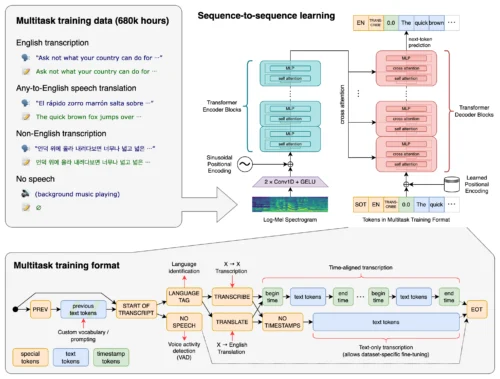
OpenAI Whisper is an open-source multilingual speech recognition model for transcription, speech translation, language identification and timestamped audio processing.
Whisper provides multilingual transcription, translation, language detection, timestamps and several model sizes. The MIT license supports self-hosting, but installation requires Python, PyTorch, FFmpeg and suitable hardware. OpenAI documentation now recommends newer transcription models for some ge
OpenAI Whisper is an open-source automatic speech recognition model released in September 2022. It converts audio into text, identifies spoken languages, and translates supported non-English speech into English.
The official implementation uses a Transformer encoder-decoder architecture. It processes audio in 30-second windows and supports local inference through Python code or a command-line interface.
Whisper is available in multiple model sizes, including tiny, base, small, medium, large and turbo. Larger models generally require more memory and provide different speed and accuracy trade-offs.
Whisper supports multilingual speech transcription and language identification. OpenAI’s documentation lists support for 98 languages, although recognition quality varies by language.
The model can produce text, JSON, SRT, VTT and TSV outputs through the local command-line tools. Its API supports transcription, English translation, response formatting and timestamp data.
The local package runs with Python and PyTorch and requires FFmpeg for audio loading. The repository documents installation paths for Linux, macOS and Windows environments.
Whisper includes English-only model variants for several sizes. The turbo model is optimized for faster transcription but isn’t trained for speech translation.
The local Whisper code and model weights are available under the MIT License. Self-hosting has no Whisper software fee, although users pay for their own compute, storage and infrastructure.
OpenAI’s hosted whisper-1 API is priced at $0.006 per minute. The API accepts supported audio files through transcription and translation endpoints.
No separate product trial for the local package was verified. The local installation is free to use under the MIT License, while hosted API access requires an OpenAI API account and usage billing.
Comparable alternatives include Deepgram, Google Cloud Speech-to-Text, Amazon Transcribe, Azure AI Speech and AssemblyAI. These services focus primarily on hosted speech recognition APIs, while Whisper also supports local inference and open-source deployment.
For teams requiring managed infrastructure, realtime processing, enterprise administration or built-in speaker features, a commercial speech API may reduce operational work. For privacy-sensitive or offline workflows, Whisper’s local deployment model remains a relevant option.
The local implementation is available under the MIT License and has no software charge. Hosting, compute and storage costs still apply. The hosted Whisper API is billed at $0.006 per minute.
Yes. The official repository supports downloading model files and running inference locally without sending audio to OpenAI’s API.
The documented installation process covers Linux, macOS and Windows. It runs through Python and PyTorch rather than a standalone native desktop application.
Yes. Multilingual models can translate supported non-English speech into English. The turbo model is intended for transcription and isn’t trained for translation.
The official Whisper implementation provides transcription, language detection, translation and timestamps. Speaker diarization isn’t listed as a built-in feature in the official repository.
The local model can be incorporated into streaming applications, but the hosted whisper-1 API doesn’t support streaming. Realtime workloads require an application-level implementation or another OpenAI transcription model.
| Product type | Open-source automatic speech recognition model |
|---|---|
| Developer | OpenAI |
| Original release | September 2022 |
| License | MIT |
| Local runtime | Python and PyTorch |
| Supported local operating systems | Linux, macOS and Windows |
| Command-line interface | Yes |
| API model | whisper-1 |
| API endpoints | /v1/audio/transcriptions and /v1/audio/translations |
| API pricing | $0.006 per minute |
| API upload limit | 25 MB for whisper-1 transcription uploads |
| API supported formats | mp3, mp4, mpeg, mpga, m4a, wav and webm |
| Integrations | Python, PyTorch, FFmpeg, OpenAI API and OpenAI SDKs |
| Free trial | No separate Whisper trial verified |
| Realtime streaming | Not supported by whisper-1 API |
| Languages | 98 languages listed in OpenAI documentation |
| Model sizes | tiny, base, small, medium, large and turbo |
A proprietary editorial score based on product capabilities, usability, value, performance, support and user sentiment evidence.
Whisper provides multilingual transcription, translation, language detection, timestamps and several model sizes. The MIT license supports self-hosting, but installation requires Python, PyTorch, FFmpeg and suitable hardware. OpenAI documentation now recommends newer transcription models for some general-purpose API workloads.
Methodology v1.0. This is a TechZella editorial assessment, not a direct user-review average.
The official code and model weights are released under the MIT License. Users provide their own compute, storage and deployment infrastructure.
Check current pricing →OpenAI's hosted whisper-1 model supports audio transcription and translation through API endpoints.
Check current pricing →Pricing may change. Verify current plans on the vendor's website.
No reviews yet. Be the first to share your experience.
Please log in to submit a review.