
KLayout's LVS workflow needs a reference schematic netlist, and the documented input format is SPICE.
Teams should confirm their netlist and device-recognition setup before relying on LVS in an existing verification flow.
Evidence source ↗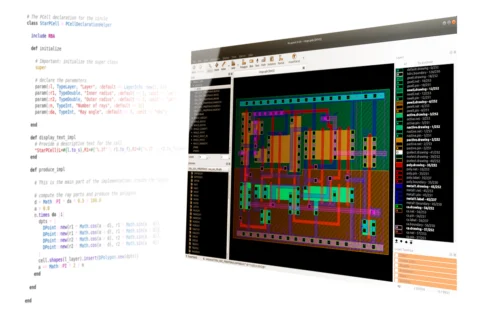
KLayout is a desktop viewer and editor for chip layouts, with Ruby and Python scripting, format conversion, DRC and LVS tools.
Official materials document layout viewing and editing, scripting, format support, DRC and LVS. The software is free, but no reliable third-party review ratings were verified; usability, performance and support scores are editorial assessments, not user ratings.
This profile combines documented product information and independent evidence where available. It is not a hands-on test unless TechZella explicitly identifies one.
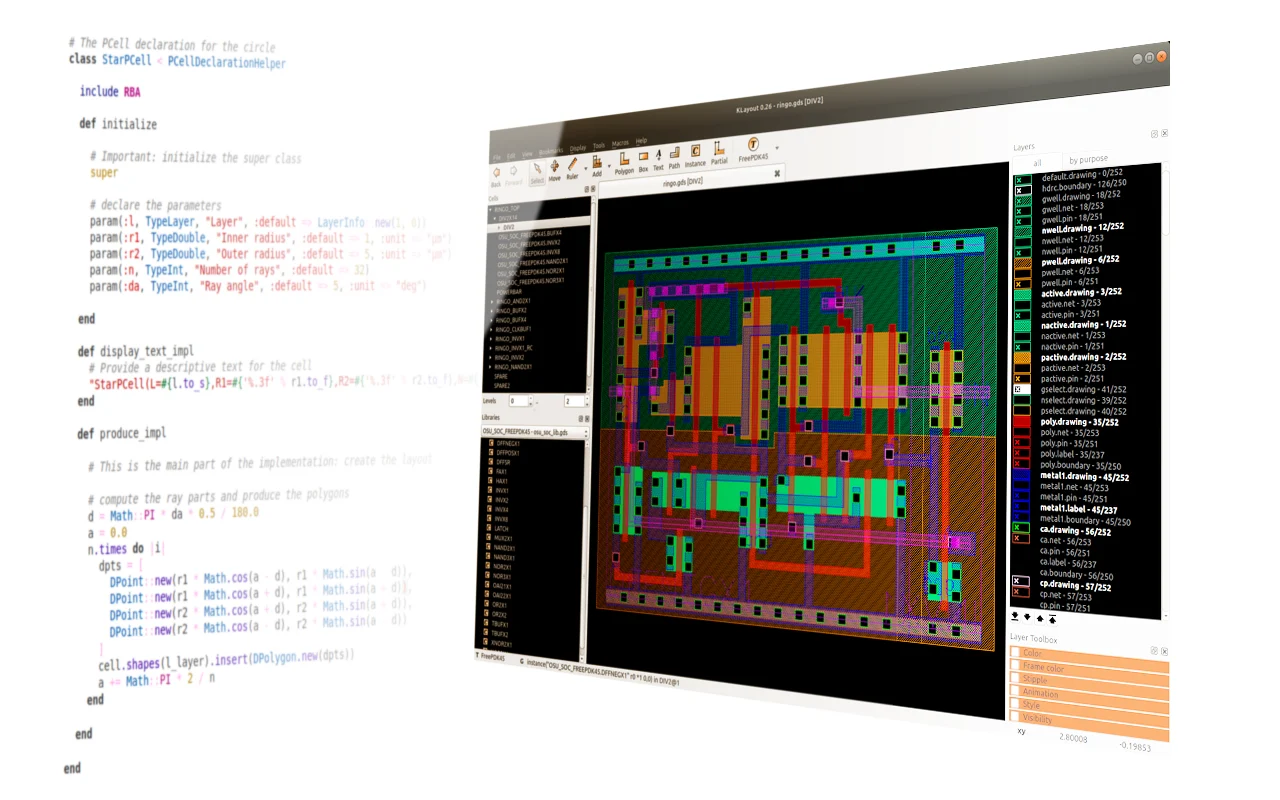
KLayout is a desktop viewer and editor for semiconductor mask layouts. It combines interactive layout work with Ruby and Python scripting, file-format conversion, design-rule checking and layout-versus-schematic verification.
Its documented formats include GDS2, OASIS, DXF, CIF, Gerber and LEF/DEF. The application is free under the license stated on its official site, and is distributed for desktop use rather than as a hosted service.
A quick way to understand who this product may suit, where its limits matter, and which facts are most relevant before you compare alternatives.
Engineers and researchers who need a locally installed tool to inspect or edit chip layouts, automate geometry tasks, convert layout files, or develop DRC and LVS scripts.
Teams seeking a hosted, turnkey chip-design suite with a vendor-provided, foundry-qualified verification flow may need additional tools and process-specific scripts, and should evaluate alternatives such as Magic VLSI instead.
API, Linux, macOS, Python, Windows
7.4/10
These are the product-specific differences that may matter when deciding whether the software fits your workflow. They are based on documented evidence rather than a universal ranking.
These are documented constraints or practical friction points that may matter before you adopt the product.
Teams should confirm their netlist and device-recognition setup before relying on LVS in an existing verification flow.
Evidence source ↗Automation that depends on GUI or Qt classes may require the full application rather than the lean Python package.
Evidence source ↗Organizations should assess their own validation and support needs before using the tool in production workflows.
Evidence source ↗Free desktop software. The official license page specifies GNU GPL version 2 or later.
Check current pricing →Pricing may change. Verify current plans on the vendor's website.
Compare similar products directly, then see which alternatives may make more sense when your requirements differ.
| Decision factor | KLayout | Magic VLSI | GDSFactory |
|---|---|---|---|
| Core scope | Layout viewer and editor with format conversion, scripting, DRC and LVS features. | VLSI layout editor with design-rule checking and circuit extraction. Source ↗ | Python chip-design framework for programmatic layout generation, simulation and verification workflows. Source ↗ |
| Editing and automation | GUI editor with integrated Ruby and Python scripting and an API. | Interactive editor with Tcl-based workflows and technology files. Source ↗ | Uses Python or YAML to define and generate layout components. Source ↗ |
| Verification | Provides scriptable DRC and LVS; the documented LVS flow can read SPICE netlists. | Provides a design-rule checker and circuit extraction; its documented flow uses technology files. Source ↗ | Documents DRC, DFM and LVS as parts of its design and verification workflows. Source ↗ |
| Pricing model | Free; official license page specifies GPL version 2 or later. | Open-source software; official project materials describe an open-source license. Source ↗ | The GDSFactory Python library is open source; GDSFactory+ is a separate commercial extension. Source ↗ |
Only factors supported by the available research are shown. The comparison is descriptive, not a ranking.
These products address broadly similar requirements. The descriptions focus on documented reasons a buyer might compare them with KLayout.
| License | GNU GPL version 2 or later, as stated on the official license page |
|---|---|
| Latest verified version | 0.30.13, released November 2, 2026 |
| Desktop platforms | Windows, Linux and macOS packages or builds are documented |
| Scripting API | Ruby and Python |
| Input and output formats | GDS2, OASIS, DXF, CIF, Gerber and LEF/DEF are listed by official product materials |
| Deployment | Locally installed desktop application |
| LVS netlist input | SPICE-format netlists are documented |
Verified installation, hosting, administration, or environment details that can affect implementation.
| Installation or hosting | Desktop software distributed through Windows and Linux packages, source archives, and macOS DMG packages. It is not presented as a hosted SaaS product. Source ↗ |
|---|
Documented portability, standards, export, or switching considerations. No switching-cost score is shown unless the evidence supports one.
The application reads and writes multiple layout formats, including GDS2 and OASIS; its homepage also lists DXF, CIF, Gerber and LEF/DEF support.
Evidence source ↗A proprietary editorial score based on product capabilities, usability, value, performance, support and user sentiment evidence.
Official materials document layout viewing and editing, scripting, format support, DRC and LVS. The software is free, but no reliable third-party review ratings were verified; usability, performance and support scores are editorial assessments, not user ratings.
Methodology v1.0. The assessment weighs feature coverage (25%), ease of use (15%), value for money (20%), performance (15%), support (10%) and user sentiment (15%), using researched product evidence and verified review evidence where available. It is a TechZella editorial assessment, not a direct user-review average.
Key claims are linked to the sources used to verify them. This evidence record is separate from third-party user ratings.
TechZella evaluates software using documented product capabilities, pricing information, usability and value considerations, independent user evidence where available, and competitive context. The assessment is an editorial review, not a hands-on test unless one is explicitly identified. Our editorial assessment is based on 6 documented sources.
The official product page describes viewer and editor modes, including geometry creation and editing operations.
View source ↗Verified 2026-11-10The programming documentation lists integrated Ruby and Python scripting and application, database and geometry APIs.
View source ↗Verified 2026-11-10The official product page lists DRC and LVS scripts; the manual describes LVS as a built-in feature beginning with version 0.26.
View source ↗Verified 2026-11-10The download page identifies version 0.30.13 as current; release notes date it November 2, 2026.
View source ↗Verified 2026-11-10The official license page states the license and that the program may be copied and distributed freely.
View source ↗Verified 2026-11-10The official Python module page documents GDS, OASIS, CIF, DXF and additional formats including Gerber; the product page also lists LEF/DEF.
View source ↗Verified 2026-11-10Answers begin with the clearest available response, followed by the context that helps you act on it.
No reviews yet. Be the first to share your experience.
Please log in to submit a review.