
Free and Pro plans have monthly event and metrics-point limits.
Instrumenting additional services, logs, or metrics can increase billable event volume, so estimate production traffic and metric collection before choosing a tier.
Evidence source ↗
Honeycomb is a hosted observability platform for exploring application telemetry, tracing distributed requests, and investigating production behavior. It accepts OpenTelemetry data and charges by telemetry volume on paid plans.
The assessment reflects documented tracing, telemetry exploration, integrations, and plan limits, plus G2's displayed rating and accessible review excerpts. It is not based on hands-on testing.
This profile combines documented product information and independent evidence where available. It is not a hands-on test unless TechZella explicitly identifies one.
Honeycomb is a hosted observability service for collecting and exploring telemetry from software systems. It accepts traces, metrics, and logs through OpenTelemetry and offers an Events API for sending JSON events.
Engineering teams can use queries, visualizations, and BubbleUp to investigate production behavior and compare unusual data with a broader dataset. The product is designed for engineering and operations workflows, rather than general business reporting.
A quick way to understand who this product may suit, where its limits matter, and which facts are most relevant before you compare alternatives.
Software engineering, SRE, and platform teams that need to investigate distributed production systems using detailed, queryable telemetry and OpenTelemetry instrumentation.
Teams that require self-hosted observability, or want a broad infrastructure-monitoring suite purchased and organized primarily around host-level modules, should compare deployment and product scope before selecting Honeycomb, and should evaluate alternatives such as New Relic or Datadog instead.
API, AWS, Kubernetes, SaaS, Web
8.3/10
These are the product-specific differences that may matter when deciding whether the software fits your workflow. They are based on documented evidence rather than a universal ranking.
These are documented constraints or practical friction points that may matter before you adopt the product.
Instrumenting additional services, logs, or metrics can increase billable event volume, so estimate production traffic and metric collection before choosing a tier.
Evidence source ↗A team evaluating enterprise-only Service Map or larger-scale allowances may need to coordinate with sales and plan an onboarding process.
Evidence source ↗Review the service terms and billing cycle before purchasing or changing a paid subscription.
Evidence source ↗Free forever; up to 20M events and 100M metrics data points per month. Includes two triggers.
Check current pricing →Up to 750M events and 3.75B metrics data points monthly; includes 100 triggers and two SLOs.
Check current pricing →Variable telemetry allowances; listed with 300 triggers, 100 SLOs, and Service Map. Trial available by request.
Check current pricing →Pricing may change. Verify current plans on the vendor's website.
Compare similar products directly, then see which alternatives may make more sense when your requirements differ.
| Decision factor | Honeycomb.io | New Relic | Datadog |
|---|---|---|---|
| Pricing model | Free plan allows up to 20M events and 100M metrics data points monthly; Pro starts at $150 per month and prices event allowances. | Free plan includes 100 GB of data ingest monthly and one full-platform user; paid usage can combine ingest and user charges. Source ↗ | APM is listed from $31 per host per month on annual billing, with separate infrastructure, indexed-span, and other product charges available. Source ↗ |
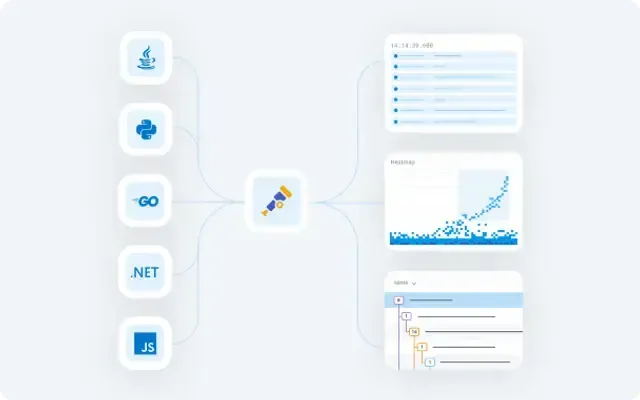
| OpenTelemetry ingestion | Accepts OTLP over gRPC, HTTP/protobuf, and HTTP/JSON; other formats can be converted through the OpenTelemetry Collector. | Supports native OTLP ingest and recommends it for sending OpenTelemetry data. Source ↗ | Its Infrastructure Pro plan lists OpenTelemetry support; Datadog also bills APM by host and related telemetry products by their own units. Source ↗ |
| Free-plan allowance | Up to 20M events and 100M metrics data points monthly, with two triggers listed. | 100 GB monthly ingest, one full-platform user, and unlimited basic users; the page lists at least eight days of default retention. Source ↗ | Datadog's listed APM product starts at $31 per host per month on annual billing; the reviewed pricing page does not establish an equivalent free APM allowance. Source ↗ |
Only factors supported by the available research are shown. The comparison is descriptive, not a ranking.
These products address broadly similar requirements. The descriptions focus on documented reasons a buyer might compare them with Honeycomb.io.


| Deployment | Hosted SaaS |
|---|---|
| Telemetry protocol | OpenTelemetry Protocol (OTLP) |
| API | Events API and configuration APIs |
| Integrations | AWS, Kubernetes, GitHub Actions, GitLab CI, Buildkite, and others documented |
| Data retention | 60 days for most customers; verify account-specific terms |
| Encryption | Data encrypted at rest and in transit |
| API key limit | 100 API keys per team; increase can be requested from Support |
| Enterprise network connection | AWS PrivateLink for eligible Enterprise users with AWS-hosted services |
Verified installation, hosting, administration, or environment details that can affect implementation.
| Service hosting | Hosted SaaS observability service; Enterprise customers using AWS-hosted services can use AWS PrivateLink to connect to the Honeycomb API. Source ↗ |
|---|---|
| Telemetry pipeline | Honeycomb documents OpenTelemetry Collector configuration and Enterprise Refinery, which runs within the customer's infrastructure. Source ↗ |
Documented portability, standards, export, or switching considerations. No switching-cost score is shown unless the evidence supports one.
Honeycomb accepts OTLP, and its documentation describes converting OpenTracing, Zipkin, or Jaeger data through the OpenTelemetry Collector. This can preserve an OpenTelemetry-based instrumentation path when changing backends.
Evidence source ↗A proprietary editorial score based on product capabilities, usability, value, performance, support and user sentiment evidence.
The assessment reflects documented tracing, telemetry exploration, integrations, and plan limits, plus G2's displayed rating and accessible review excerpts. It is not based on hands-on testing.
Methodology v1.0. The assessment weighs feature coverage (25%), ease of use (15%), value for money (20%), performance (15%), support (10%) and user sentiment (15%), using researched product evidence and verified review evidence where available. It is a TechZella editorial assessment, not a direct user-review average.
Key claims are linked to the sources used to verify them. This evidence record is separate from third-party user ratings.
TechZella evaluates software using documented product capabilities, pricing information, usability and value considerations, independent user evidence where available, and competitive context. The assessment is an editorial review, not a hands-on test unless one is explicitly identified. Our editorial assessment is based on 4 documented sources.
The official pricing page lists all three plans and their feature and usage allowances.
View source ↗Verified 2026-11-08The official plan page lists the Pro starting price and its monthly event allowance.
View source ↗Verified 2026-11-08Documentation names gRPC, HTTP/protobuf, and HTTP/JSON support for OTLP telemetry.
View source ↗Verified 2026-11-08The data-ingestion documentation lists Kubernetes, AWS services, and CI/CD integrations including GitHub Actions, GitLab CI, and Buildkite.
View source ↗Verified 2026-11-08The security documentation states both encryption practices and the usual retention window, while noting retention is plan-dependent.
View source ↗Verified 2026-11-08G2's company profile lists 2016 as the founding year; the official About page describes the company as founded about ten years ago.
View source ↗Verified 2026-11-08Answers begin with the clearest available response, followed by the context that helps you act on it.
No reviews yet. Be the first to share your experience.
Please log in to submit a review.