Editorial overview
Aggregated Overview
Cube documents multiple APIs, data-source integrations, governed modeling, caching, and embedded analytics. Public G2 reviews praise flexibility and metric modeling, while some report learning-curve, documentation, and support or scaling concerns.
This profile combines documented product information and independent evidence where available. It is not a hands-on test unless TechZella explicitly identifies one.
Overview
Cube is a semantic layer and analytics platform from Cube Dev, Inc. Teams define metrics and business logic in a shared model, then expose that model to analytics tools, applications, and AI agents.
Cube Cloud is the managed offering, while Cube Core is open-source. Cube sits over connected data sources, so it complements rather than replaces a warehouse. Its API and integration approach suits teams building internal analytics or analytics inside their own products.
Cube Software Decision Snapshot
A quick way to understand who this product may suit, where its limits matter, and which facts are most relevant before you compare alternatives.
Best suited toData and software teams that need governed metrics shared across BI tools, AI agents, or embedded customer-facing analytics.
Look elsewhere ifTeams seeking a complete BI suite with extensive built-in visualization and catalog features, or those needing production compute without usage-based infrastructure charges, and should evaluate alternatives such as dbt Semantic Layer or AtScale instead.
PlatformsCloud, GraphQL API, MCP, REST API, SaaS
TechZella assessment7.9/10
Cube Software — What Sets It Apart?
These are the product-specific differences that may matter when deciding whether the software fits your workflow. They are based on documented evidence rather than a universal ranking.
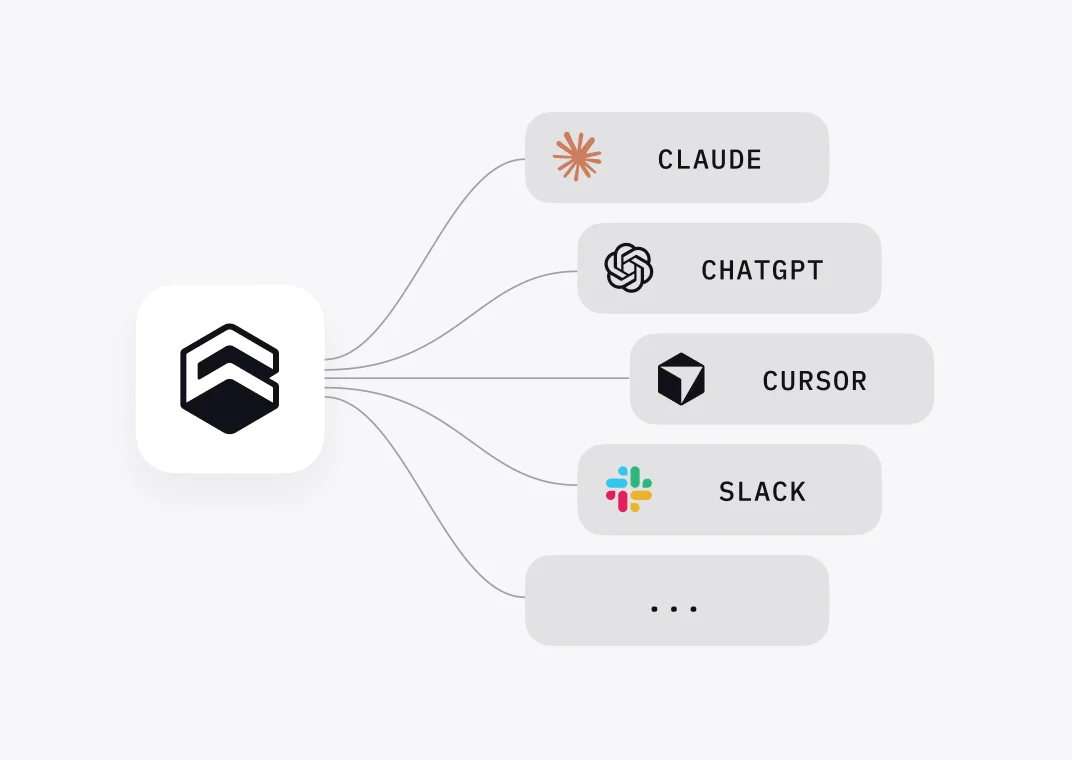
- The same semantic model can serve analytics over SQL, REST, GraphQL, and MCP interfaces.
- Open-source Cube Core is available alongside the managed Cube Cloud product.
- Semantic Layer Sync can publish Cube metrics into connected BI tools and synchronize model changes.
Editorial assessmentCube Software Pros & Cons
Pros
- Multiple interfaces allow modeled metrics to serve BI, applications, and AI agents.
- Official catalog lists a wide range of warehouses, databases, and transformation tools.
- Offers both managed Cube Cloud and open-source Cube Core.
- Free plan is available for evaluation and small projects.
Cons
- It is a semantic and serving layer, not a standalone warehouse or full visualization suite.
- Free and paid tiers have request, workbook, role, and feature distinctions.
- Production infrastructure options can add hourly charges to published seat prices.
- Some public reviewers report learning-curve, documentation, integration, or scaling issues.
Cube Software Gotchas & Operational Limits
These are documented constraints or practical friction points that may matter before you adopt the product.
Starter and Premium infrastructure can incur hourly charges for dedicated deployments, extra API instances, and Cube Store workers.
Developer-seat prices alone may not represent production costs for workloads requiring dedicated compute, additional instances, or caching.
Evidence source ↗The Free plan lists a daily request limit of 1,000 and up to five workbooks.
Teams evaluating the free tier should check expected request volume and workbook needs before relying on it for production.
Evidence source ↗Cube is designed to supply governed data and analytics interfaces, not replace a data warehouse or provide every visualization and catalog function.
Buyers may still need a warehouse and separate downstream BI or visualization products.
Evidence source ↗Cube Software Pricing & Plans
Free
$0
month
Free forever. Includes up to five workbooks, analytics chat, dashboards, and an MCP server; daily request limit is 1,000.
Check current pricing →Starter
$40 per developer
month
Includes production deployment compute, Cube Store caching, unlimited workbooks, and extended query and agent limits. Some infrastructure options are billed separately.
Check current pricing →Premium
$80 per developer
month
Adds Explorer and Viewer roles, embedded dashboards, unlimited queries, and higher-tier features. Some infrastructure options are billed separately.
Check current pricing →Enterprise
Custom
custom
Custom pricing with enterprise features including dedicated single-tenant installation, BYOC, BYOLLM, SAML SSO, and workspace access control.
Check current pricing →Pricing may change. Verify current plans on the vendor's website.
Cost contextTotal Cost & Hidden Costs
Additional costs or implementation requirements that are documented in the available evidence.
Implementation and onboarding
Public pricing does not list implementation or onboarding fees. Cube's pricing page was checked; teams should confirm any services costs with the vendor.
Evidence source ↗Hosting and production infrastructure
Cube Cloud is managed, but pricing lists separately billed hourly options for dedicated deployment, API instances, and Cube Store workers.
Evidence source ↗Seat and usage charges
Starter and Premium list per-developer monthly rates; Premium also lists Explorer and Viewer seats, while request limits and infrastructure options vary by plan.
Evidence source ↗Cube Software Competitors & Alternatives
Compare similar products directly, then see which alternatives may make more sense when your requirements differ.
At a glance
Developer ToolsOnly factors supported by the available research are shown. The comparison is descriptive, not a ranking.
Direct competitors
These products address broadly similar requirements. The descriptions focus on documented reasons a buyer might compare them with Cube Software.
dbt Semantic LayerDefines and serves metrics within the dbt ecosystem, using MetricFlow and dbt Semantic Layer APIs.
CapabilitiesCube Software Features
Semantic modeling and governance
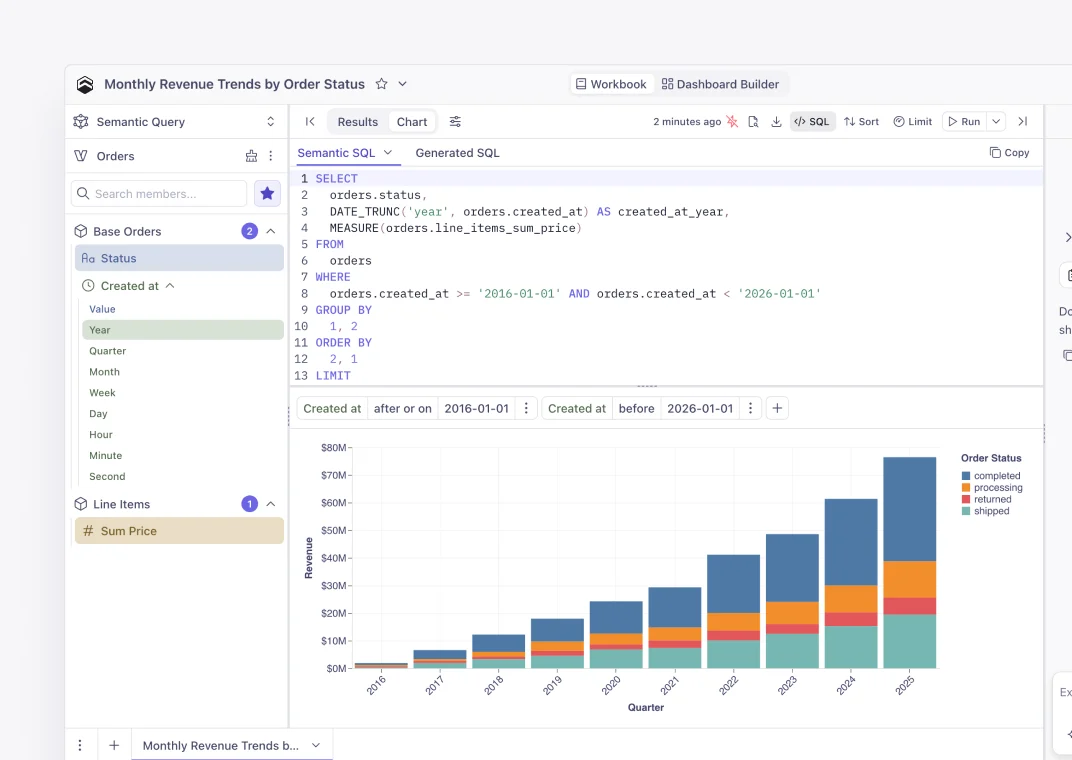
- Define reusable metrics, dimensions, and joins
- Model access rules in a shared semantic layer
- Integrate dbt models
APIs and integration
- SQL API
- REST API
- GraphQL API
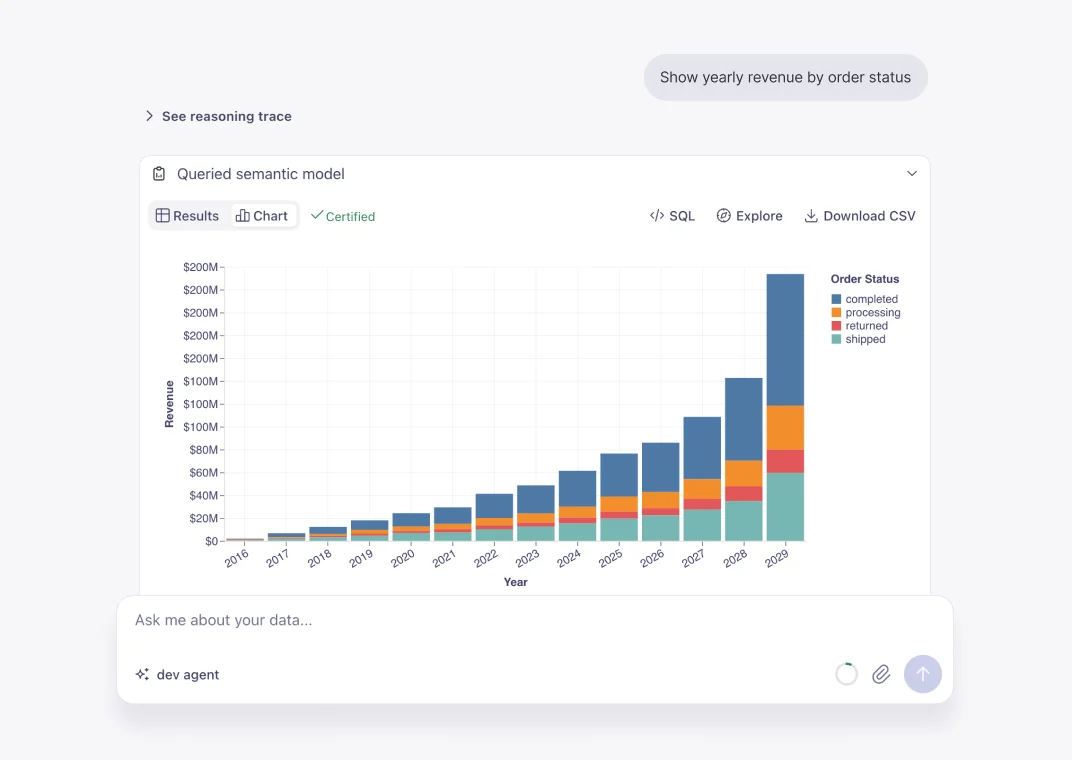
- MCP server for AI agents
- Semantic Layer Sync for connected BI tools
Analytics delivery
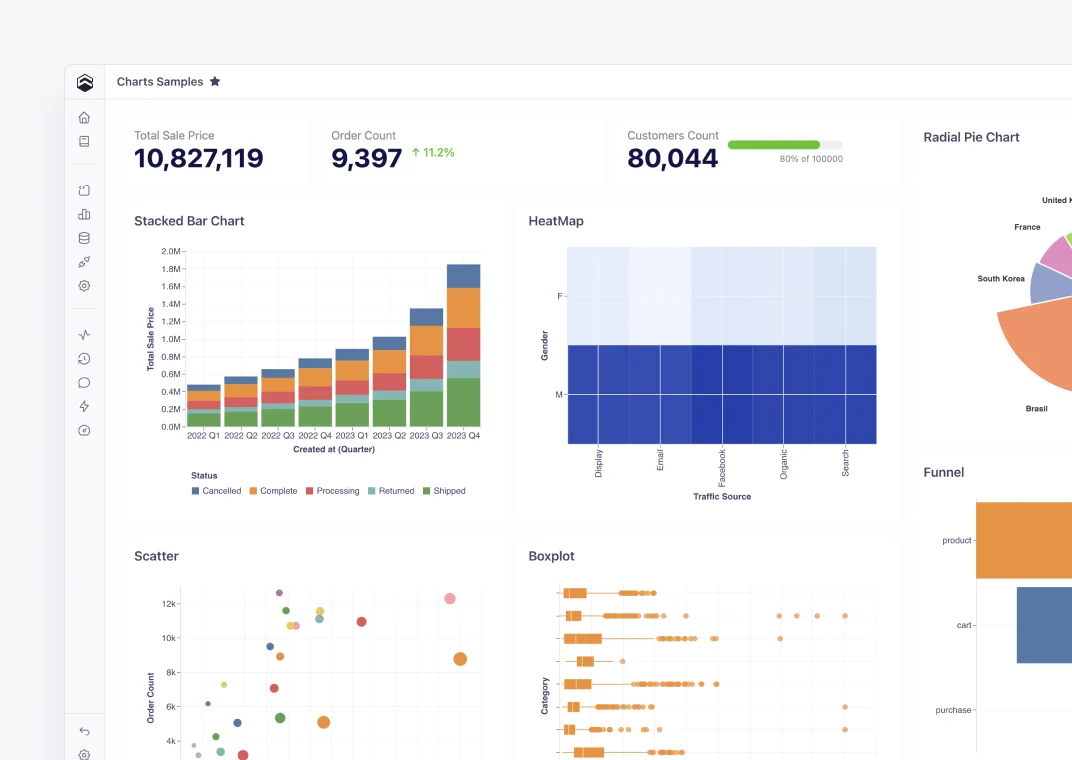
- Workbooks and dashboards
- Embedded analytics
- Analytics chat
- Caching and pre-aggregations
Data connections
- Connectors for Snowflake, BigQuery, Databricks, PostgreSQL, Redshift, and other listed sources
Cube Software Specifications
| Hosting | Managed Cube Cloud or self-managed Cube Core |
|---|
| API | SQL, REST, GraphQL, MCP, Sync, and DAX interfaces |
|---|
| Open-source core | Cube Core; Apache 2.0 license per vendor comparison |
|---|
| Free-plan request limit | 1,000 per day |
|---|
| Free-plan workbook limit | Up to five |
|---|
| SAML SSO | Listed for Enterprise |
|---|
| Data sources | Snowflake, BigQuery, Databricks, PostgreSQL, Redshift, and additional listed integrations |
|---|
| Free trial | Free-forever plan listed; no time-limited trial duration found |
|---|
Exit planningMigration & Lock-In
Documented portability, standards, export, or switching considerations. No switching-cost score is shown unless the evidence supports one.
Data portability
Cube Core is published as open-source software under Apache 2.0, and Cube serves data from connected sources rather than replacing the warehouse.
Evidence source ↗Our evidence-based assessmentTechZella Score
A proprietary editorial score based on product capabilities, usability, value, performance, support and user sentiment evidence.
7.9/10Moderate confidence
Cube documents multiple APIs, data-source integrations, governed modeling, caching, and embedded analytics. Public G2 reviews praise flexibility and metric modeling, while some report learning-curve, documentation, and support or scaling concerns.
Methodology v1.0. The assessment weighs feature coverage (25%), ease of use (15%), value for money (20%), performance (15%), support (10%) and user sentiment (15%), using researched product evidence and verified review evidence where available. It is a TechZella editorial assessment, not a direct user-review average.
Editorial transparency
Our Review Methodology
Key claims are linked to the sources used to verify them. This evidence record is separate from third-party user ratings.
TechZella evaluates software using documented product capabilities, pricing information, usability and value considerations, independent user evidence where available, and competitive context. The assessment is an editorial review, not a hands-on test unless one is explicitly identified. Our editorial assessment is based on 5 documented sources.
What TechZella adds- The same semantic model can serve analytics over SQL, REST, GraphQL, and MCP interfaces.
- Open-source Cube Core is available alongside the managed Cube Cloud product.
- Semantic Layer Sync can publish Cube metrics into connected BI tools and synchronize model changes.
Important limitations- Cube is a semantic and data-serving layer rather than a general-purpose warehouse or full visualization suite.
- Higher-tier features and production infrastructure can add costs beyond developer-seat pricing.
- Public G2 reviews mention a learning curve and occasional documentation, integration, or scaling concerns.
Evidence-backed claimsCube Cloud has Free, Starter, Premium, and Enterprise plans.The official pricing page lists four plans and publishes Free as free forever, Starter at $40 per developer monthly, Premium at $80 per developer monthly, and custom Enterprise pricing.
View source ↗Verified 2026-10-19The Free plan includes workbooks, dashboards, analytics chat, and an MCP server.The pricing page lists these capabilities in the Free plan and caps workbooks at five in the comparison table.
View source ↗Verified 2026-10-19Cube lists data-source integrations including Snowflake, BigQuery, Databricks, PostgreSQL, and Redshift.The official integrations page enumerates these and other data-source connectors.
View source ↗Verified 2026-10-19Cube's data interfaces include REST, GraphQL, SQL, Sync, and DAX.The official Data APIs page lists those API and sync interfaces.
View source ↗Verified 2026-10-19Cube Dev, Inc. identifies Artyom Keydunov as CEO and co-founder and Pavel Tiunov as CTO and co-founder.The official About page lists the named leaders and titles.
View source ↗Verified 2026-10-19G2 displays Cube at 4.6 out of 5 from 27 reviews.The public G2 product review page shows an aggregate rating of 4.6 and 27 reviews.
View source ↗Verified 2026-10-19 Independent review sources
Cube Software Ratings & Reviews
Ratings are published by the respective review platforms and may change over time.
Common questionsCube Software FAQs
Answers begin with the clearest available response, followed by the context that helps you act on it.
Does Cube include a free trial?
Cube's official pricing page lists a free-forever plan; it does not state a time-limited trial.
What APIs does Cube support?
Cube documents SQL, REST, GraphQL, and MCP, as well as Sync and DAX interfaces.
Which data sources does Cube connect to?
Its integration catalog lists sources including Snowflake, BigQuery, PostgreSQL, Databricks, Redshift, MySQL, and others.
Does Cube replace a data warehouse?
No. Cube's documented architecture positions it as a semantic and serving layer over connected data sources.
Community feedback
Reviews
No reviews yet. Be the first to share your experience.
Write a Review
Please log in to submit a review.
Recently added Developer Tools