Editorial overview
Aggregated Overview
The score reflects documented access controls, integrations, and deployment choices, not hands-on testing. Public G2 results listed no Boundary reviews, so user sentiment could not be assessed.
This profile combines documented product information and independent evidence where available. It is not a hands-on test unless TechZella explicitly identifies one.
Overview
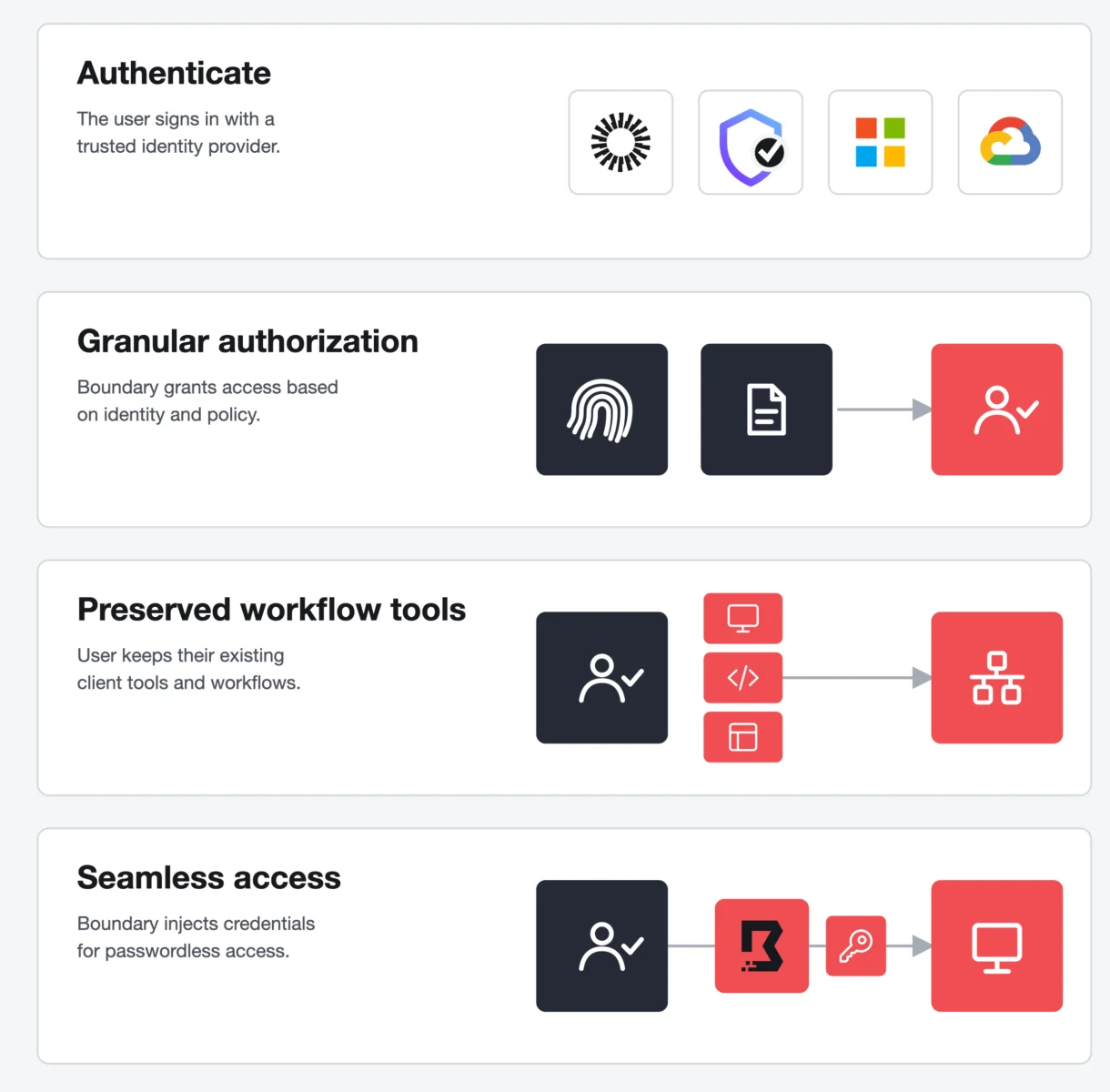
Boundary provides identity-based access to servers, databases, applications, and other infrastructure without requiring users to reach the underlying network directly. It applies role-based permissions and brokers proxied sessions.
Buyers can use HCP Boundary, where HashiCorp hosts the control plane, or deploy Boundary Enterprise themselves. The product is designed for organizations managing access across cloud and on-premises environments.
Boundary Decision Snapshot
A quick way to understand who this product may suit, where its limits matter, and which facts are most relevant before you compare alternatives.
Best suited toOrganizations that need identity-based, least-privilege access to servers, databases, and other private infrastructure across cloud or on-premises environments.
Look elsewhere ifTeams seeking only AWS EC2 session access may prefer AWS Systems Manager Session Manager, which AWS documents as available without additional Session Manager charges. Boundary requires deployment and configuration of its own access platform, and should evaluate alternatives such as Teleport instead.
PlatformsCloud, Linux, macOS, Self-hosted, Windows
TechZella assessment7.1/10
Boundary — What Sets It Apart?
These are the product-specific differences that may matter when deciding whether the software fits your workflow. They are based on documented evidence rather than a universal ranking.
- Uses proxy-based sessions so users can access approved targets without direct access to the underlying network.
- Supports both HCP-managed control planes with private workers and self-managed deployments.
- Combines access brokering with dynamic host discovery for AWS, Azure, and Google Cloud environments.
- Boundary 1.1 adds scoped machine-to-machine app tokens and a public-preview MCP server.
Editorial assessmentBoundary Pros & Cons
Pros
- Offers managed and self-managed deployment choices.
- Supports access workflows across cloud and on-premises infrastructure.
- Combines proxied sessions with credential brokering and role-based authorization.
- Supports Terraform, CLI, and API-based administration.
Cons
- HCP pricing varies by user tier, edition, and support level.
- Session recording is not listed for HCP Standard.
- Self-managed deployments require customer-operated infrastructure.
- The MCP server is in public preview and is not recommended for production use.
Boundary Gotchas & Operational Limits
These are documented constraints or practical friction points that may matter before you adopt the product.
Boundary 1.1.0 has a documented database-migration upgrade hazard for certain earlier versions.
Operators upgrading from 0.20.x, 0.21.x, 1.0.2, or 1.0.3 should follow the documented upgrade path and use 1.0.4 or 1.1.1 rather than 1.1.0.
Evidence source ↗HCP Boundary billing counts any human or machine identity that takes an authenticated action during a billing month.
Organizations should account for active machine identities as well as human users when estimating usage.
Evidence source ↗The Boundary MCP server is public preview and does not have its own Boundary identity.
It uses a user's Boundary token and permissions, so buyers should follow the security guidance and avoid production use of preview features.
Evidence source ↗Boundary Pricing & Plans
HCP Boundary Standard
$0.00000
month per user
The published table lists the first 1–5 users at this rate. Additional users are billed by tier; the listed rates vary by support level.
Check current pricing →HCP Boundary Standard, users 6–20
$23.95833
month per user
Published Silver Support rate for the next 6–20 users. Gold Support is listed at $25.00000 per user monthly; further tiers have different rates.
Check current pricing →HCP Boundary Plus
$47.91667
month per user
Published Silver Support rate for the next 6–20 users. Gold Support is listed at $50.00000 per user monthly; the public table lists a separate rate for the next user tier.
Check current pricing →Boundary Enterprise
Self-managed commercial offering. A universal public license price was not verified.
Check current pricing →Pricing may change. Verify current plans on the vendor's website.
Cost contextTotal Cost & Hidden Costs
Additional costs or implementation requirements that are documented in the available evidence.
HCP hosting
HashiCorp manages the HCP Boundary control plane. The organization remains responsible for its private workers and the infrastructure they require.
Evidence source ↗User-based charges
HCP Boundary is billed by monthly authenticated users. The first five users are listed at $0 per month; rates for additional users vary by edition, tier, and support level.
Evidence source ↗Self-managed infrastructure and operations
Boundary Enterprise is self-managed. The public material reviewed describes deployment but does not state a universal infrastructure or onboarding cost; buyers should estimate controller, worker, database, and operational needs for their design.
Evidence source ↗Boundary Competitors & Alternatives
Compare similar products directly, then see which alternatives may make more sense when your requirements differ.
At a glance
Privileged Access ManagementOnly factors supported by the available research are shown. The comparison is descriptive, not a ranking.
Direct competitors
These products address broadly similar requirements. The descriptions focus on documented reasons a buyer might compare them with Boundary.
CapabilitiesBoundary Features
Identity and access
- OIDC and LDAP authentication
- Identity-provider managed groups
- Role-based authorization
- Just-in-time access
Infrastructure access
- Proxy-based sessions to infrastructure targets
- Credential brokering and injection
- Dynamic host discovery for AWS, Azure, and Google Cloud
- Multi-hop sessions
Administration and audit
- Boundary API and CLI
- Terraform support
- Audit logs and streaming
- Session recording and playback on HCP Plus and Enterprise
Machine and AI integrations
- Scoped app tokens for machine-to-machine authentication
- MCP server in public preview
Boundary Specifications
| Deployment | HCP-managed or self-managed Boundary Enterprise |
|---|
| Client operating systems | Windows, macOS, Linux |
|---|
| API | Boundary API documented using OpenAPI v2 |
|---|
| Identity integrations | OIDC, LDAP, Microsoft Entra ID, Okta, Ping |
|---|
| Cloud host discovery | AWS, Microsoft Azure, Google Cloud |
|---|
| Pricing metric | HCP Boundary monthly authenticated users |
|---|
| Session recording | HCP Plus and Boundary Enterprise |
|---|
Exit planningMigration & Lock-In
Documented portability, standards, export, or switching considerations. No switching-cost score is shown unless the evidence supports one.
Upgrade path
Release notes warn that upgrading directly to 1.1.0 from specified earlier versions can skip database migrations; the documented safe choices include 1.0.4 or 1.1.1.
Evidence source ↗Our evidence-based assessmentTechZella Score
A proprietary editorial score based on product capabilities, usability, value, performance, support and user sentiment evidence.
7.1/10Moderate confidence
The score reflects documented access controls, integrations, and deployment choices, not hands-on testing. Public G2 results listed no Boundary reviews, so user sentiment could not be assessed.
Methodology v1.0. The assessment weighs feature coverage (25%), ease of use (15%), value for money (20%), performance (15%), support (10%) and user sentiment (15%), using researched product evidence and verified review evidence where available. It is a TechZella editorial assessment, not a direct user-review average.
Editorial transparency
Our Review Methodology
Key claims are linked to the sources used to verify them. This evidence record is separate from third-party user ratings.
TechZella evaluates software using documented product capabilities, pricing information, usability and value considerations, independent user evidence where available, and competitive context. The assessment is an editorial review, not a hands-on test unless one is explicitly identified. Our editorial assessment is based on 6 documented sources.
What TechZella adds- Uses proxy-based sessions so users can access approved targets without direct access to the underlying network.
- Supports both HCP-managed control planes with private workers and self-managed deployments.
- Combines access brokering with dynamic host discovery for AWS, Azure, and Google Cloud environments.
- Boundary 1.1 adds scoped machine-to-machine app tokens and a public-preview MCP server.
Important limitations- HCP Boundary billing is based on monthly authenticated users, and paid-user rates vary by edition, user tier, and support level.
- Session recording and playback are listed for HCP Plus and Enterprise, not HCP Standard.
- The MCP server is in public preview; HashiCorp advises against using preview features in production.
Evidence-backed claimsBoundary offers HCP-managed and self-managed editions.The product documentation describes HCP Boundary as managed by HashiCorp and Boundary Enterprise as self-managed.
View source ↗Verified 2026-11-23Boundary supports identity-provider authentication and role-based access controls.The product page names Okta, Ping, and Microsoft Entra ID as identity-provider examples and describes authorization based on roles and logical services.
View source ↗Verified 2026-11-23HCP Boundary pricing is based on monthly authenticated users.The Flex consumption table defines HCP Boundary users and lists monthly per-user tiers for Standard and Plus editions.
View source ↗Verified 2026-11-23Boundary provides desktop and CLI clients for Windows, macOS, and Linux.The client installation documentation lists Windows, macOS, and Linux support.
View source ↗Verified 2026-11-23Boundary 1.1 introduced app tokens, cross-account AWS host discovery, and an MCP server in public preview.HashiCorp's release announcement describes these additions and the MCP preview status.
View source ↗Verified 2026-11-23The G2 HashiCorp seller page listed zero HashiCorp Boundary reviews when checked.The public seller page showed HashiCorp Boundary with zero reviews.
View source ↗Verified 2026-11-23 Common questionsBoundary FAQs
Answers begin with the clearest available response, followed by the context that helps you act on it.
Does Boundary have a free plan?
HCP Boundary's published pricing table lists the first five users at $0 per month. HashiCorp also offers HCP trial credits for HCP services.
Can Boundary be self-hosted?
Yes. Boundary Enterprise is a self-managed offering, while HCP Boundary is managed by HashiCorp.
Does Boundary support Microsoft Entra ID?
Yes. HashiCorp documents OIDC authentication with Microsoft Entra ID and lists Entra ID among supported identity-provider integrations.
Does Boundary record privileged sessions?
Session recording and playback are listed for HCP Plus and Boundary Enterprise, but not HCP Standard in the editions comparison.
Does Boundary have an API?
Yes. Boundary documents an API described using OpenAPI v2, alongside CLI and Terraform configuration workflows.
Community feedback
Reviews
No reviews yet. Be the first to share your experience.
Write a Review
Please log in to submit a review.
Recently added Privileged Access Management