
Current public pricing pages provide plan descriptions but no numeric prices.
Buyers need a vendor quote to compare total subscription cost and understand the commercial basis for their deployment.
Evidence source ↗
Astrato builds governed analytics and data apps on live cloud-warehouse data, with dashboarding, embedded analytics, AI-assisted workflows, and writeback.
Scores reflect documented warehouse connections, governed modeling, app-building and writeback capabilities, plus limited public review evidence. Pricing is quote-based on the current site, and no hands-on testing was conducted.
This profile combines documented product information and independent evidence where available. It is not a hands-on test unless TechZella explicitly identifies one.
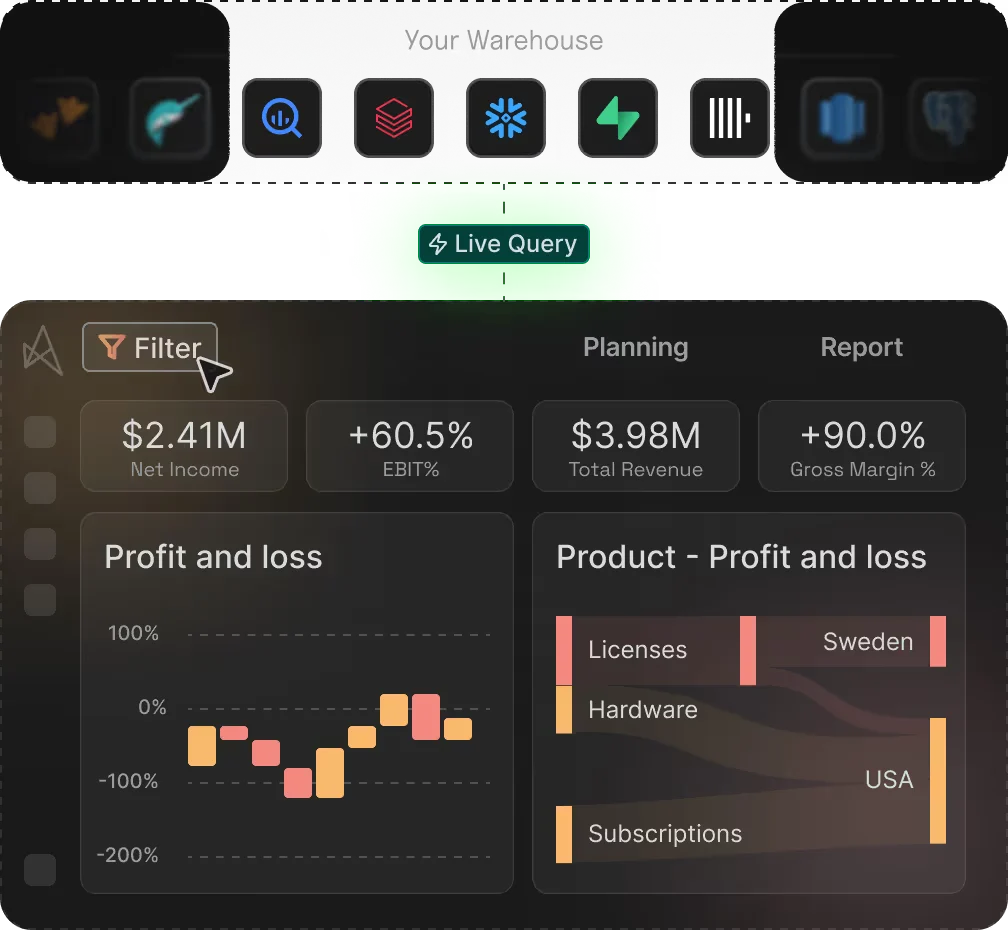
Astrato is a cloud analytics and data-app platform that connects to supported warehouses, including Snowflake, BigQuery, and Databricks. It combines governed semantic modeling, dashboards, embedded analytics, AI-assisted workflows, and writeback.
Its live-query approach places query execution on the connected warehouse. Teams can use Astrato for internal reporting or build customer-facing applications; warehouse compute and access permissions remain important parts of deployment planning.
A quick way to understand who this product may suit, where its limits matter, and which facts are most relevant before you compare alternatives.
Organizations using supported cloud data warehouses that need governed analytics, embedded customer dashboards, or interactive data apps with writeback and approval workflows.
Teams requiring a publicly priced self-service subscription, primarily on-premises deployment, or broad native data preparation across unrelated sources should verify fit before adopting, and should evaluate alternatives such as Sigma Computing u2014 compare when spreadsheet-oriented analytics and Input Tables are priorities. or Tableau u2014 compare when a team needs Tableau Cloud analytics or its separate embedded licensing model. instead.
API, Cloud, Web
7.9/10
These are the product-specific differences that may matter when deciding whether the software fits your workflow. They are based on documented evidence rather than a universal ranking.
These are documented constraints or practical friction points that may matter before you adopt the product.
Buyers need a vendor quote to compare total subscription cost and understand the commercial basis for their deployment.
Evidence source ↗Embedding architecture and server-side authentication need to be settled before committing to writeback or custom SQL workflows.
Evidence source ↗A successful app configuration alone does not guarantee that a warehouse role can perform the required inserts, updates, or procedures.
Evidence source ↗For departmental analytics and self-service reporting; includes governed semantic modeling, AI dashboard building, scheduled reporting, live warehouse querying, and onboarding call and chat support.
Check current pricing →For enterprise BI modernization and operational workflows; includes advanced governance, writeback workflows, GenAI integrations, and premium onboarding and support.
Check current pricing →For OEM and customer-facing analytics; lists multi-tenancy, white-labeling, usage-based scaling, and deployment architecture guidance.
Check current pricing →The official trial page advertises a 30-day trial and requires a registration form.
Check current pricing →Pricing may change. Verify current plans on the vendor's website.
Compare the product with documented alternatives across the factors that can change a buying decision. Each row is evidence-backed rather than a generic feature checklist.
| Decision factor | Astrato | Sigma Computing |
|---|---|---|
| Core scope | Warehouse-native BI, embedded analytics, data apps, and writeback workflows. | Analytics platform covering dashboards, reports, embedded analytics, and AI-powered insights. Source ↗ |
| Writeback | Writeback can insert or update data in supported warehouse tables and can be used in embedded dashboards. | Sigma documents Input Tables for writing data back to a warehouse. Source ↗ |
| Embedded development | Offers a developer SDK and a distinct route for externally hosted apps and governed charts. | Offers an Embed SDK and React quickstart for embedded analytics. Source ↗ |
| Decision factor | Astrato | Tableau |
|---|---|---|
| Core scope | Combines live-warehouse analytics with data apps, embedding, and warehouse writeback. | Offers self-service analytics and a separate Embedded Analytics offering for external-facing solutions. Source ↗ |
| Embedded deployment | Supports embedded applications and white-label customer analytics through its Embedded plan. | Tableau documents a limited-use Tableau Cloud license for embedding analytics in external-facing solutions. Source ↗ |
| Pricing model | Current plans require a demo or sales discussion; public numeric prices are not shown. | Tableau's U.S. webstore presents role-based Cloud and Server subscriptions, while embedded licensing has separate terms. Source ↗ |
Only factors supported by the available research are shown. The comparison is descriptive, not a ranking.




| Deployment | Cloud SaaS; hosted Data Apps and externally hosted embed options documented |
|---|---|
| API and developer tools | SDK, REST-style API routes, CLI, App runtime, and MCP |
| Data architecture | Live connections to supported cloud warehouses |
| Free trial | 30 days, by registration |
| Compliance | Company states SOC 2 Type II and ISO 27001 certification |
| Pricing disclosure | Current plan pricing requires a sales discussion |
Verified installation, hosting, administration, or environment details that can affect implementation.
| Hosting | Cloud-based Astrato service; documentation also describes Astrato-hosted Data Apps and externally hosted applications using its SDK and transport. Source ↗ |
|---|---|
| Data architecture | Queries use supported data connections to customer warehouses; Astrato describes data as remaining in the customer's warehouse rather than being copied into a proprietary storage layer. Source ↗ |
| Developer interfaces | Documented options include CLI, SDK, App runtime, writeback and SQL APIs, visualization references, and MCP for AI assistants. Source ↗ |
Sigma Computing is worth comparing when spreadsheet-style analytics and its Input Tables are central requirements. Tableau may fit teams seeking its broader self-service analytics offering or existing Tableau Cloud deployments. Astrato is more directly aligned with buyers prioritizing warehouse-native data apps and integrated writeback.
Documented portability, standards, export, or switching considerations. No switching-cost score is shown unless the evidence supports one.
Astrato offers migration guidance, semantic-layer guidance, dashboard rebuild support, and parallel-run rollout for organizations moving from Tableau, Power BI, or Qlik.
Evidence source ↗A proprietary editorial score based on product capabilities, usability, value, performance, support and user sentiment evidence.
Scores reflect documented warehouse connections, governed modeling, app-building and writeback capabilities, plus limited public review evidence. Pricing is quote-based on the current site, and no hands-on testing was conducted.
Methodology v1.0. The assessment weighs feature coverage (25%), ease of use (15%), value for money (20%), performance (15%), support (10%) and user sentiment (15%), using researched product evidence and verified review evidence where available. It is a TechZella editorial assessment, not a direct user-review average.
Key claims are linked to the sources used to verify them. This evidence record is separate from third-party user ratings.
TechZella evaluates software using documented product capabilities, pricing information, usability and value considerations, independent user evidence where available, and competitive context. The assessment is an editorial review, not a hands-on test unless one is explicitly identified. Our editorial assessment is based on 6 documented sources.
The company About page states that Astrato is headquartered in London and lists it as independent since 2023.
View source ↗Verified 2026-11-07The official trial page invites users to try the product for 30 days and presents a registration form.
View source ↗Verified 2026-11-07The current data-connection documentation lists Snowflake, BigQuery, ClickHouse, Databricks, Redshift, Supabase, DuckDB, Dremio, and PostgreSQL.
View source ↗Verified 2026-11-07The integration documentation maps these use cases to the Data App runtime, SDK, Writeback and SQL documentation, and MCP setup.
View source ↗Verified 2026-11-07The Writeback and SQL documentation lists writeback endpoints, OAuth scopes, and the need for compatible datasource support and permissions.
View source ↗Verified 2026-11-07The company About page identifies both credentials; the company's security page also describes its security and governance position.
View source ↗Verified 2026-11-07The G2 Astrato reviews page displays the rating and review count in its product profile.
View source ↗Verified 2026-11-07Answers begin with the clearest available response, followed by the context that helps you act on it.
No reviews yet. Be the first to share your experience.
Please log in to submit a review.