Editorial overview
Aggregated Overview
Official documentation describes consumer-data enrichment, prediction models, APIs, MCP access, and deployment options. G2 displayed 14 reviews and a 3.4/5 rating, but the accessible review evidence was limited.
This profile combines documented product information and independent evidence where available. It is not a hands-on test unless TechZella explicitly identifies one.
Decision guideFaraday Decision Snapshot
A quick way to understand who this product may suit, where its limits matter, and which facts are most relevant before you compare alternatives.
Best suited toMarketing and customer-insight teams that want to enrich existing records, build audience segments, or use predictive scores in their data and activation workflows.
Look elsewhere ifTeams seeking a general-purpose generative AI platform, or organizations needing a self-contained marketing execution suite. Faraday supplies customer context and predictions rather than generated marketing content or campaign management.
PlatformsAPI, Cloud, MCP, REST API, Web
TechZella assessment7.2/10
Overview
Faraday is a customer-context and predictive analytics platform from Faraday, Inc., founded in 2012 and based in Burlington, Vermont. It combines customer-provided data with its consumer Identity Graph to support enrichment, audience analysis, and predictions.
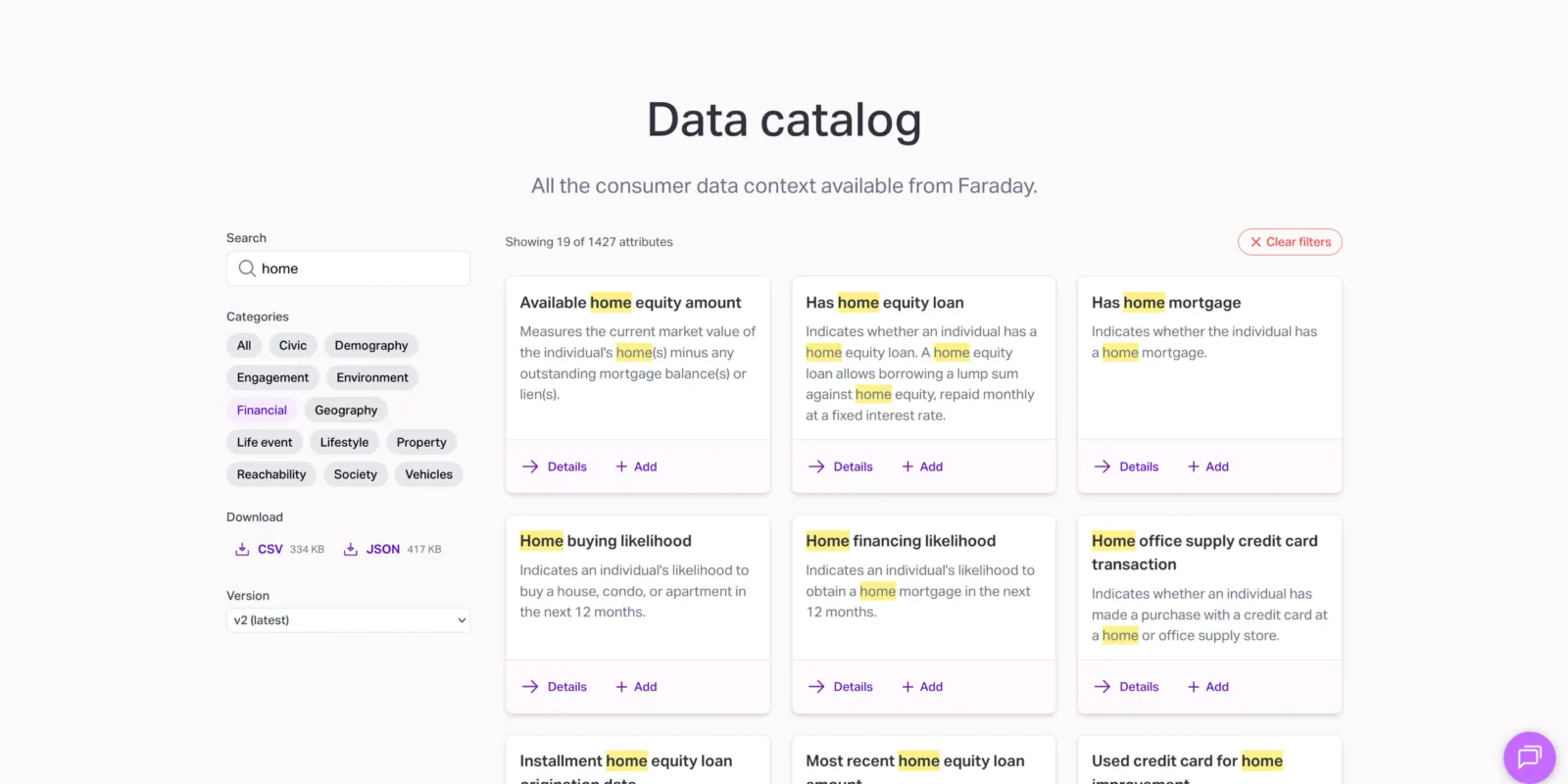
The company describes its graph as covering approximately 240 million U.S. adults and households, with more than 1,400 attributes per consumer. Faraday offers self-serve Pro for data enrichment and an annual Enterprise engagement that includes managed expertise.
Faraday is not a general-purpose generative AI system. Its documented role is to supply consumer attributes and predictions to marketing teams, existing business systems, and AI agents.
Faraday — What Sets It Apart?
These are the product-specific differences that may matter when deciding whether the software fits your workflow. They are based on documented evidence rather than a universal ranking.
- Combines a proprietary consumer identity graph with customer first-party data and custom predictive models.
- Provides a self-serve, pay-per-match consumer enrichment product alongside an annual managed Enterprise engagement.
- Offers customer-context access through dashboard workflows, a REST API, and MCP.
6 key claims verifiedOur editorial team checked this profile against company information, vendor documentation, pricing information. Supported by 6 documented sources.
Editorial assessmentFaraday Pros & Cons
Pros
- Combines customer-provided data with a consumer identity graph and predictive attributes.
- Offers both self-serve data enrichment and managed Enterprise service.
- Documents API, MCP, CSV, warehouse, and application connection workflows.
Cons
- Enterprise pricing is not published as a fixed public amount.
- Some managed application connections may require vendor setup and additional charges.
- Usage charges depend on matches, selected attributes, and predictive-scoring use.
Faraday Gotchas & Operational Limits
These are documented constraints or practical friction points that may matter before you adopt the product.
Faraday-managed connections require a support request for setup and may carry an additional charge.
Buyers planning direct CRM or marketing-platform synchronization should include vendor setup and possible connection fees in implementation planning.
Evidence source ↗Faraday Pro charges for matched attributes, and predictive scoring consumes more credits than basic enrichment.
The total spend depends on records matched, attributes selected, and whether predictive scores are requested.
Evidence source ↗Faraday Pro is not approved for decisions involving credit, lending, insurance underwriting, or employment.
Organizations considering regulated eligibility or employment decisions need a different permitted data and decisioning approach.
Evidence source ↗Faraday Pricing & Plans
Faraday Pro
$0.05 per credit
Usage-based
Self-serve enrichment billed by matched attributes. Basic enrichment uses one credit per matched attribute; predictive scoring uses ten credits. Volume discounts are available; the public announcement does not specify discount thresholds.
Check current pricing →Faraday Enterprise
Quote-based
Annual
Managed engagement with Faraday's platform and consulting expertise. Public fixed pricing was not found.
Check current pricing →Pricing may change. Verify current plans on the vendor's website.
Cost contextTotal Cost & Hidden Costs
Additional costs or implementation requirements that are documented in the available evidence.
Managed integrations
Faraday-managed connections to CRMs, email service providers, and other software may involve an additional cost. Salesforce managed deployment is documented as a paid add-on.
Evidence source ↗Usage charges
Faraday Pro bills $0.05 per credit; basic enrichment uses one credit per matched attribute, and predictive scoring uses ten credits. Volume discounts are available, but the discount schedule is not specified in the announcement.
Evidence source ↗Faraday Features
Customer Data and Analytics
- Consumer data enrichment using selected attributes
- Customer cohorts and audience analysis
- Predictive outcomes including churn, conversion, repeat purchase, and lead scoring
- Persona and recommendation modeling
Access and Delivery
- REST API with bearer-token authentication
- MCP access for customer-context workflows
- Connections to databases, warehouses, cloud storage, and selected business applications
- Deployment to connections, CSV files, and API lookup targets
Alternatives
No alternative is listed here because the reviewed sources did not establish enough comparable, buyer-specific facts to make a useful distinction without speculation. Buyers can compare Faraday with customer-data, audience-intelligence, and predictive-marketing products based on their data coverage, modeling needs, integration architecture, and pricing model.
Faraday Specifications
| Hosting | Cloud-hosted SaaS |
|---|
| Dashboard | Web |
|---|
| API | REST API with bearer-token authentication |
|---|
| Agent access | MCP |
|---|
| Integrations | Documented examples include Salesforce, Iterable, Segment, BigQuery, and Snowflake |
|---|
| Enterprise pricing | Annual engagement; quote-based |
|---|
| Faraday Pro pricing | $0.05 per credit; usage-based |
|---|
Exit planningMigration & Lock-In
Documented portability, standards, export, or switching considerations. No switching-cost score is shown unless the evidence supports one.
Data portability
Documented delivery options include CSV files, database and warehouse connections, cloud-storage connections, and API lookups. The reviewed sources do not describe a packaged migration service.
Evidence source ↗Our evidence-based assessmentTechZella Score
A proprietary editorial score based on product capabilities, usability, value, performance, support and user sentiment evidence.
7.2/10Moderate confidence
Official documentation describes consumer-data enrichment, prediction models, APIs, MCP access, and deployment options. G2 displayed 14 reviews and a 3.4/5 rating, but the accessible review evidence was limited.
Methodology v1.0. The assessment weighs feature coverage (25%), ease of use (15%), value for money (20%), performance (15%), support (10%) and user sentiment (15%), using researched product evidence and verified review evidence where available. It is a TechZella editorial assessment, not a direct user-review average.
Editorial transparency
Our Review Methodology
Key claims are linked to the sources used to verify them. This evidence record is separate from third-party user ratings.
TechZella evaluates software using documented product capabilities, pricing information, usability and value considerations, independent user evidence where available, and competitive context. The assessment is an editorial review, not a hands-on test unless one is explicitly identified. Our editorial assessment is based on 6 documented sources.
What TechZella adds- Combines a proprietary consumer identity graph with customer first-party data and custom predictive models.
- Provides a self-serve, pay-per-match consumer enrichment product alongside an annual managed Enterprise engagement.
- Offers customer-context access through dashboard workflows, a REST API, and MCP.
Important limitations- Enterprise pricing is not published as a fixed public amount; the vendor describes it as an annual engagement.
- Faraday-managed connections to some external applications require vendor involvement and may incur an additional charge.
- Faraday Pro is restricted to marketing, personalization, and customer-intelligence use cases, not credit, lending, insurance underwriting, or employment decisions.
Evidence-backed claimsFaraday is a customer-context platform founded in 2012 and headquartered in Burlington, Vermont.The company FAQ states the founding year and headquarters location and describes the customer-context product.
View source ↗Verified 2026-10-09Faraday's Identity Graph covers approximately 240 million U.S. adults and households, with more than 1,400 data points per consumer.Faraday's official welcome documentation describes the graph's approximate coverage and attribute count.
View source ↗Verified 2026-10-09Faraday Pro is self-serve and bills per matched attribute using credits.The launch announcement states that credits cost $0.05 each, basic enrichment uses one credit per matched attribute, and predictive scoring uses ten credits.
View source ↗Verified 2026-10-09Faraday supports REST API access with bearer-token authentication.The API reference documents the API base URL, bearer authentication, and resource endpoints.
View source ↗Verified 2026-10-09Faraday documents connections for systems including Salesforce, Iterable, Segment, BigQuery, and Snowflake.The official connection guides describe these named systems and integration workflows.
View source ↗Verified 2026-10-09G2 displayed Faraday at 3.4/5 from 14 reviews when accessed.The public G2 review page displayed the score and review count; its accessible content included limited review text.
View source ↗Verified 2026-10-09 Independent review sources
Faraday Ratings & Reviews
Ratings are published by the respective review platforms and may change over time.
Community feedback
Reviews
No reviews yet. Be the first to share your experience.
Write a Review
Please log in to submit a review.
FAQ
What does Faraday do? It enriches customer records with consumer attributes and supports audience analysis and predictive customer models.
Does Faraday provide an API? Yes. Its documentation describes a REST API using bearer-token authentication. Faraday also documents MCP access.
How is Faraday Pro priced? Pro charges $0.05 per credit. Basic enrichment uses one credit per matched attribute, while predictive scoring uses ten credits. Volume discounts are available.
Is there a free trial? The documentation says account sign-up is free, but the reviewed sources do not establish a time-limited trial or free usage allowance for Pro.
Can Faraday be used for lending or employment decisions? Faraday’s Pro guidance says it is not designed for credit, lending, insurance underwriting, or employment decisions.
Recently added software