
The Content Delivery API is opt-in and can expose published content publicly when enabled unless access is restricted.
Teams should review endpoint exposure and configure access before using the API in production.
Evidence source ↗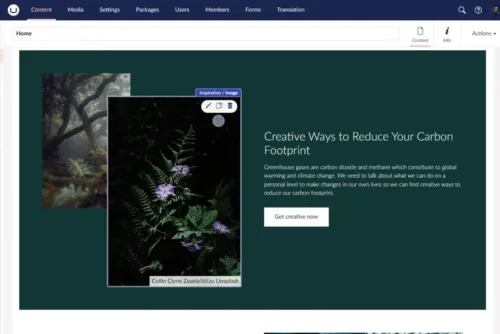
Umbraco is an open-source .NET content management system for building and managing websites. Its Content Delivery API also supports headless and hybrid publishing.
Assessment reflects documented CMS, API, hosting, and pricing capabilities, plus G2's displayed rating and review themes. The open-source CMS is free, while managed hosting and support add paid options. Scores are editorial assessments, not hands-on test results.
This profile combines documented product information and independent evidence where available. It is not a hands-on test unless TechZella explicitly identifies one.
Umbraco is an open-source content management system built on Microsoft .NET. Organizations can use it to manage website content, while developers shape the site’s design and functionality.
The CMS can render a conventional website or deliver published content through its Content Delivery API. This makes it relevant to teams building hybrid websites and other front ends that consume CMS content.
A quick way to understand who this product may suit, where its limits matter, and which facts are most relevant before you compare alternatives.
Organizations and agencies with .NET development capacity that want an extensible CMS, optional managed Azure hosting, and a route to hybrid or headless content delivery.
Teams seeking a fully managed CMS without taking responsibility for development or implementation may find the free self-hosted CMS requires more technical ownership. Cloud hosting is separately priced, and should evaluate alternatives such as WordPress or Drupal instead.
Linux, macOS, SaaS, Web, Windows
8.1/10
These are the product-specific differences that may matter when deciding whether the software fits your workflow. They are based on documented evidence rather than a universal ranking.
These are documented constraints or practical friction points that may matter before you adopt the product.
Teams should review endpoint exposure and configure access before using the API in production.
Evidence source ↗Teams planning to test upgrades in a separate environment should account for plan features or add-on costs.
Evidence source ↗Open-source CMS under the MIT License. Hosting and operations for self-hosted projects are separate.
Check current pricing →Umbraco Cloud plan with managed Azure hosting and listed features including five hosting regions and Cloudflare CDN.
Check current pricing →Cloud plan adding multiple environments, a Website and Delivery API SLA, and increased usage limits.
Check current pricing →Cloud plan with business-hours support, additional hosting features, and increased usage limits.
Check current pricing →Custom Cloud plan listing expanded SLA, 24/7 support features, a dedicated customer success manager, and custom usage limits.
Check current pricing →Pricing may change. Verify current plans on the vendor's website.
Compare similar products directly, then see which alternatives may make more sense when your requirements differ.
These products address broadly similar requirements. The descriptions focus on documented reasons a buyer might compare them with Umbraco.






| License | MIT License for the CMS |
|---|---|
| Technology | Microsoft .NET |
| Hosting | Self-hosted or Umbraco Cloud |
| Cloud provider | Microsoft Azure |
| Headless API | Content Delivery API; opt-in configuration |
| Free trial | 14-day Umbraco Cloud trial; no credit card required |
| Documented integration | Shopify |
Verified installation, hosting, administration, or environment details that can affect implementation.
| Installation or hosting | The CMS can be downloaded and self-hosted. Umbraco Cloud provides managed hosting on Microsoft Azure. Source ↗ |
|---|---|
| Development environment | Umbraco 13 documentation lists .NET 8 and supported operating systems, including Windows, macOS, and Ubuntu/Linux. Requirements vary by CMS version. Source ↗ |
Documented portability, standards, export, or switching considerations. No switching-cost score is shown unless the evidence supports one.
Upgrade guidance calls for checking the target version's requirements and reviewing version-specific changes. Moving from Umbraco 8 to current versions involves a change from ASP.NET to ASP.NET Core, so custom code cannot simply be migrated unchanged.
Evidence source ↗A proprietary editorial score based on product capabilities, usability, value, performance, support and user sentiment evidence.
Assessment reflects documented CMS, API, hosting, and pricing capabilities, plus G2's displayed rating and review themes. The open-source CMS is free, while managed hosting and support add paid options. Scores are editorial assessments, not hands-on test results.
Methodology v1.0. The assessment weighs feature coverage (25%), ease of use (15%), value for money (20%), performance (15%), support (10%) and user sentiment (15%), using researched product evidence and verified review evidence where available. It is a TechZella editorial assessment, not a direct user-review average.
Key claims are linked to the sources used to verify them. This evidence record is separate from third-party user ratings.
TechZella evaluates software using documented product capabilities, pricing information, usability and value considerations, independent user evidence where available, and competitive context. The assessment is an editorial review, not a hands-on test unless one is explicitly identified. Our editorial assessment is based on 6 documented sources.
The vendor's source-code license page states that the software is open source and identifies the MIT License.
View source ↗Verified 2026-10-12The current pricing page lists Starter at €45 per month; the Cloud pricing page describes a 14-day trial without a credit card.
View source ↗Verified 2026-10-12The CMS documentation describes the API, its configuration, endpoints, and access controls.
View source ↗Verified 2026-10-12The integration documentation describes a product picker, value converter, and API-token or OAuth authentication options.
View source ↗Verified 2026-10-12The vendor's About Us page identifies Odense as its headquarters.
View source ↗Verified 2026-10-12The G2 seller profile displays the average rating and review count.
View source ↗Verified 2026-10-12Answers begin with the clearest available response, followed by the context that helps you act on it.
No reviews yet. Be the first to share your experience.
Please log in to submit a review.
This history records material data changes detected when TechZella re-researched the profile.