
The free software license does not include a stated managed-hosting or implementation price.
Buyers should budget separately for hosting, configuration, upgrades, and specialist support when they cannot operate Plone internally.
Evidence source ↗
Plone is an open-source content management system for websites, intranets, and headless content delivery. It includes a React-based Volto frontend and a REST API.
The assessment reflects documented CMS, workflow, extensibility, API, deployment, and demo capabilities, plus a small public G2 review sample. Setup and ongoing operation require technical resources.
This profile combines documented product information and independent evidence where available. It is not a hands-on test unless TechZella explicitly identifies one.
Plone is an open-source content management system used to build websites, intranets, and customized content applications. Its Plone 6 ecosystem includes the React-based Volto frontend, the Blicca server-rendered frontend, and a REST API for content delivery and integration.
The Plone Foundation protects and promotes the project and owns its codebase and trademarks. Organizations can run Plone on their own infrastructure or use cloud deployments, but the official site does not list a single bundled hosting price.
A quick way to understand who this product may suit, where its limits matter, and which facts are most relevant before you compare alternatives.
Organizations that need a customizable website, intranet, or headless content platform and can provide technical administration or engage a Plone service provider. Public sector and higher-education examples document long-running, multi-site deployments.
Teams seeking a turnkey hosted website builder with a clearly priced vendor-operated service may find Plone's self-managed deployment model and implementation needs unsuitable, and should evaluate alternatives such as Drupal or Wagtail instead.
BSD, Linux, macOS, Web, Windows
7.8/10
These are the product-specific differences that may matter when deciding whether the software fits your workflow. They are based on documented evidence rather than a universal ranking.
These are documented constraints or practical friction points that may matter before you adopt the product.
Buyers should budget separately for hosting, configuration, upgrades, and specialist support when they cannot operate Plone internally.
Evidence source ↗A demo helps assess editing workflows, but does not establish production hosting terms or implementation cost.
Evidence source ↗Plone software is free to use. Hosting, implementation, customization, and support costs are not specified as part of a standard Plone subscription.
Check current pricing →Pricing may change. Verify current plans on the vendor's website.
Compare similar products directly, then see which alternatives may make more sense when your requirements differ.
These products address broadly similar requirements. The descriptions focus on documented reasons a buyer might compare them with Plone.





| License | Open source; plone.restapi is licensed under GPLv2 |
|---|---|
| API | RESTful hypermedia API |
| Frontend options | Volto and Blicca |
| Deployment | Self-hosted or cloud |
| Supported operating systems | Linux, BSD, Windows, and macOS |
| Evaluation | Public demo sites and local installation |
Verified installation, hosting, administration, or environment details that can affect implementation.
| Installation or hosting | Plone can be installed on supported operating systems or deployed on servers and cloud infrastructure. Hosting and operations are not presented as a single mandatory vendor-hosted plan. Source ↗ |
|---|---|
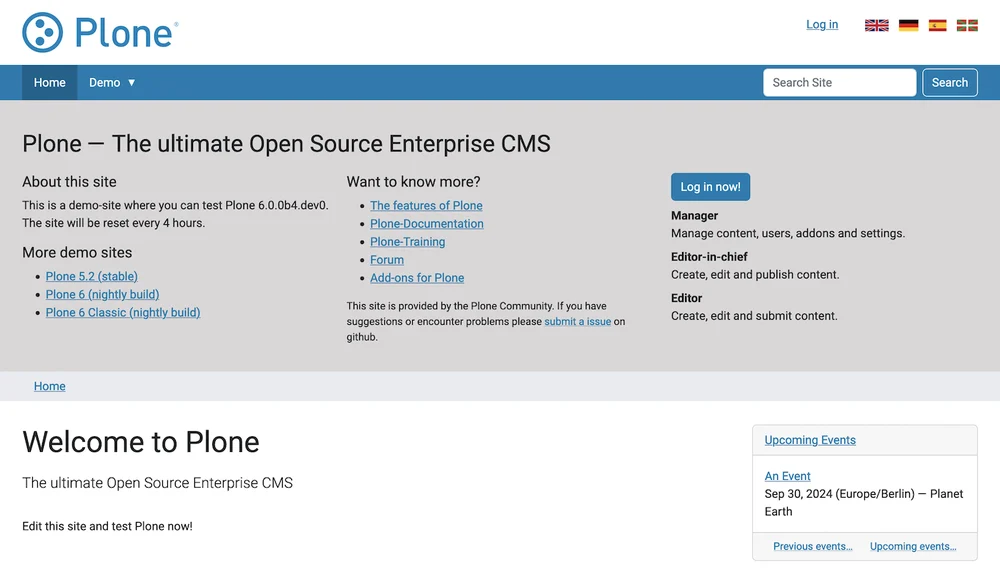
| Trial access | The project provides demo sites for Volto, Blicca, and a Volto Light Theme experience; it also offers installation for local evaluation. Source ↗ |
A proprietary editorial score based on product capabilities, usability, value, performance, support and user sentiment evidence.
The assessment reflects documented CMS, workflow, extensibility, API, deployment, and demo capabilities, plus a small public G2 review sample. Setup and ongoing operation require technical resources.
Methodology v1.0. The assessment weighs feature coverage (25%), ease of use (15%), value for money (20%), performance (15%), support (10%) and user sentiment (15%), using researched product evidence and verified review evidence where available. It is a TechZella editorial assessment, not a direct user-review average.
Key claims are linked to the sources used to verify them. This evidence record is separate from third-party user ratings.
TechZella evaluates software using documented product capabilities, pricing information, usability and value considerations, independent user evidence where available, and competitive context. The assessment is an editorial review, not a hands-on test unless one is explicitly identified. Our editorial assessment is based on 6 documented sources.
The Foundation governance history identifies Alan Runyan and Alex Limi as starting Plone in 1999.
View source ↗Verified 2026-10-12The official site describes the software as open source and says it can be run on premises or in the cloud.
View source ↗Verified 2026-10-12The official documentation describes plone.restapi as a RESTful API, and the project presents Plone as a headless CMS option.
View source ↗Verified 2026-10-12The official tryout page provides separate Plone 6 Volto and Plone 6 Blicca demo sites.
View source ↗Verified 2026-10-12The Foundation's About page identifies it as the legal owner of the codebase, trademarks, and domain names.
View source ↗Verified 2026-10-12The G2 Plone CMS review page displayed the rating and review count when accessed.
View source ↗Verified 2026-10-12Answers begin with the clearest available response, followed by the context that helps you act on it.
No reviews yet. Be the first to share your experience.
Please log in to submit a review.
This history records material data changes detected when TechZella re-researched the profile.