
The Vienna web server stops jobs requiring more than 24 hours or 1 GB of RAM.
Large analyses may need to be resumed locally or run on a separately provisioned machine.
Evidence source ↗
IQ-TREE infers phylogenetic trees from sequence alignments using maximum likelihood, with model selection and branch-support methods.
The feature assessment reflects documented inference, model-selection, simulation, and support methods. Free GPL-licensed software scores strongly on license cost; command-line use adds setup effort. No reliable public review evidence was accessed, so user sentiment is unassessed.
This profile combines documented product information and independent evidence where available. It is not a hands-on test unless TechZella explicitly identifies one.
IQ-TREE is open-source software for inferring phylogenetic trees using maximum likelihood. The project has been developed since 2011 under the GNU GPL version 2.
Researchers can run the command-line program locally or submit alignments through a documented web server. The core workflow supports automatic model selection and branch-support analyses. The Vienna web server has stated resource limits, so larger jobs may require local or separately provisioned computing.
A quick way to understand who this product may suit, where its limits matter, and which facts are most relevant before you compare alternatives.
Researchers and bioinformatics teams that need local or web-based maximum-likelihood phylogenetic inference, model selection, and branch support analysis.
Users who require a graphical desktop workflow, managed compute without job limits, or a general-purpose tree visualization application, and should evaluate alternatives such as RAxML-NG instead.
CLI, Linux, macOS, Web, Windows
7.1/10
These are the product-specific differences that may matter when deciding whether the software fits your workflow. They are based on documented evidence rather than a universal ranking.
These are documented constraints or practical friction points that may matter before you adopt the product.
Large analyses may need to be resumed locally or run on a separately provisioned machine.
Evidence source ↗Users expecting a native graphical desktop application may need training or a separate analysis interface.
Evidence source ↗Freely available under GNU GPL version 2. Local computing resources are provided separately by the user.
Check current pricing →Pricing may change. Verify current plans on the vendor's website.
Compare similar products directly, then see which alternatives may make more sense when your requirements differ.
| Decision factor | IQ-TREE | RAxML-NG |
|---|---|---|
| Core scope | Maximum-likelihood phylogenetic inference with integrated model selection, ultrafast bootstrap, and other analysis methods. | Maximum-likelihood phylogenetic inference with adaptive search heuristics, automatic model selection, and branch-support metrics. Source ↗ |
| License | GNU GPL version 2. | GNU AGPL version 3. Source ↗ |
| Platform and installation | Native 64-bit Windows, macOS, and Linux downloads; command-line use. | Precompiled Linux and macOS binaries; Windows users can use the Linux binary through WSL. Source ↗ |
| Programmatic access | Command-line application plus the piqtree Python library interface. | Command-line application with build-from-source options, including MPI. Source ↗ |
Only factors supported by the available research are shown. The comparison is descriptive, not a ranking.
These products address broadly similar requirements. The descriptions focus on documented reasons a buyer might compare them with IQ-TREE.
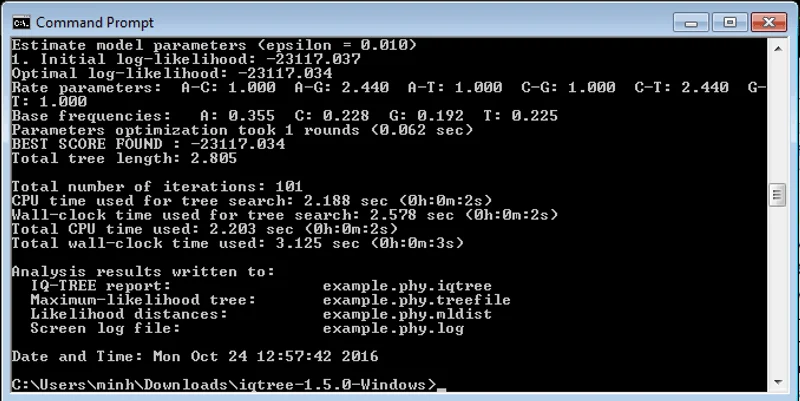
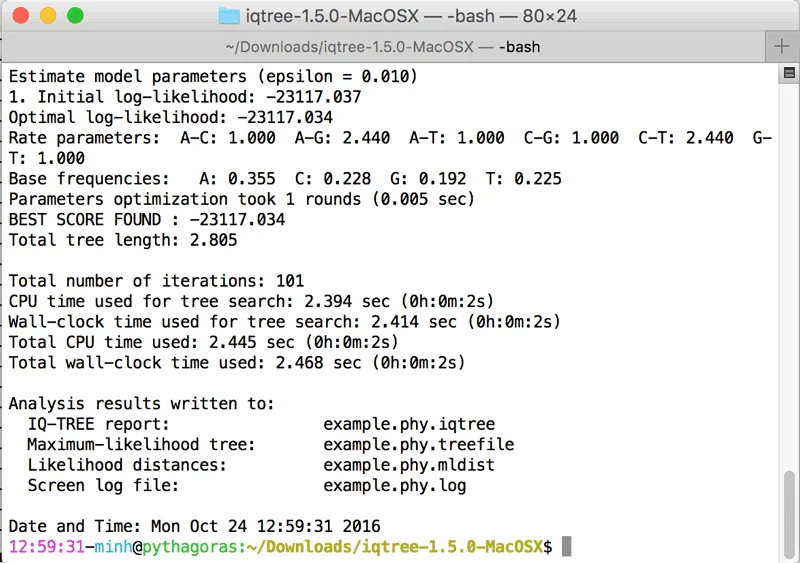
| License | GNU GPL version 2 |
|---|---|
| Native operating systems | Windows, macOS, Linux |
| Primary interface | Command line |
| Web interface | Online inference and model-selection server |
| Data types | DNA, protein, codon, binary, morphological |
| Python interface | piqtree library; cogent3 interface |
| Free trial | Not applicable; software is freely available |
| Web server resource limits | Documented Vienna server: 24 hours CPU time and 1 GB RAM |
Verified installation, hosting, administration, or environment details that can affect implementation.
| Installation or hosting | Download native Windows, macOS, or Linux builds for local command-line execution; an online web server is also documented. Source ↗ |
|---|---|
| License | Open-source software under GNU GPL version 2. Source ↗ |
A proprietary editorial score based on product capabilities, usability, value, performance, support and user sentiment evidence.
The feature assessment reflects documented inference, model-selection, simulation, and support methods. Free GPL-licensed software scores strongly on license cost; command-line use adds setup effort. No reliable public review evidence was accessed, so user sentiment is unassessed.
Methodology v1.0. The assessment weighs feature coverage (25%), ease of use (15%), value for money (20%), performance (15%), support (10%) and user sentiment (15%), using researched product evidence and verified review evidence where available. It is a TechZella editorial assessment, not a direct user-review average.
Key claims are linked to the sources used to verify them. This evidence record is separate from third-party user ratings.
TechZella evaluates software using documented product capabilities, pricing information, usability and value considerations, independent user evidence where available, and competitive context. The assessment is an editorial review, not a hands-on test unless one is explicitly identified. Our editorial assessment is based on 4 documented sources.
The project page gives 2011 as the development start and identifies the GNU GPL license.
View source ↗Verified 2026-11-10The official download page identifies version 3.1.4 and its release date.
View source ↗Verified 2026-11-10The official download page lists 64-bit builds for all three operating systems.
View source ↗Verified 2026-11-10The web server tutorial documents both workflows and supported alignment file formats.
View source ↗Verified 2026-11-10The web server tutorial states these resource thresholds and describes resuming stopped jobs locally.
View source ↗Verified 2026-11-10The project's piqtree repository describes the Python library and examples for tree construction and model selection.
View source ↗Verified 2026-11-10Answers begin with the clearest available response, followed by the context that helps you act on it.
No reviews yet. Be the first to share your experience.
Please log in to submit a review.