
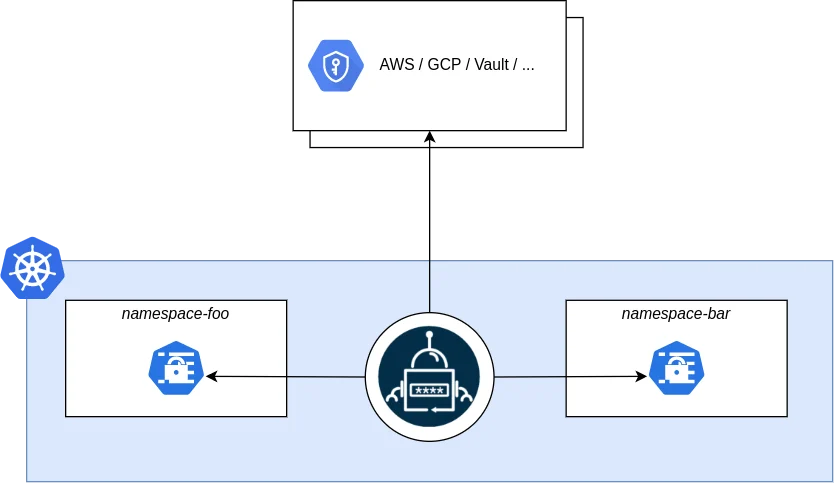
ExternalSecret resources create or update Kubernetes Secret objects.
The external manager remains the source, but secret values also enter the Kubernetes API and are subject to cluster RBAC and storage configuration.
Evidence source ↗An open-source Kubernetes operator that retrieves secrets from external providers and synchronizes them into Kubernetes Secret resources.
The project documents many provider integrations, configurable refresh and lifecycle policies, and a Helm-based Kubernetes deployment. It is free and open source, but requires Kubernetes administration, provider credentials, and buyer-managed upgrades. Public third-party review evidence was not verified, so sentiment and support assessments have lower confidence.
This profile combines documented product information and independent evidence where available. It is not a hands-on test unless TechZella explicitly identifies one.
External Secrets Operator (ESO) connects Kubernetes to external secret management services. It retrieves provider data and makes it available as Kubernetes Secret resources, configured through custom resources such as ExternalSecret and SecretStore.
This design suits teams whose applications already consume Kubernetes Secrets. It also means secret values are represented in the Kubernetes API, so cluster permissions and secret-storage controls remain part of the security design.
A quick way to understand who this product may suit, where its limits matter, and which facts are most relevant before you compare alternatives.
Kubernetes platform and application teams that need to synchronize secrets from supported external managers into Kubernetes Secret resources.
Teams that need secrets mounted directly into containers without creating Kubernetes Secrets, or organizations seeking a managed service and vendor support contract, and should evaluate alternatives such as Secrets Store CSI Driver instead.
API, Cloud, Kubernetes, Self-hosted
7.6/10
These are the product-specific differences that may matter when deciding whether the software fits your workflow. They are based on documented evidence rather than a universal ranking.
These are documented constraints or practical friction points that may matter before you adopt the product.
The external manager remains the source, but secret values also enter the Kubernetes API and are subject to cluster RBAC and storage configuration.
Evidence source ↗Administrators should limit who can change ESO resources and consider scoped RBAC when cluster-wide permissions are unnecessary.
Evidence source ↗Teams should confirm the status of the specific provider they depend on before adopting it in production.
Evidence source ↗Apache-2.0 licensed software. No paid ESO plan is listed; Kubernetes infrastructure and external provider costs are separate.
Check current pricing →Pricing may change. Verify current plans on the vendor's website.
Compare similar products directly, then see which alternatives may make more sense when your requirements differ.
| Decision factor | External Secrets Operator | Secrets Store CSI Driver |
|---|---|---|
| Primary delivery model | Synchronizes data into Kubernetes Secret resources. | Mounts external secrets into pod filesystems through CSI volumes; syncing to Kubernetes Secrets is optional. Source ↗ |
| Application access pattern | Applications can consume the generated Kubernetes Secret using Kubernetes-native secret references. | Applications can read mounted files; Kubernetes Secret synchronization is an additional option. Source ↗ |
| Pricing model | Open-source Apache-2.0 project; no paid ESO plan is listed. | Open-source Kubernetes SIG project; no paid driver plan is listed. Source ↗ |
Only factors supported by the available research are shown. The comparison is descriptive, not a ranking.
These products address broadly similar requirements. The descriptions focus on documented reasons a buyer might compare them with External Secrets Operator.
| License | Apache-2.0 |
|---|---|
| Deployment model | Self-hosted Kubernetes deployment |
| Configuration interface | Kubernetes custom resources |
| Installation method | Helm |
| Project affiliation | CNCF Sandbox |
Verified installation, hosting, administration, or environment details that can affect implementation.
| Installation or hosting | Runs as a deployment in a Kubernetes cluster; the official getting-started guide documents installation through Helm. Source ↗ |
|---|---|
| License | The source repository identifies the project license as Apache-2.0. Source ↗ |
Documented portability, standards, export, or switching considerations. No switching-cost score is shown unless the evidence supports one.
Provider access is configured through SecretStore or ClusterSecretStore resources, while ExternalSecret resources map provider data into Kubernetes Secret keys. Migration requires checking the target provider's capabilities and stability status.
Evidence source ↗A proprietary editorial score based on product capabilities, usability, value, performance, support and user sentiment evidence.
The project documents many provider integrations, configurable refresh and lifecycle policies, and a Helm-based Kubernetes deployment. It is free and open source, but requires Kubernetes administration, provider credentials, and buyer-managed upgrades. Public third-party review evidence was not verified, so sentiment and support assessments have lower confidence.
Methodology v1.0. The assessment weighs feature coverage (25%), ease of use (15%), value for money (20%), performance (15%), support (10%) and user sentiment (15%), using researched product evidence and verified review evidence where available. It is a TechZella editorial assessment, not a direct user-review average.
Key claims are linked to the sources used to verify them. This evidence record is separate from third-party user ratings.
TechZella evaluates software using documented product capabilities, pricing information, usability and value considerations, independent user evidence where available, and competitive context. The assessment is an editorial review, not a hands-on test unless one is explicitly identified. Our editorial assessment is based on 6 documented sources.
The official introduction describes ESO as a Kubernetes operator and identifies ExternalSecret, SecretStore, and ClusterSecretStore resources.
View source ↗Verified 2026-11-24The stability page lists provider integrations and assigns each a support level, including stable classifications for these named providers.
View source ↗Verified 2026-11-24The API documentation describes explicit key mapping, fetching values from provider APIs, templates, and refresh policies.
View source ↗Verified 2026-11-24The getting-started guide describes the operator as a Kubernetes deployment and provides a Helm installation method.
View source ↗Verified 2026-11-24The security guide notes the controller's broad secret access and recommends restricting resource access, using scoped RBAC where appropriate, and limiting network traffic.
View source ↗Verified 2026-11-24The CNCF project page gives the acceptance date and maturity level.
View source ↗Verified 2026-11-24Answers begin with the clearest available response, followed by the context that helps you act on it.
No reviews yet. Be the first to share your experience.
Please log in to submit a review.