
Company licenses are sold in packs of five seats.
A team needing fewer seats may still have to purchase the minimum company pack.
Evidence source ↗
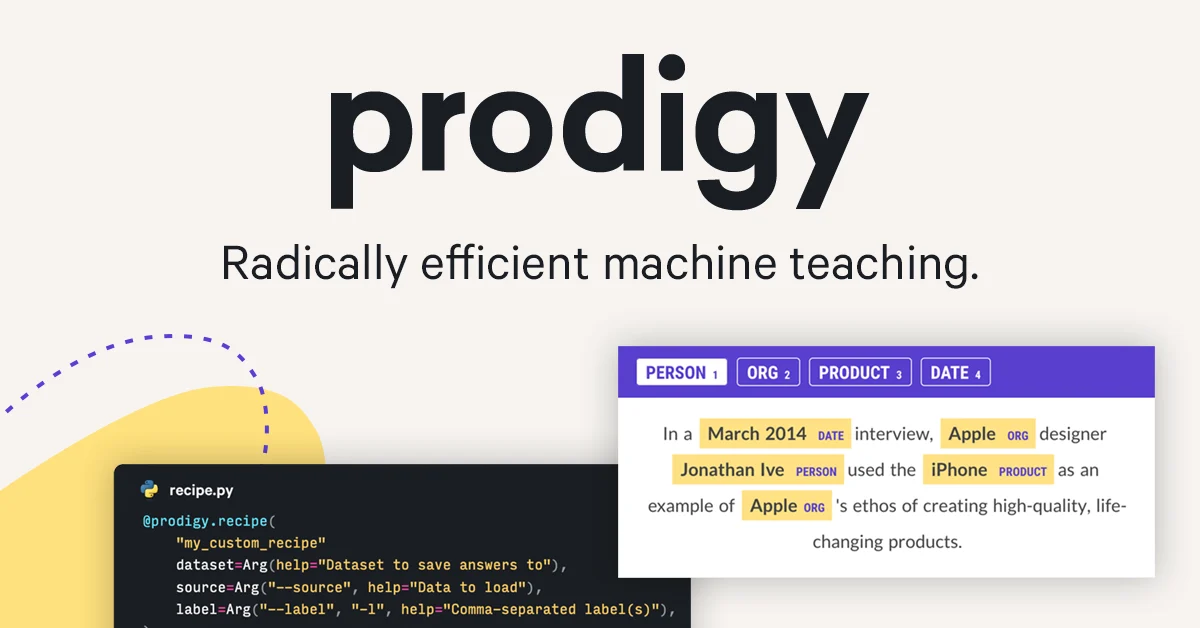
Prodigy is a self-hosted annotation tool for creating and reviewing machine-learning training data across text, images, audio, and video.
Scores reflect published functionality, licensing terms, documentation, and deployment options, not hands-on testing. Public review evidence was insufficient to assess user sentiment.
This profile combines documented product information and independent evidence where available. It is not a hands-on test unless TechZella explicitly identifies one.
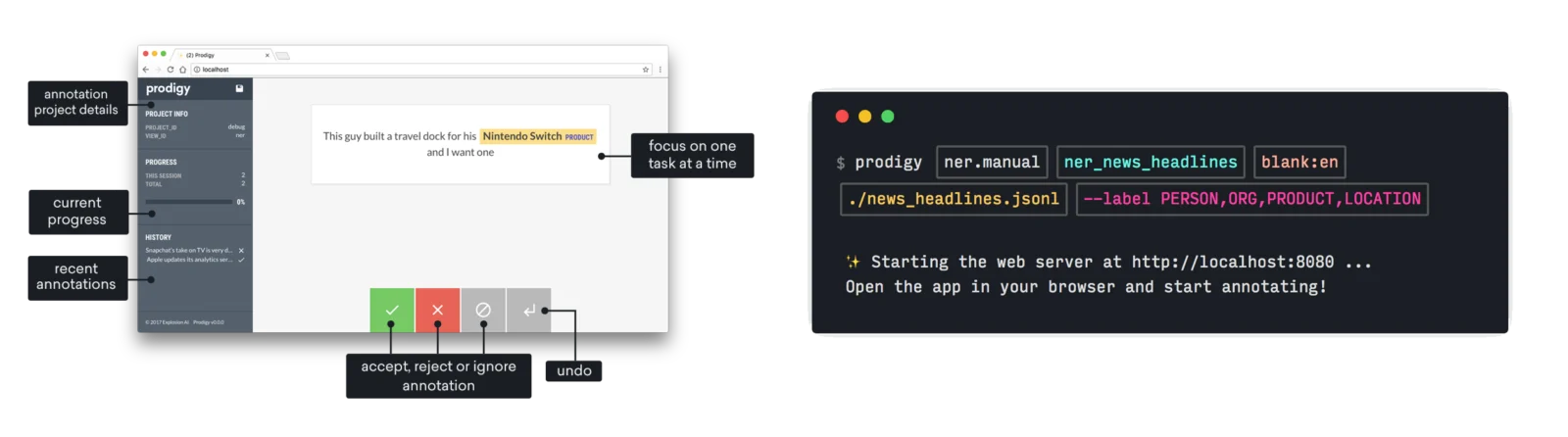
Prodigy is a developer-oriented annotation tool from Explosion, released in 2017. It helps teams create training and evaluation data for machine-learning projects, using a web interface and configurable workflows.
The product runs on the buyer’s hardware rather than requiring a vendor-hosted workspace. Its use of Python recipes and a command-line interface suits teams that want to connect annotation tasks with their own data and models.
A quick way to understand who this product may suit, where its limits matter, and which facts are most relevant before you compare alternatives.
Developers and research teams building custom machine-learning datasets who want local data handling, programmable annotation workflows, and model-assisted labeling.
Teams seeking a turnkey hosted annotation service or a tool that requires no Python or command-line familiarity may prefer another approach, and should evaluate alternatives such as Label Studio or doccano instead.
CLI, Linux, macOS, Web, Windows
6.6/10
These are the product-specific differences that may matter when deciding whether the software fits your workflow. They are based on documented evidence rather than a universal ranking.
These are documented constraints or practical friction points that may matter before you adopt the product.
A team needing fewer seats may still have to purchase the minimum company pack.
Evidence source ↗Teams should plan media storage and backups so annotation records retain access to the referenced source files.
Evidence source ↗Individual buyers should use the online interface demo or contact the vendor about a trial license.
Evidence source ↗Personal lifetime license with 12 months of upgrades, the installer, web application, plugins, basic HTTP authentication, and community forum support.
Check current pricing →Company lifetime license sold in packs of five seats. Includes 12 months of upgrades, HTTP authentication, OpenID Connect SSO, priority forum and email support, and transferable seats within the company.
Check current pricing →Pricing may change. Verify current plans on the vendor's website.
Compare similar products directly, then see which alternatives may make more sense when your requirements differ.
| Decision factor | Prodigy | Label Studio | doccano |
|---|---|---|---|
| Core scope | Annotation workflows for text, images, audio, video, and other machine-learning data. | Annotation for text, images, audio, video, time series, and multimodal data. Source ↗ | Open-source text labeling for classification, sequence labeling, and sequence-to-sequence tasks. Source ↗ |
| Deployment model | Standalone, self-hosted backend running on the buyer’s machine or infrastructure. | Community Edition is open source; paid editions include Starter Cloud and Enterprise, with Enterprise also available on-premises. Source ↗ | Self-installed using Python or Docker, with Docker Compose also documented. Source ↗ |
| API and workflow integration | REST API plus custom Python recipes for data processing and model-in-the-loop annotation. | API and Python SDK support importing data, exporting annotations, connecting machine-learning backends, and syncing cloud storage. Source ↗ | REST APIs let scripts and machine-learning models interact with annotation projects. Source ↗ |
| Pricing model | One-time lifetime license: $390 Personal, or $490 per seat in five-seat Company packs; 12 months of upgrades included. | Community Edition is open source; paid Starter Cloud and Enterprise editions are also offered. Source ↗ | Open-source software available under the project’s public repository. Source ↗ |
Only factors supported by the available research are shown. The comparison is descriptive, not a ranking.
These products address broadly similar requirements. The descriptions focus on documented reasons a buyer might compare them with Prodigy.
| Deployment | Standalone, self-hosted |
|---|---|
| Operating systems | macOS, Linux, Windows |
| Runtime | Python 3.8+ |
| Interface | Web application operated through command-line recipes |
| API | REST API with interactive documentation |
| Databases | SQLite, MySQL, PostgreSQL, or custom storage |
| Data export | JSON and other supported formats |
| Free trial | Online interface demo; hosted trials available to organizations by request |
| License updates | 12 months of upgrades included with purchase |
Verified installation, hosting, administration, or environment details that can affect implementation.
| Installation or hosting | Installed on Python 3.8+ for macOS, Linux, or Windows; the annotation backend is standalone and self-hosted. Source ↗ |
|---|---|
| Local data handling | The vendor describes Prodigy as running on the buyer’s hardware, without requiring data to leave the buyer’s servers. Source ↗ |
Documented portability, standards, export, or switching considerations. No switching-cost score is shown unless the evidence supports one.
Existing annotations can be imported with db-in; db-out exports data, including JSON-compatible formats.
Evidence source ↗SQLite is the default; MySQL, PostgreSQL, and custom storage solutions are also supported.
Evidence source ↗A proprietary editorial score based on product capabilities, usability, value, performance, support and user sentiment evidence.
Scores reflect published functionality, licensing terms, documentation, and deployment options, not hands-on testing. Public review evidence was insufficient to assess user sentiment.
Methodology v1.0. The assessment weighs feature coverage (25%), ease of use (15%), value for money (20%), performance (15%), support (10%) and user sentiment (15%), using researched product evidence and verified review evidence where available. It is a TechZella editorial assessment, not a direct user-review average.
Key claims are linked to the sources used to verify them. This evidence record is separate from third-party user ratings.
TechZella evaluates software using documented product capabilities, pricing information, usability and value considerations, independent user evidence where available, and competitive context. The assessment is an editorial review, not a hands-on test unless one is explicitly identified. Our editorial assessment is based on 5 documented sources.
Explosion’s company update states that it released Prodigy in 2017.
View source ↗Verified 2026-11-12The pricing page lists $390 for a Personal license and $490 per seat in five-seat Company packs, each including 12 months of upgrades.
View source ↗Verified 2026-11-12The vendor lists annotation recipes and interfaces for text, images, audio, and video.
View source ↗Verified 2026-11-12The database documentation describes SQLite as the default and documents MySQL, PostgreSQL, and custom storage options.
View source ↗Verified 2026-11-12The API documentation describes REST endpoints and interactive API documentation.
View source ↗Verified 2026-11-12The audio and video documentation describes transcription, classification, speaker diarization, and timestamped region annotation workflows.
View source ↗Verified 2026-11-12Answers begin with the clearest available response, followed by the context that helps you act on it.
No reviews yet. Be the first to share your experience.
Please log in to submit a review.