
The standalone quickstart uses SQLite and is not intended for production.
Production buyers need to plan a suitable metadata database and deployment architecture rather than treating the local setup as a production template.
Evidence source ↗
Apache Airflow is open-source software for authoring, scheduling, and monitoring Python-defined workflows, including data pipelines and machine-learning workloads.
The assessment reflects Airflow's Python workflow model, provider ecosystem, deployment options, official technical constraints, and a small public Capterra review sample. Self-management requirements temper ease and support assessments.
This profile combines documented product information and independent evidence where available. It is not a hands-on test unless TechZella explicitly identifies one.
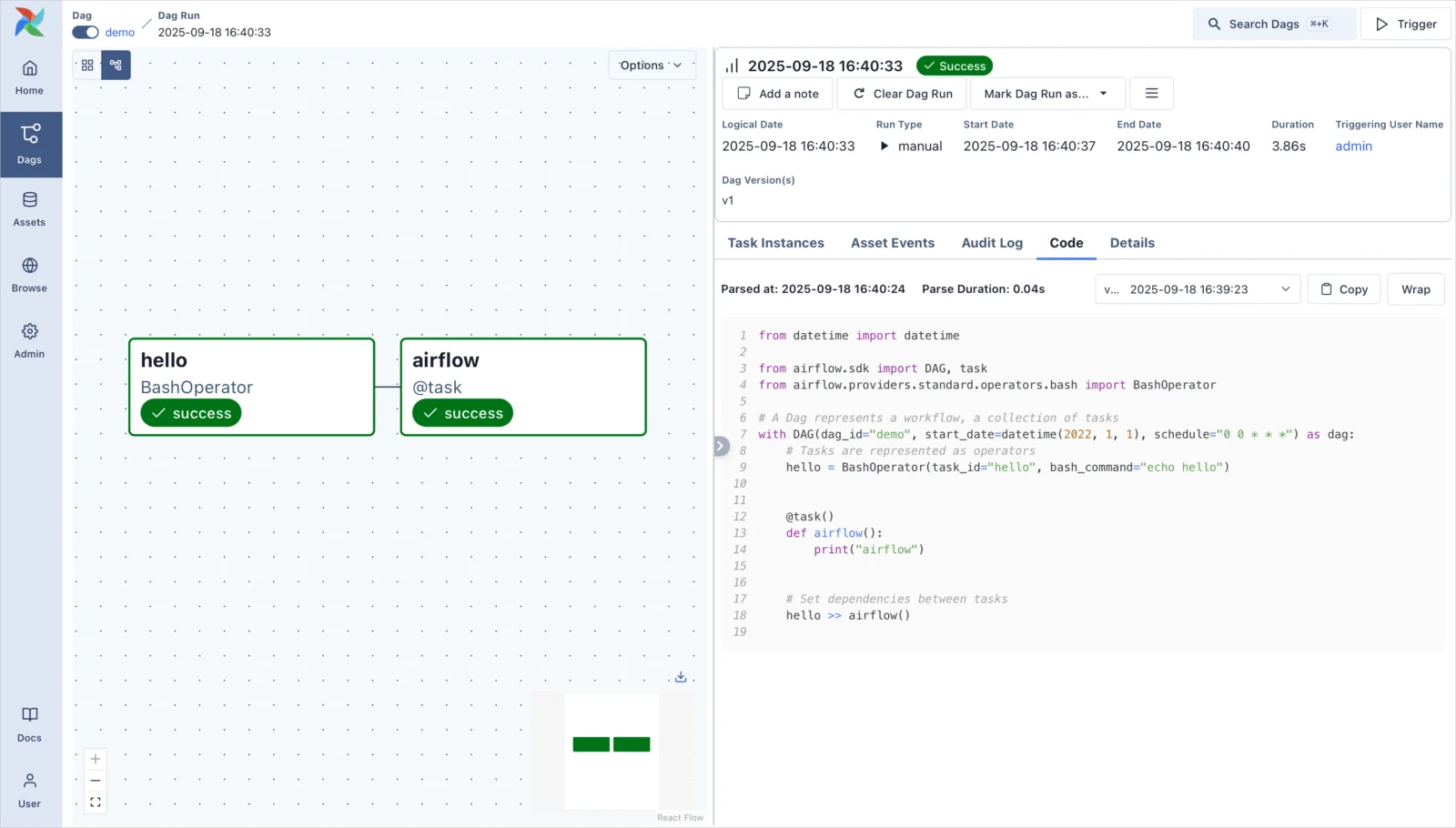
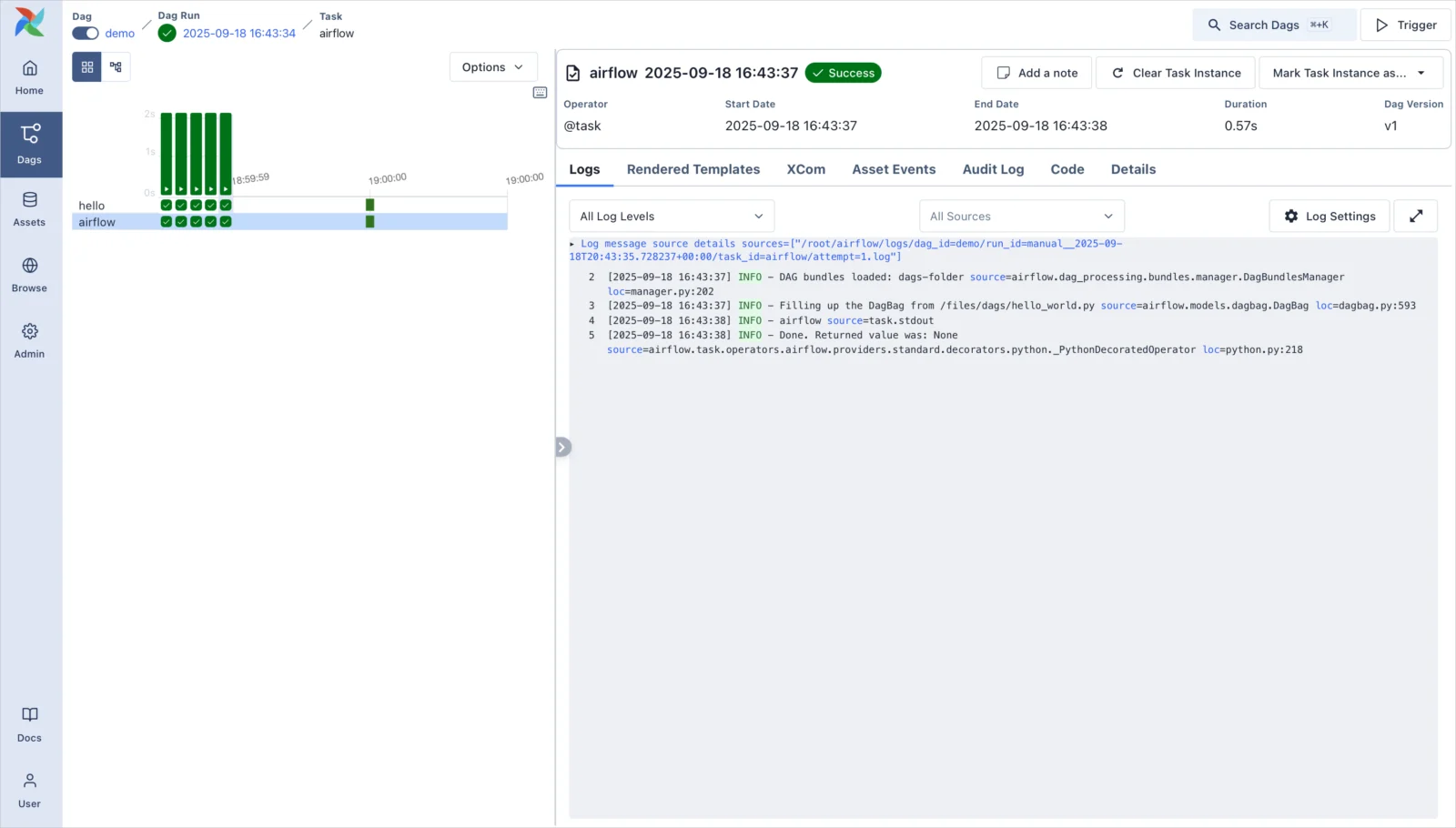
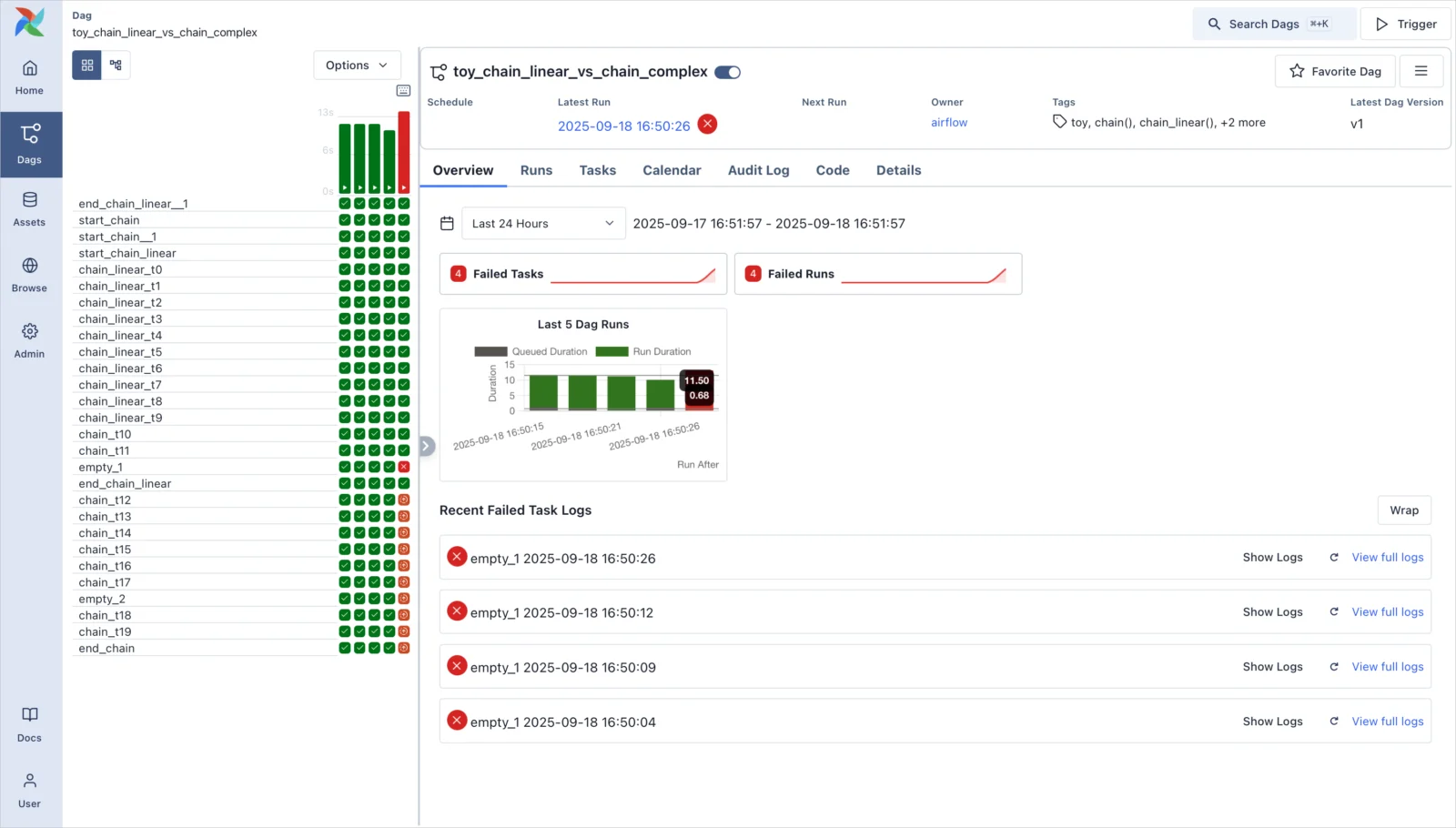
Apache Airflow is an open-source platform for authoring, scheduling, and monitoring workflows. Teams define workflows in Python as directed acyclic graphs, then use the web interface to view runs and troubleshoot tasks.
It is used for scheduled or event-triggered batch pipelines, machine-learning workloads, and other Python-orchestrated processes. The project offers installation and deployment choices, but production operators remain responsible for infrastructure and configuration unless they choose a separate managed service.
A quick way to understand who this product may suit, where its limits matter, and which facts are most relevant before you compare alternatives.
Technical teams that want Python-defined workflow orchestration, control over deployment, and provider integrations across data and cloud services.
Teams seeking a turnkey hosted service without responsibility for production infrastructure, dependency management, upgrades, and monitoring may prefer a managed offering, and should evaluate alternatives such as Prefect or Dagster instead.
Docker, Kubernetes, Linux, Python, Self-hosted
8.1/10
These are the product-specific differences that may matter when deciding whether the software fits your workflow. They are based on documented evidence rather than a universal ranking.
These are documented constraints or practical friction points that may matter before you adopt the product.
Production buyers need to plan a suitable metadata database and deployment architecture rather than treating the local setup as a production template.
Evidence source ↗Teams still running Airflow 2 should account for the published end-of-life status when planning upgrades and maintenance.
Evidence source ↗Existing Python environments and database choices need compatibility checks before installation or upgrade.
Evidence source ↗Open-source software. Self-hosting, infrastructure, and external service costs are separate.
Check current pricing →Pricing may change. Verify current plans on the vendor's website.
Compare similar products directly, then see which alternatives may make more sense when your requirements differ.
| Decision factor | Apache Airflow | Dagster+ | Prefect Cloud |
|---|---|---|---|
| Workflow model | Defines workflows as Python DAGs, with tasks and dependencies. | Supports asset-based and workflow-based orchestration, with asset lineage and metadata features in its plans. Source ↗ | Uses Python flows and tasks, including a flow decorator and deployment workflows. Source ↗ |
| Deployment model | The Apache project provides software for self-managed deployments; users operate production infrastructure. | Dagster+ offers a hosted instance and supports hybrid deployments, with plan-specific capabilities. Source ↗ | Offers a managed cloud control plane with hybrid workers or managed serverless execution. Source ↗ |
| Published pricing | The open-source Airflow distribution is available without a software license fee; hosting and operations are separate. | Dagster+ lists Solo at $10 per month plus $0.040 per credit; serverless compute has a separate per-minute charge. Source ↗ | Prefect Cloud lists a free Hobby tier and paid plans, including Starter at $100 per month. Source ↗ |
Only factors supported by the available research are shown. The comparison is descriptive, not a ranking.
These products address broadly similar requirements. The descriptions focus on documented reasons a buyer might compare them with Apache Airflow.
| License | Apache License 2.0 |
|---|---|
| Workflow definition | Python |
| API | Public REST API; Airflow 3 API endpoints use /api/v2 |
| Production operating system | Linux-based distributions |
| Windows support | WSL2 or Linux containers; not documented as a supported production OS |
| Python versions | 3.11, 3.12, 3.13, and 3.14 for Airflow 3.4.0 |
| Metadata databases | PostgreSQL 14–18, MySQL 8.0/8.4/Innovation, or SQLite for development and testing; MariaDB is not supported |
| Deployment | Self-managed; pip, Docker, and official Helm chart options |
| Providers | Separate packages add integrations and capabilities |
| Onboarding | Official standalone quickstart for local development and testing; not for production |
Verified installation, hosting, administration, or environment details that can affect implementation.
| Installation or hosting | Self-managed installation is available through pip, Docker, and an official Helm chart. The standalone quickstart is for local development and testing. Source ↗ |
|---|---|
| Production operating system | Linux-based distributions are the documented supported production environment. Windows users can run Airflow through WSL2 or Linux containers. Source ↗ |
Documented portability, standards, export, or switching considerations. No switching-cost score is shown unless the evidence supports one.
The published lifecycle marks Airflow 2.11.2 as end of life on April 22, 2026, and Airflow 3.4.0 as the current version.
Evidence source ↗Airflow documents version-specific constraint files to keep installed Python dependencies compatible with the selected Airflow release.
Evidence source ↗A proprietary editorial score based on product capabilities, usability, value, performance, support and user sentiment evidence.
The assessment reflects Airflow's Python workflow model, provider ecosystem, deployment options, official technical constraints, and a small public Capterra review sample. Self-management requirements temper ease and support assessments.
Methodology v1.0. The assessment weighs feature coverage (25%), ease of use (15%), value for money (20%), performance (15%), support (10%) and user sentiment (15%), using researched product evidence and verified review evidence where available. It is a TechZella editorial assessment, not a direct user-review average.
Key claims are linked to the sources used to verify them. This evidence record is separate from third-party user ratings.
TechZella evaluates software using documented product capabilities, pricing information, usability and value considerations, independent user evidence where available, and competitive context. The assessment is an editorial review, not a hands-on test unless one is explicitly identified. Our editorial assessment is based on 7 documented sources.
The official documentation describes Airflow as an open-source workflow platform and identifies batch data pipelines and machine-learning workloads as examples.
View source ↗Verified 2026-11-11The documentation describes its workflows-as-code approach and Python-defined DAGs.
View source ↗Verified 2026-11-11The official release notes list Airflow 3.4.0 with its release date.
View source ↗Verified 2026-11-11The prerequisites page identifies Linux-based distributions as the supported production environment and describes the Windows workarounds.
View source ↗Verified 2026-11-11The public API reference documents REST endpoints and API authentication.
View source ↗Verified 2026-11-11The official provider documentation describes provider packages and lists integrations including Amazon, Google, Microsoft Azure, GitHub, Slack, and Salesforce.
View source ↗Verified 2026-11-11The official supported-versions page lists its lifecycle status and end-of-life date.
View source ↗Verified 2026-11-11The public Capterra review page displayed the aggregate rating and review count when accessed.
View source ↗Verified 2026-11-11Answers begin with the clearest available response, followed by the context that helps you act on it.
/api/v2.No reviews yet. Be the first to share your experience.
Please log in to submit a review.