
Maple Proxy supports selected OpenAI-compatible endpoints rather than the full OpenAI API.
Check whether the connected client depends on unsupported endpoints before migrating its model provider.
Evidence source ↗
Maple is a private AI chat and team workspace with desktop apps and an OpenAI-compatible proxy. It offers free and paid plans, with API use billed separately by model.
Official documentation verifies chat, team plans, apps, and a local API proxy. Public review evidence was insufficient to assess user sentiment or support quality.
This profile combines documented product information and independent evidence where available. It is not a hands-on test unless TechZella explicitly identifies one.
Maple is a private AI product from Maple Privacy Labs Inc., with chat, team-workspace, and developer-proxy offerings. The company describes on-device message encryption and hardware-isolated processing, and publishes code and verification materials for its privacy claims.
Maple’s apps cover mobile, desktop, and web. Developers can use Maple Proxy with compatible tools, but its API reference lists unsupported OpenAI API families, so compatibility needs checking before adoption.
A quick way to understand who this product may suit, where its limits matter, and which facts are most relevant before you compare alternatives.
Individuals and teams seeking AI chat or developer-tool access to open-weight models, with an emphasis on encrypted processing and a published verification path.
Buyers who need a full OpenAI API replacement, because Maple Proxy documents a narrower set of supported endpoints and excludes several API families, and should evaluate alternatives such as ChatGPT or Lumo instead.
Android, iOS, macOS, Web, Windows
7.2/10
These are the product-specific differences that may matter when deciding whether the software fits your workflow. They are based on documented evidence rather than a universal ranking.
These are documented constraints or practical friction points that may matter before you adopt the product.
Check whether the connected client depends on unsupported endpoints before migrating its model provider.
Evidence source ↗A free account may not cover research workflows or developer integrations.
Evidence source ↗Desktop-based integrations may stop working when the app is closed; a dedicated proxy deployment is documented separately.
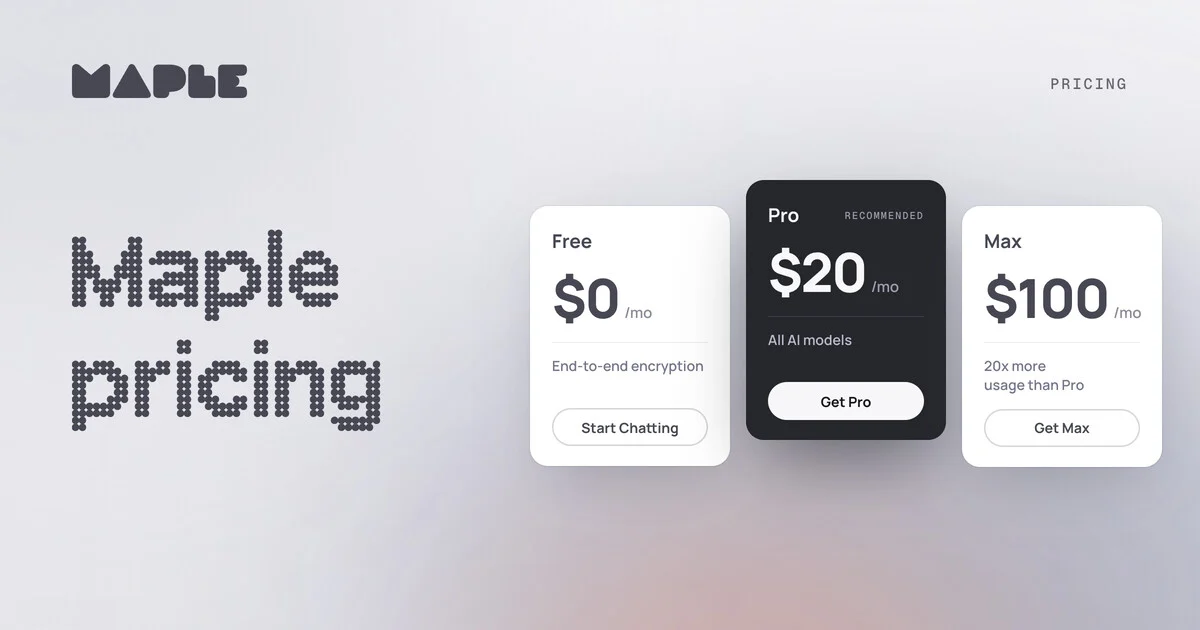
Evidence source ↗Basic AI features and end-to-end encryption; web search is not included.
Check current pricing →Includes access to listed models, app-based image and document uploads, voice recording, and API access. API usage is billed separately.
Check current pricing →Includes Pro features, ten times more usage than Pro, priority support, and early access to features and models.
Check current pricing →Includes Pro features, pooled chat credits, unified billing, and two times more usage per team member.
Check current pricing →Separate input, cached-input, and output rates are listed by model.
Check current pricing →Pricing may change. Verify current plans on the vendor's website.
Compare similar products directly, then see which alternatives may make more sense when your requirements differ.
| Decision factor | Maple | ChatGPT | Lumo |
|---|---|---|---|
| Free and paid plans | Maple lists a free plan, Pro at $20/month, Max at $100/month, and Team at $30/user/month. | ChatGPT Plus is $20/month; ChatGPT also has a Free tier. Source ↗ | Not documented |
| Developer API | Maple Proxy documents chat completions, embeddings, model discovery, and a limited set of other endpoints; API access requires a paid Maple plan. | ChatGPT subscriptions and OpenAI API billing are separate products and billing systems. Source ↗ | Not documented |
| Free plan | Maple Free includes basic AI features and encryption; web search is not included. | Not documented | Lumo's free plan includes basic chat history, web search, and limited file uploads. Source ↗ |
| Privacy and data use | Maple says messages are encrypted on-device, processed in hardware-isolated infrastructure, and not used for model training. | Not documented | Proton says Lumo uses zero-access encryption and does not use chats to train AI. Source ↗ |
Only factors supported by the available research are shown. The comparison is descriptive, not a ranking.
These products address broadly similar requirements. The descriptions focus on documented reasons a buyer might compare them with Maple.




| Apps | iPhone, Android, macOS, Windows, Linux, and Web |
|---|---|
| Linux requirement | Ubuntu 24.04 or later |
| Developer API | OpenAI-compatible Maple Proxy; supported endpoints include chat completions, embeddings, and model discovery |
| API access plans | Pro, Max, and Team |
| API billing | Separate model-specific token pricing |
| Open source | Vendor states that client and server code are public |
Verified installation, hosting, administration, or environment details that can affect implementation.
| Installation or hosting | Maple offers a web app and native apps. Its proxy can run through the desktop app or as a dedicated service using Docker or a release binary. Source ↗ |
|---|---|
| Proxy traffic boundary | The proxy runs locally; traffic between a connected application and the local proxy is plaintext unless protected with TLS and a trusted network boundary. Source ↗ |
Documented portability, standards, export, or switching considerations. No switching-cost score is shown unless the evidence supports one.
Clients that allow a custom OpenAI-compatible base URL can connect to Maple Proxy, subject to endpoint, model-capability, and parameter support.
Evidence source ↗A proprietary editorial score based on product capabilities, usability, value, performance, support and user sentiment evidence.
Official documentation verifies chat, team plans, apps, and a local API proxy. Public review evidence was insufficient to assess user sentiment or support quality.
Methodology v1.0. The assessment weighs feature coverage (25%), ease of use (15%), value for money (20%), performance (15%), support (10%) and user sentiment (15%), using researched product evidence and verified review evidence where available. It is a TechZella editorial assessment, not a direct user-review average.
Key claims are linked to the sources used to verify them. This evidence record is separate from third-party user ratings.
TechZella evaluates software using documented product capabilities, pricing information, usability and value considerations, independent user evidence where available, and competitive context. The assessment is an editorial review, not a hands-on test unless one is explicitly identified. Our editorial assessment is based on 5 documented sources.
The pricing page lists Free, Pro, Max, Team, and model-specific API rates.
View source ↗Verified 2026-11-10The official download page lists iPhone, Android, macOS, Windows, Linux, and web access, and specifies Ubuntu 24.04 or later for Linux.
View source ↗Verified 2026-11-10The API reference lists chat completions, embeddings, and model discovery, and names unsupported API families.
View source ↗Verified 2026-11-10The Teams page lists admin-managed seats, pooled usage, unified billing, MCP connections, and a $30 per-user monthly plan.
View source ↗Verified 2026-11-10The company describes public code, reproducible builds, and enclave attestation as verification mechanisms.
View source ↗Verified 2026-11-10Answers begin with the clearest available response, followed by the context that helps you act on it.
No reviews yet. Be the first to share your experience.
Please log in to submit a review.