Editorial overview
Aggregated Overview
The assessment reflects documented language, provider, automation, state-management, and deployment capabilities, plus G2's displayed aggregate score. It is not based on hands-on testing; user sentiment evidence is limited to the public G2 aggregate and review material.
This profile combines documented product information and independent evidence where available. It is not a hands-on test unless TechZella explicitly identifies one.
Overview
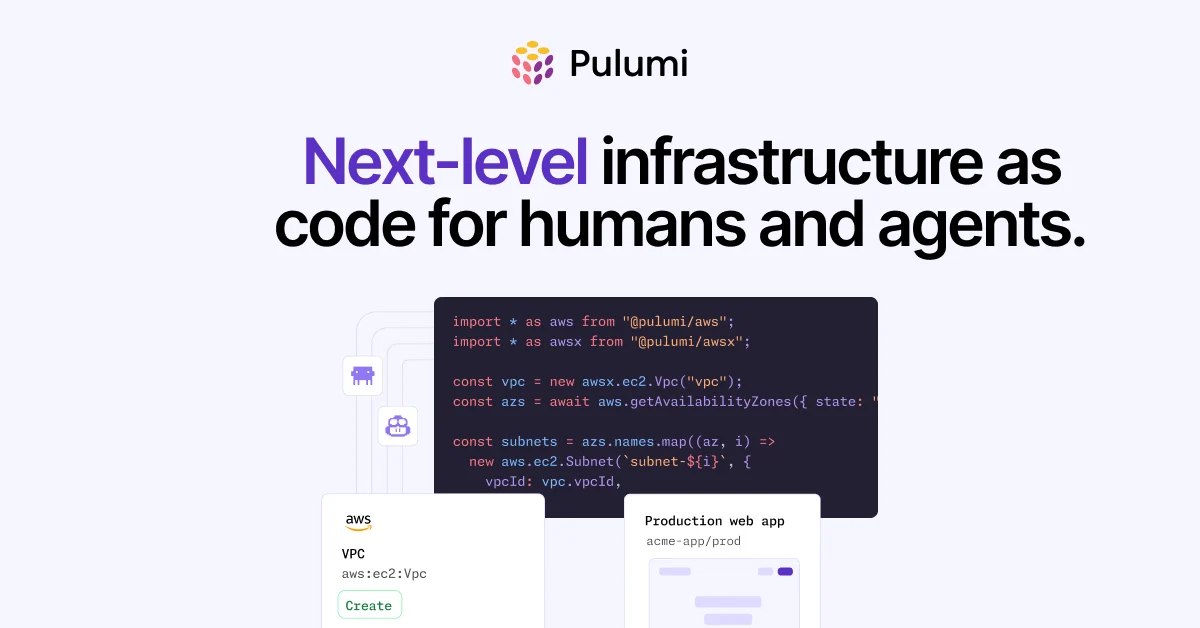
Pulumi is an infrastructure-as-code platform. Users define and manage cloud resources with supported programming languages, YAML, or HCL, then run programs through the Pulumi CLI and deployment engine.
Pulumi Cloud provides managed state, stack coordination, and team features. Teams can instead store state in a self-managed backend, including local storage or supported cloud object storage.
Pulumi Decision Snapshot
A quick way to understand who this product may suit, where its limits matter, and which facts are most relevant before you compare alternatives.
Best suited toPlatform and software teams that want to define cloud infrastructure using familiar programming languages, automate deployments, or introduce infrastructure-as-code workflows incrementally alongside Terraform.
Look elsewhere ifTeams seeking a fully hosted control plane without usage metering, or teams that do not want to maintain programming-language runtimes, cloud credentials, and infrastructure code, should assess the added operational and learning requirements, and should evaluate alternatives such as Terraform or AWS CDK instead.
PlatformsCLI, Cloud, Linux, macOS, Windows
TechZella assessment8.2/10
Pulumi — What Sets It Apart?
These are the product-specific differences that may matter when deciding whether the software fits your workflow. They are based on documented evidence rather than a universal ranking.
- Infrastructure programs can use TypeScript, JavaScript, Python, Go, .NET languages, Java, YAML, or HCL.
- Pulumi supports both a managed Pulumi Cloud backend and self-managed state backends, including local files and cloud object storage.
- Terraform migration paths include coexistence, state and resource import, HCL execution, and code conversion.
- Automation API exposes infrastructure operations through SDKs so applications can run previews, updates, refreshes, and destroys programmatically.
Editorial assessmentPulumi Pros & Cons
Pros
- Supports infrastructure definitions in several general-purpose programming languages, YAML, and HCL.
- Offers both Pulumi Cloud and self-managed state backends.
- Provides multiple documented paths for Terraform coexistence and migration.
- Automation API can embed infrastructure operations in applications and internal tools.
Cons
- Programming-language workflows require maintaining runtimes and their project dependencies.
- Automation API requires the Pulumi CLI at runtime.
- Paid Pulumi Cloud usage can be billed beyond included monthly credits.
- Some enterprise capabilities and self-hosting are edition-dependent.
Pulumi Gotchas & Operational Limits
These are documented constraints or practical friction points that may matter before you adopt the product.
Pulumi Cloud paid editions use credits, and additional usage can be billed after included credits are consumed.
Estimate managed resources, secrets, discovery, workflow minutes, and Neo usage rather than comparing only the monthly base fee.
Evidence source ↗The 14-day all-features trial is for a work organization; a personal organization starts on the free edition.
Buyers evaluating team features should create the appropriate organization type and confirm the trial’s edition boundaries.
Evidence source ↗Automation API still requires the Pulumi CLI at runtime.
Embedding infrastructure operations in an application does not remove the need to package, install, or otherwise provide the CLI.
Evidence source ↗Pulumi Pricing & Plans
Free
$0
month
One user; includes state management, Pulumi Deployments, basic ESC, unlimited projects and stacks, and up to 500 workflow minutes.
Check current pricing →Essentials
$40
month
Includes 40 Pulumi Credits; additional service usage is billed on demand.
Check current pricing →Enterprise
Starting at $2,000
month
Includes 2,000 Pulumi Credits; offers enterprise governance features and self-hosting availability.
Check current pricing →Pricing may change. Verify current plans on the vendor's website.
Cost contextTotal Cost & Hidden Costs
Additional costs or implementation requirements that are documented in the available evidence.
Pulumi Cloud hosting
Hosting is included when using the managed Pulumi Cloud service. Self-managed state instead requires the customer to provide and operate the selected storage backend.
Evidence source ↗Usage beyond plan credits
Paid editions include monthly credits. Usage beyond the included pool is billed in arrears; unused monthly credits expire at the end of the term.
Evidence source ↗Implementation and support
The official pages reviewed do not publish a standard onboarding fee or implementation duration. Optional paid support is separately priced, and self-hosted customers require Platinum support.
Evidence source ↗Pulumi Competitors & Alternatives
Compare similar products directly, then see which alternatives may make more sense when your requirements differ.
At a glance
Cloud InfrastructureOnly factors supported by the available research are shown. The comparison is descriptive, not a ranking.
Direct competitors
These products address broadly similar requirements. The descriptions focus on documented reasons a buyer might compare them with Pulumi.
CapabilitiesPulumi Features
Infrastructure as Code
- Define infrastructure using programming-language SDKs, YAML, or HCL
- Manage resources across cloud and service providers
- Preview, update, refresh, import, and destroy resources
- Reuse components and reference outputs across stacks
Pulumi Cloud
- Managed stack state and update history
- Pulumi Deployments and team collaboration
- Secrets and configuration management
- Policy and governance features vary by edition
Integrations and APIs
- GitHub, GitLab, and Azure DevOps deployment integrations
- Automation API for programmatic infrastructure operations
- Pulumi Cloud REST API and client SDKs
Migration
- Terraform HCL conversion and resource import
- Terraform module use and state coexistence
- Migration guides for CloudFormation, Azure ARM, Kubernetes YAML, and other tools
Pulumi Specifications
| Supported languages and configuration | TypeScript, JavaScript, Python, Go, C#, VB, F#, Java, YAML, and HCL |
|---|
| CLI operating systems | macOS, Linux, and Windows |
|---|
| State backends | Pulumi Cloud, Amazon S3, Azure Blob Storage, Google Cloud Storage, or local filesystem |
|---|
| API | Automation API, Pulumi Cloud REST API, and Pulumi Cloud SDK |
|---|
| Version-control integrations | GitHub, GitLab, and Azure DevOps |
|---|
| Free trial | 14 days for work organizations; no credit card required |
|---|
| Free edition user limit | 1 user |
|---|
| Cloud provider scope | AWS, Azure, Google Cloud, Kubernetes, and additional providers |
|---|
Exit planningMigration & Lock-In
Documented portability, standards, export, or switching considerations. No switching-cost score is shown unless the evidence supports one.
Terraform coexistence
Pulumi documents using Pulumi Cloud as a Terraform state backend, running HCL on the Pulumi engine, and referencing Terraform state from Pulumi programs.
Evidence source ↗Terraform conversion and import
The CLI can convert Terraform HCL and import existing Terraform state; the documentation warns that unsupported conversion features can require manual work.
Evidence source ↗Our evidence-based assessmentTechZella Score
A proprietary editorial score based on product capabilities, usability, value, performance, support and user sentiment evidence.
8.2/10Moderate confidence
The assessment reflects documented language, provider, automation, state-management, and deployment capabilities, plus G2's displayed aggregate score. It is not based on hands-on testing; user sentiment evidence is limited to the public G2 aggregate and review material.
Methodology v1.0. The assessment weighs feature coverage (25%), ease of use (15%), value for money (20%), performance (15%), support (10%) and user sentiment (15%), using researched product evidence and verified review evidence where available. It is a TechZella editorial assessment, not a direct user-review average.
Editorial transparency
Our Review Methodology
Key claims are linked to the sources used to verify them. This evidence record is separate from third-party user ratings.
TechZella evaluates software using documented product capabilities, pricing information, usability and value considerations, independent user evidence where available, and competitive context. The assessment is an editorial review, not a hands-on test unless one is explicitly identified. Our editorial assessment is based on 6 documented sources.
What TechZella adds- Infrastructure programs can use TypeScript, JavaScript, Python, Go, .NET languages, Java, YAML, or HCL.
- Pulumi supports both a managed Pulumi Cloud backend and self-managed state backends, including local files and cloud object storage.
- Terraform migration paths include coexistence, state and resource import, HCL execution, and code conversion.
- Automation API exposes infrastructure operations through SDKs so applications can run previews, updates, refreshes, and destroys programmatically.
Important limitations- Automation API drives the Pulumi CLI under the hood, so the CLI must be available at runtime.
- Pulumi Cloud paid plans meter service usage through credits; usage beyond included credits is billed separately.
- Pulumi’s programming-language approach requires teams to maintain the relevant language runtime and understand its package and project tooling.
Evidence-backed claimsPulumi supports multiple programming languages as well as YAML and HCL.The documentation lists TypeScript and JavaScript, Python, Go, .NET languages, Java, Pulumi YAML, and HCL.
View source ↗Verified 2026-11-07Pulumi Cloud Free is limited to one user and includes state management and Pulumi Deployments.The official pricing page lists one user, state management, Pulumi Deployments, basic ESC, unlimited projects and stacks, and 500 workflow minutes.
View source ↗Verified 2026-11-07The Essentials plan is listed at $40 per month and includes 40 credits.The pricing page lists a $40 monthly base price, 40 included credits, and additional on-demand usage.
View source ↗Verified 2026-11-07Pulumi documents integrations with GitHub, GitLab, and Azure DevOps for deployment workflows.The integrations documentation describes previews and deployment workflows for each of these version-control platforms.
View source ↗Verified 2026-11-07Pulumi Automation API can run Pulumi operations from an application.The documentation describes an SDK interface for previews, updates, refreshes, destroys, stack creation, and related operations.
View source ↗Verified 2026-11-07Pulumi supports gradual adoption from Terraform.The migration guide documents state-backend use, HCL runtime, module reuse, resource import, conversion, and coexistence.
View source ↗Verified 2026-11-07Pulumi offers a 14-day trial for a work organization.The account documentation says a work organization starts a 14-day trial with access to all features and no credit card requirement.
View source ↗Verified 2026-11-07 Independent review sources
Pulumi Ratings & Reviews
Ratings are published by the respective review platforms and may change over time.
Common questionsPulumi FAQs
Answers begin with the clearest available response, followed by the context that helps you act on it.
Does Pulumi have a free plan?
Yes. Pulumi Cloud Free costs $0, supports one user, and includes state management, Pulumi Deployments, basic ESC, unlimited projects and stacks, and up to 500 workflow minutes.
Does Pulumi offer a free trial?
Yes. A work organization starts a 14-day trial with access to all features and no credit card requirement. A personal organization starts on Free.
Can Pulumi use Terraform state and modules?
Yes. Pulumi documents using Pulumi Cloud as a Terraform state backend, referencing Terraform state, using Terraform modules, importing state, and converting HCL.
Does Pulumi require Pulumi Cloud?
No. The CLI can use self-managed backends, including local files, Amazon S3, Azure Blob Storage, and Google Cloud Storage.
Does Pulumi provide an API?
Yes. Automation API runs infrastructure operations from code, while Pulumi Cloud also provides a REST API and client SDKs.
Community feedback
Reviews
No reviews yet. Be the first to share your experience.
Write a Review
Please log in to submit a review.
Recently added Cloud Infrastructure