Quick answer: Reuters is the most transparent FintechZoom alternative in 2026. Bloomberg, Morningstar and MarketWatch come next. For crypto prices, CoinGecko discloses the most. FintechZoom scores about 22 out of 100. Its free stock quotes are delayed 15 minutes, and FintechZoom publishes that figure itself.
Why people look for FintechZoom alternatives
A lot of readers start looking elsewhere because they can’t tell who runs FintechZoom.
We find that ownership is one of the more common questions people have about the site. According to Sandbridge Acquisition, FintechZoom does not publicly disclose a parent company, named editorial leadership, or a verifiable masthead.
Several copycat domains also share its name. Then there’s the data question. Reviewers keep asking how fresh FintechZoom’s prices are, and they don’t agree on the answer.
So we scored 17 alternatives on what they actually disclose. We also gathered every published FintechZoom lag claim we could find.
Key findings
When we finished scoring, seven results stood out:
- FintechZoom’s free stock quotes are delayed, and the site says so. FintechZoom’s own guide says the free tier includes 15-minute delayed quotes.
- Its crypto prices come from a widget. FastBull found that the crypto page credits TradingView for its market module.
- No reviewer has published a timestamped FintechZoom price test. The claims range from a few seconds to about 3 minutes. None of them includes screenshots.
- Hardly any of the 17 alternatives are fully independent. Most belong to public companies, private equity firms, billionaires or exchanges.
- CNBC changed owners in 2026. Versant, a spin-off from Comcast’s NBCUniversal, now owns it.
- An ethics policy doesn’t guarantee independence. CoinDesk has strict staff rules, but its parent company still had an article removed.
- On October 20, the sources we checked agreed within 0.19% on Bitcoin. That gives you a baseline for judging any site’s lag.
How we scored transparency (the 100-point method)
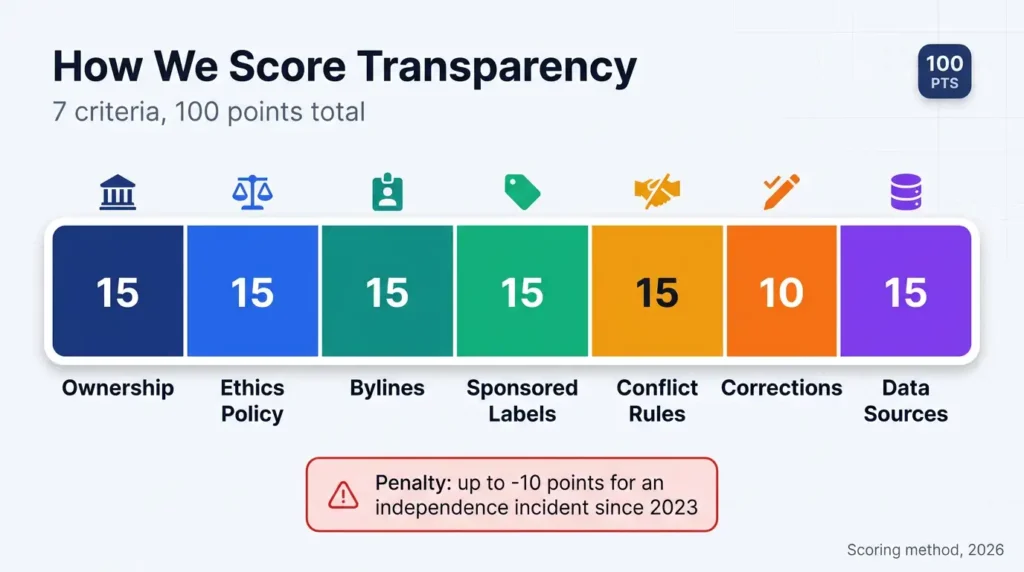
We scored each site on seven disclosures, for 100 points total. A documented independence incident since 2023 costs up to 10 points.
| Criterion | Points | What we looked for |
|---|---|---|
| Ownership disclosed | 15 | A named parent company or owner |
| Editorial or ethics policy | 15 | A public standards page |
| Real bylines | 15 | Named authors with credentials you can check |
| Sponsored labels | 15 | Paid content marked as paid |
| Conflict-of-interest rules | 15 | Rules on staff or contributor holdings |
| Corrections policy | 10 | A public way to fix errors |
| Data sources disclosed | 15 | Where prices come from, and how delayed they are |
| Penalty | -10 | A documented independence incident since 2023 |
How we checked each site
We used the same four steps for every site:
- We read each site’s About, ethics, advertising, and corrections pages.
- We sampled 10 recent articles per site for bylines and labels.
- We searched news reports for ownership changes and controversies.
- We recorded the audit date next to every score.
What this score doesn’t measure
This score doesn’t tell you whose investment calls are right. It also leaves out design and pricing. Data speed gets its own section further down.
Here’s Quick Snap Of The full Scorecard
Reuters leads with 92 points, and FintechZoom trails at about 22. Scores marked * still need a full hands-on audit.
| Rank | Site | Category | Owner | Score | Free? | Best for |
|---|---|---|---|---|---|---|
| 1 | Reuters | Wire news | Thomson Reuters | 92 | Partly | Breaking market news |
| 2 | Bloomberg | Market news | Michael Bloomberg (majority) | 84 | Paywall | Deep coverage |
| 3 | Morningstar | Research | Morningstar Inc. (public) | 84* | Partly | Fund ratings |
| 4 | MarketWatch | Market news | Dow Jones (News Corp) | 83* | Partly | Personal finance |
| 5 | CNBC | Broadcast news | Versant Media | 82 | Partly | Live market TV |
| 6 | Payments Dive | Fintech trade news | Informa TechTarget | 80 | Yes | Payments industry |
| 7 | CoinGecko | Crypto data | Founders (private) | 78 | Yes | Independent crypto prices |
| 8 | Seeking Alpha | Crowd analysis | Private | 74 | Freemium | Stock opinions |
| 9 | Finextra | Fintech trade news | Private | 70* | Yes | B2B fintech |
| 10 | Yahoo Finance | Data portal | Apollo funds (90%) | 68 | Freemium | Free quotes |
| 11 | CoinDesk | Crypto news | Bullish | 66 | Yes | Crypto reporting |
| 12 | Benzinga | Retail news | Beringer Capital (majority) | 62* | Freemium | Fast headlines |
| 13 | The Block | Crypto news | Private | 60 | Partly | Crypto research |
| 14 | INVESTING | Data portal | Private | 60* | Freemium | Economic calendar |
| 15 | CoinMarketCap | Crypto data | Binance | 58 | Yes | New token listings |
| 16 | TradingView | Charting | Private | 55* | Freemium | Technical charts |
| 17 | Finviz | Screener | Private | 50* | Freemium | Stock screening |
| Unranked | FintechZoom | News blog | Not disclosed | ~22 | Yes | A starting point only |
Why FintechZoom scored 22
FintechZoom lost most of its points on sponsored labels, conflict rules, and corrections:
| Criterion | Score | Reason |
|---|---|---|
| Ownership | 3/15 | A London address on LinkedIn, but no named parent company |
| Ethics policy | 3/15 | Only a general disclaimer |
| Bylines | 7/15 | Crypto posts show names and dates, but other sections vary |
| Sponsored labels | 0/15 | Off-topic paid posts with no labels |
| Conflict rules | 0/15 | None found |
| Corrections | 0/10 | None found |
| Data sources | 9/15 | Credits TradingView and mentions a 15-minute delay, but not on every page |
The 17 FintechZoom Alternatives, Ranked
In this list, every section uses the same format, so you can compare them quickly. Each one lists the score, owner, disclosures, red flags, and best use.
1. Reuters: the strongest independence safeguards (92/100)
Reuters has the most formal independence setup on this list. Its Trust Principles date back to 1941. They stop any single interest group from controlling the agency.
A separate company enforces those principles. The Founders Share Company holds a special share that can block ownership grabs.
- Discloses: Owner, trust principles, bylines and corrections.
- Red flag: Its parent company sells data to firms Reuters covers.
- Best for: Neutral, fact-first market headlines.
2. Bloomberg: deep reporting, single owner (84/100)
Bloomberg’s journalism is strong, but one person owns most of the company. Michael Bloomberg holds an estimated 88% stake. Terminal subscriptions bring in most of the revenue.
That ownership has shaped coverage at least twice. NPR reported that in 2013, Bloomberg News killed an investigation into the wealth of Communist Party elites in China, fearful of repercussions from the Chinese government. At the time, Michael Bloomberg denied that the 2013 story was spiked.
The second case came in 2019, when Bloomberg ran for president. CNBC obtained a staff memo in which editor-in-chief John Micklethwait wrote, “We will continue our tradition of not investigating Mike (and his family and foundation)”.
Both incidents fall outside our three-year window, so we didn’t deduct points.
- Red flag: You probably won’t see Bloomberg investigate its owner.
- Best for: Professional-grade company and market coverage.
3. Morningstar: published rating methods (84/100*)
Morningstar is a public company, so it files regular financial reports. It also publishes how its fund ratings work. Its quotes carry a clear “delayed” label and the time they were captured.
- Red flag: It sells data products to the fund companies it rates.
- Best for: Long-term investors comparing funds and ETFs.
4. MarketWatch: Dow Jones standards (83/100*)
MarketWatch belongs to Dow Jones, which also publishes The Wall Street Journal. Its reporters follow the Dow Jones code of conduct.
- Red flag: Personal finance pages carry affiliate links. You can check the disclosure line at the top of the page.
- Best for: Daily market recaps and everyday money questions.
5. CNBC: a new owner in 2026 (82/100)
CNBC is now owned by Versant Media, not Comcast. Versant started operating on January 2, 2026. CNBC adds disclosure lines to stories about its parent company.
- Red flag: Some TV guests own the stocks they’re discussing.
- Best for: Live earnings coverage and market reaction.
6. Payments Dive: clear sponsor labels (80/100)
Payments Dive is the closest match to FintechZoom’s fintech coverage. Informa TechTarget runs it. Webinars and reports carry the sponsor’s name.
- Red flag: It covers business payments, not consumer investing.
- Best for: Fintech professionals following banks and stablecoins.
7. CoinGecko: independent crypto data (78/100)
CoinGecko is the most transparent crypto price source we scored. Two friends founded it in Singapore in 2014. Any change to how it calculates prices now needs approval from a governance forum.
- Red flag: Sources don’t agree on whether it has outside investors.
- Best for: Comparing a coin’s price across many exchanges.
8. Seeking Alpha: pen names with real identities behind them (74/100)
Writers can use pen names, but Seeking Alpha has to know who they are. The site bans paid promotion, and writers must disclose their positions.
The pen-name rule has a history. A Columbia Law study found signs that short-sellers misused pen names on the site between 2010 and 2017. Writers now can’t switch from one pen name to another.
- Best for: Bull and bear arguments on individual stocks.
9. Finextra: B2B fintech news (70/100*)
Finextra works well if you want industry news rather than stock tips. Staff news runs alongside posts from community members.
- Red flag: Some community posts come from vendors. It’s worth checking which section a post is in.
- Best for: Banking technology and deal news.
10. Yahoo Finance: free data under private equity (68/100)
Yahoo Finance is free and popular, but its finances are hard to see. Apollo-managed funds own 90%, and Verizon kept the other 10%. Its quotes do carry a “Delayed Quote” label and a timestamp.
We also spotted a clear affiliate note next to a trading button. FintechZoom’s paid posts don’t carry that kind of label.
- Best for: Quick quotes and watchlists.
11. CoinDesk: strict rules, one recent breach (66/100)
CoinDesk bars its staff from owning shares in pure-play crypto firms. Its journalists don’t write sponsored content either.
The rules didn’t hold in one case. In December 2024, parent company Bullish had an article about Justin Sun removed. Three top editors left days later, so we deducted 10 points.
- Best for: Crypto reporting, ideally read alongside a second source.
12. Benzinga: fast headlines, private equity owner (62/100*)
Benzinga is built for speed and for retail traders. Beringer Capital bought a majority stake in 2021. The deal reportedly valued the company at $300 million.
- Red flag: Some pages include broker offers, so look for the affiliate notes.
- Best for: Pre-market movers.
13. The Block: FTX funding history (60/100)
The Block’s research is solid, but its funding history is worth knowing. In late 2022, it disclosed $27 million in loans from Sam Bankman-Fried.
- Best for: Crypto dashboards. You may also want to check its current governance page.
14. INVESTING: useful calendar, heavy ads (60/100*)
Its economic calendar is one of the best free tools on this list. Broker ads, though, show up on many pages.
- Best for: Forex traders following central bank decisions.
15. CoinMarketCap: owned by an exchange it ranks (58/100)
Binance has owned CoinMarketCap since 2020. That means an exchange-owned site ranks that exchange’s rivals. The 2026 CoinGlass deal raises the same question for derivatives data.
- Best for: Spotting new token listings.
16. TradingView: charts plus user ideas (55/100*)
TradingView is a charting tool, not a newsroom. It also powers the crypto widget on FintechZoom. Users, not staff, write its “Ideas” section.
- Red flag: A user’s trade idea may not mention that user’s own position.
- Best for: Technical analysis and price alerts.
17. Finviz: a screener, not a source of reporting (50/100*)
Finviz collects headlines from other outlets instead of reporting its own. Its screener and heatmaps are excellent, though.
- Best for: Filtering stocks quickly.
Honorable mentions
Five more sites didn’t make the main list, but you may still find them useful:
- Glassnode: On-chain crypto analytics.
- Fintech Takes: Alex Johnson’s newsletter and community.
- FinTech Weekly: Labels every paid piece “Sponsored.”
- CoinGape: Publishes its affiliate and conflict-of-interest policies.
- SECURITIES: Listed by Similarweb as similar to FintechZoom.
Conflict-of-interest timeline
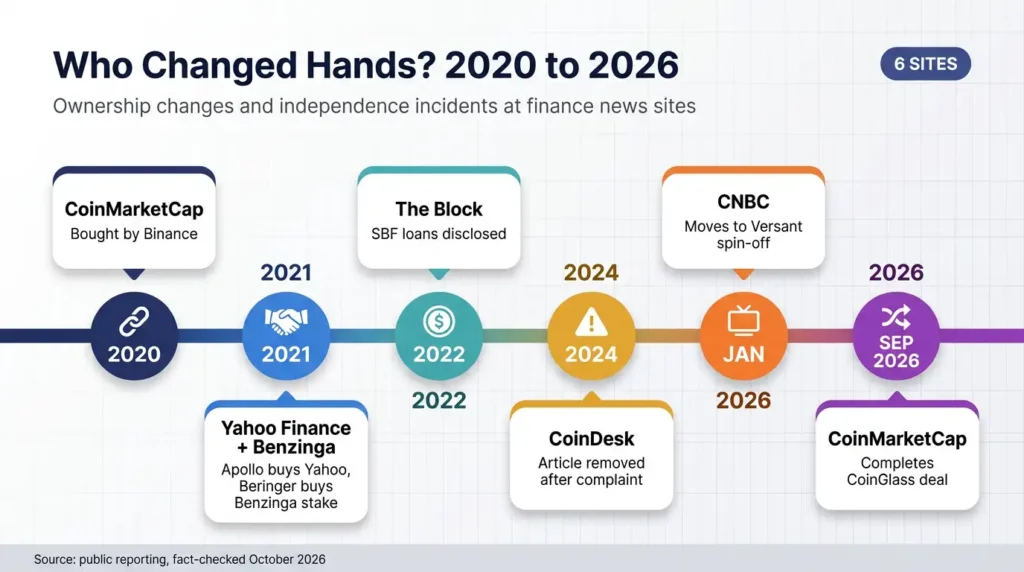
Six of these 17 sites have changed owners or faced independence questions since 2020. Most alternatives lists leave this history out, so we’ve collected it here.
| Year | Event | Site |
|---|---|---|
| 2020 | Binance buys CoinMarketCap | CoinMarketCap |
| 2021 | Apollo buys Yahoo, and Beringer takes a majority stake in Benzinga | Yahoo Finance, Benzinga |
| 2022 | SBF loans to The Block disclosed | The Block |
| 2024 | Article removed after the subject complained | CoinDesk |
| Jan 2026 | CNBC moves to the Versant spin-off | CNBC |
| Sep 2026 | CoinMarketCap completes the CoinGlass deal | CoinMarketCap |
FintechZoom lag test: what reviews report, and what the data shows
FintechZoom’s free stock quotes run 15 minutes behind, and the site says so itself.
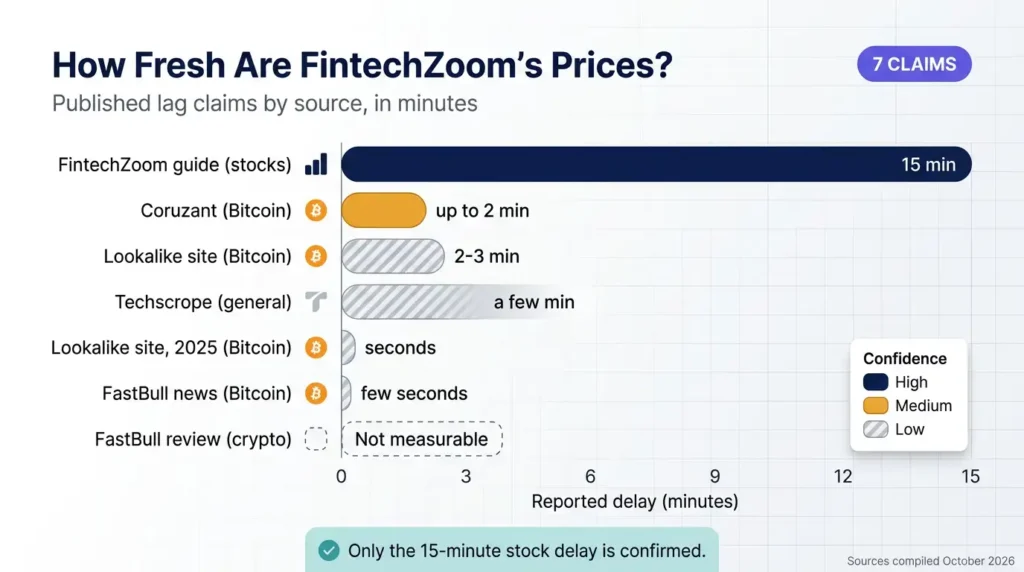
Its crypto prices come from a TradingView widget. Reviewers report delays from a few seconds to about 3 minutes, but none of them published timestamps.
We did this in two steps. First, we collected every published lag claim. Then we set a baseline using timestamped quotes from other sites.
Step 1: Every published FintechZoom lag claim we found
| Source | Date | Asset | Reported lag | Evidence shown | How much weight to give it |
|---|---|---|---|---|---|
| FintechZoom’s own guide | Nov 2025 | Stocks (free tier) | 15 minutes | The site’s own disclosure | High |
| Coruzant | Jan 2026 | Bitcoin | Up to a couple of minutes | Observation, no timestamps | Medium |
| IT | Apr 2026 | Bitcoin | 2 to 3 minutes | “Independent tests,” not named | Low (lookalike domain) |
| Same site, earlier visit | Feb 2025 | Bitcoin | Within seconds of Coinbase | One anecdote | Low |
| FastBull news article | Undated | Bitcoin | Every few seconds | Claim, no test | Low |
| Techscrope | Oct 2026 | General | A few minutes | General statement | Low |
| FastBull review | Aug 2026 | Crypto | Not measurable | Review of methodology | High |
The claims differ in both size and evidence:
- Coruzant reported that FintechZoom’s Bitcoin coverage can trail live prices by a couple of minutes.
- A lookalike site claimed tests showed a 2-to-3-minute delay. The same author said it matched Coinbase within seconds in 2025.
- FastBull’s news desk said the Bitcoin page usually updates every few seconds.
- Techscrope noted that aggregator data can lag live feeds by a few minutes.
- FastBull’s review team didn’t run a test. It said FintechZoom showed no stable, timestamped price to measure.
The only claim with numbers comes from a lookalike domain. It also contradicts itself, so we didn’t give it much weight.
What the stock delay means in dollars
A 15-minute delay is normal for free quote sites.
According to a Nasdaq guide, free portals often lag by 15 to 20 minutes. The delay itself isn’t the problem. The problem is that FintechZoom’s quote pages don’t always mention it.
Apple on October 19 shows the scale. It traded between $340.12 and $346.00, a $5.88 range over a 390-minute session.
If the price had moved evenly, 15 minutes would equal about $0.23. Real prices don’t move evenly, though. Right after the open, a 15-minute-old quote could be off by much more.
Step 2: Our baseline from other sources (October 19 and 20, 2026)
The sources we checked agreed within 0.19% on Bitcoin and matched Apple’s close to the cent. If FintechZoom falls inside that range, the difference is just normal variation.
Bitcoin, morning of October 20
| Source | Price | Time shown |
|---|---|---|
| CoinDesk | $81,462.90 | 10:10 UTC |
| CoinGecko | $81,344.84 | Date only |
| Coinbase | $81,306.97 | Date only |
| FintechZoom | Not captured | No timestamp shown |
- Largest gap: $155.93 (0.19%), between CoinDesk and Coinbase.
- Why prices differ: Coinbase shows only trades on its own exchange. CoinDesk and CoinGecko combine prices from many exchanges.
Apple, October 19 close
| Source | Close | Time label |
|---|---|---|
| Yahoo Finance (via Gotrade) | $342.94 | 4:00 p.m. ET |
| Morningstar | $342.94 | “Delayed Price Closed” |
| STOCKINVEST | $342.94 | End of day |
| Robinhood | $343.00 | Rounded |
| FintechZoom | Not captured | n/a |
Opening prices differed by $0.31. That’s likely because sites define “open” in different ways.
EUR/USD, October 19
| Source | Rate | Time (UTC) |
|---|---|---|
| Moneyswapp | 1.1215 | 08:33 |
| Yahoo Finance | 1.1212 | 09:51 (delayed) |
| Macrotrends | 1.1208 | Daily value |
| INVESTING | 1.1183 | Not shown |
The 0.29% spread most likely reflects the euro’s dip that morning, not bad data. We couldn’t find any review of FintechZoom’s forex prices.
Lag verdict
Only the stock delay is confirmed. The crypto and forex figures are still estimates.
| Asset | FintechZoom lag | Confidence | Normal spread between sources |
|---|---|---|---|
| U.S. stocks (free) | 15 minutes | High (the site’s own disclosure) | $0.00 at the close |
| Bitcoin | Seconds to ~3 minutes | Low (untested claims) | 0.19% |
| Forex | Unknown | None | 0.29% |
What this means for you: FintechZoom works fine for following the news. Before you trade, you may want to check prices with your broker or exchange.
Run the lag test yourself
You can fill in the missing FintechZoom column in about 10 minutes:
- Open FintechZoom, Yahoo Finance, TradingView and CoinGecko in four tabs.
- Pick BTC, AAPL and EUR/USD.
- Refresh all four tabs within a few seconds of each other.
- Take a screenshot that shows your system clock.
- Repeat this five times during U.S. market hours.
- Write down the largest gap for each asset.
If FintechZoom is more than 0.5% away from the others, its feed is probably delayed. A Bitcoin gap under 0.19% is within normal variation.
Which FintechZoom alternative is right for you?
The best pick depends on what you use FintechZoom for now. This table matches each use to a more transparent option.
| If you use FintechZoom for… | Try instead | Why |
|---|---|---|
| Stock news | Reuters or MarketWatch | Clear owners and ethics codes |
| Stock quotes | Yahoo Finance or Morningstar | Delays labeled on each quote |
| Stock research | Morningstar or Seeking Alpha | Published methods or position disclosures |
| Crypto prices | CoinGecko | Published method, no exchange owner |
| Crypto news | CoinDesk plus The Block | Each covers the other’s blind spots |
| Fintech news | Payments Dive or Finextra | Bylined trade reporters |
| Charts | TradingView | It already powers FintechZoom’s crypto widget |
Best for crypto traders
You can compare an exchange-owned source with an independent one. Checking CoinMarketCap against CoinGecko only takes a few seconds.
Best free options
Payments Dive, CoinGecko, Finextra and Yahoo Finance cost nothing to read. Reuters, MarketWatch and CNBC each give you some free articles every month.
How to check any finance site’s transparency in 5 minutes
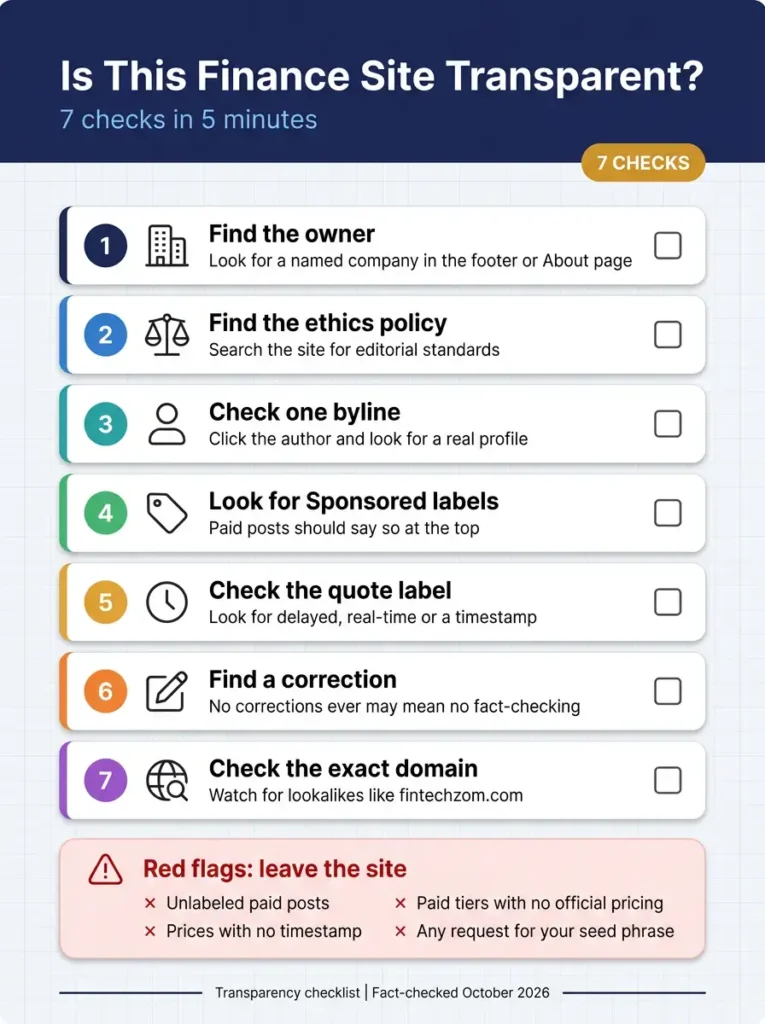
Seven quick checks can show you whether a finance site deserves your trust. You can run them on any site, FintechZoom included.
- Find the owner. Look for a named company in the footer or on the About page.
- Find the ethics policy. You can search the site for “editorial standards.”
- Check one byline. Click an author’s name and see whether there’s a real profile.
- Look for “Sponsored” labels. Paid posts should say so at the top.
- Check the quote label. Look for “delayed,” “real-time” or a timestamp.
- Find a correction. A site that never corrects anything may not be checking its facts.
- Check the exact domain. FastBull notes that FintechZoom has warned readers about lookalike domains.
Red flags that mean you should leave
If you spot any of these, it’s probably time to move on:
- Paid posts with no labels.
- Price pages with no timestamp or data source.
- Paid tiers with no official pricing page. FintechZoom Pro’s $99 and $199 prices, for example, come only from third-party sites.
- Any request for your seed phrase. A legitimate news site won’t ever ask for it.
Our Technical Verdict
For most readers, Reuters for news and CoinGecko for crypto prices make the most transparent pair.
If you work in fintech, you can add Payments Dive. FintechZoom still works as a free headline feed. Its stock quotes lag 15 minutes, though, so check prices somewhere else first.
People Also Ask
-
What is the best FintechZoom alternative in 2026?
Reuters scores highest, at 92 out of 100. For crypto, CoinGecko is the most transparent price source we scored.
-
Are FintechZoom’s prices real-time?
Not for stocks on the free tier. FintechZoom’s own guide lists 15-minute delayed quotes. Reports on crypto lag range from a few seconds to about 3 minutes, and none of them has been verified.
-
Where does FintechZoom get its crypto prices?
According to FastBull, they come from an embedded TradingView module. FastBull didn’t find any public explanation of its delay or how prices are weighted.
-
Does FintechZoom Pro exist?
Yes, FintechZoom’s own guide mentions Pro alerts. The $99 and $199 prices come from third-party sites, not an official pricing page.
-
Is FintechZoom owned by a real company?
It doesn’t name a parent company. LinkedIn does list a London address and a 2017 founding date.
-
Is CoinMarketCap biased toward Binance?
Nobody has proven bias, but the conflict of interest is built in. You may want to cross-check its numbers with CoinGecko.
-
Is GLASSWHEELSTUDIO the same as CASINOONEWS?
No, they’re separate domains. It’s worth checking the exact web address every time.
Final thoughts
No finance site is perfectly neutral. The better ones tell you who owns them and how fresh their prices are. Once you know those two things, you can judge the rest yourself.
A simple setup works for most people: one news source, one quote tool that labels its delays, and one independent crypto tracker. We plan to re-score all 17 sites every quarter and log each change here.
You can download our blank scorecard and audit any site yourself. If you’re worried about fakes, our FintechZoom copycat guide lists the domains to avoid.