
The official FAQ and v3 basics documentation differ on subscription availability.
Merchants who depend on recurring billing should confirm current subscription behavior with Snipcart before implementation.
Evidence source ↗
Snipcart adds a customizable shopping cart and checkout to existing websites through HTML and JavaScript. It provides a hosted merchant dashboard, APIs, and webhooks.
Snipcart documents broad cart, checkout, API, shipping, tax, inventory, and payment capabilities. Its embed-first design suits custom sites but assumes some HTML, CSS, or JavaScript knowledge. Public G2 evidence is limited to four reviews, so sentiment and support assessments have low sample confidence.
This profile combines documented product information and independent evidence where available. It is not a hands-on test unless TechZella explicitly identifies one.
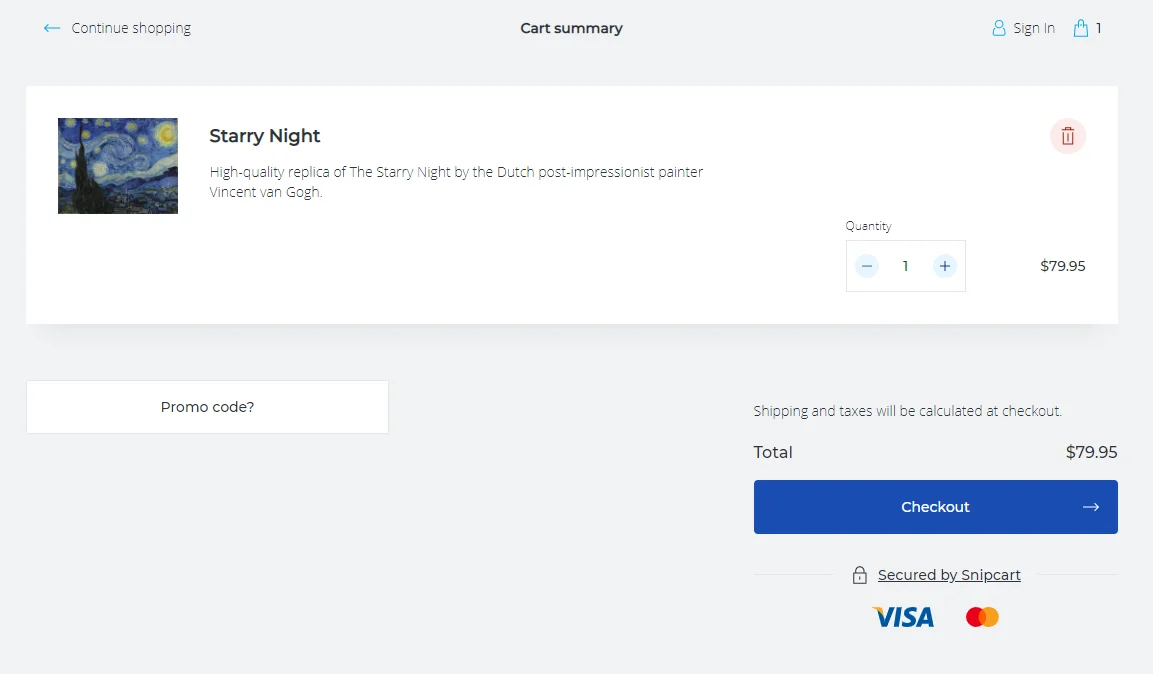
Snipcart is an embeddable shopping cart and checkout for existing websites and web applications. Merchants define products in site HTML, while a hosted dashboard handles store administration and orders.
The product is designed for developer-led storefronts rather than as a complete hosted website builder. Snipcart says its first version launched in August 2013. Its current documentation emphasizes HTML, CSS, and JavaScript as the main implementation skills.
A quick way to understand who this product may suit, where its limits matter, and which facts are most relevant before you compare alternatives.
Developers and agencies adding cart, checkout, and order management to an existing custom website or web application without replacing its frontend.
Merchants seeking a complete hosted store builder with minimal developer involvement may prefer a platform designed to manage the whole storefront. Snipcart's documentation describes the cart as an embedded site component and its merchant dashboard as separately hosted, and should evaluate alternatives such as Shopify Buy Button or WooCommerce instead.
API, REST API, SaaS, Web, Webhooks
7.6/10
These are the product-specific differences that may matter when deciding whether the software fits your workflow. They are based on documented evidence rather than a universal ranking.
These are documented constraints or practical friction points that may matter before you adopt the product.
Merchants who depend on recurring billing should confirm current subscription behavior with Snipcart before implementation.
Evidence source ↗Low-volume stores should account for the minimum and payment processing costs when estimating monthly expense.
Evidence source ↗A merchant relying on FedEx rates may need a custom shipping webhook or another shipping workflow.
Evidence source ↗Free testing environment for development; Snipcart says testing is available without a credit card.
Check current pricing →Billed monthly in USD. Payment gateway fees are additional.
Check current pricing →Pricing may change. Verify current plans on the vendor's website.
Compare similar products directly, then see which alternatives may make more sense when your requirements differ.
These products address broadly similar requirements. The descriptions focus on documented reasons a buyer might compare them with Snipcart.



| Interface | Website-embedded cart and hosted merchant dashboard |
|---|---|
| Integration method | JavaScript snippet and HTML product attributes |
| API | REST API and JavaScript API |
| Webhooks | Available |
| Payment gateways | Stripe, PayPal, Braintree, Mollie, Square, and Authorize.net; custom gateway development available |
| Shipping integrations | USPS, UPS, Purolator, Canada Post, and Australia Post; no new FedEx integrations |
| Test environment | Free test development |
| Billing currency | USD |
| Developer skills | HTML, CSS, and JavaScript knowledge is useful; custom gateways require development experience |
Verified installation, hosting, administration, or environment details that can affect implementation.
| Installation or hosting | The cart is added to a merchant's website through JavaScript and HTML. Snipcart hosts the merchant dashboard separately. Source ↗ |
|---|
Documented portability, standards, export, or switching considerations. No switching-cost score is shown unless the evidence supports one.
Snipcart's FAQ says merchants can request a copy of sensitive personal data associated with an account by contacting the company.
Evidence source ↗A proprietary editorial score based on product capabilities, usability, value, performance, support and user sentiment evidence.
Snipcart documents broad cart, checkout, API, shipping, tax, inventory, and payment capabilities. Its embed-first design suits custom sites but assumes some HTML, CSS, or JavaScript knowledge. Public G2 evidence is limited to four reviews, so sentiment and support assessments have low sample confidence.
Methodology v1.0. The assessment weighs feature coverage (25%), ease of use (15%), value for money (20%), performance (15%), support (10%) and user sentiment (15%), using researched product evidence and verified review evidence where available. It is a TechZella editorial assessment, not a direct user-review average.
Key claims are linked to the sources used to verify them. This evidence record is separate from third-party user ratings.
TechZella evaluates software using documented product capabilities, pricing information, usability and value considerations, independent user evidence where available, and competitive context. The assessment is an editorial review, not a hands-on test unless one is explicitly identified. Our editorial assessment is based on 7 documented sources.
A Snipcart article states that the product launched in 2013; an interview on Snipcart's site identifies the first version launch as August 2013.
View source ↗Verified 2026-10-10The v3 documentation describes a JavaScript snippet and HTML product attributes on the site, with the dashboard hosted on Snipcart's servers.
View source ↗Verified 2026-10-10The current pricing page lists the sales-based fee and minimum, plus separate payment gateway fees.
View source ↗Verified 2026-10-10Documentation lists Stripe, PayPal, Braintree, Mollie, Square, and Authorize.net.
View source ↗Verified 2026-10-10The product API page describes REST API, JavaScript API, and webhooks for connecting storefront and business systems.
View source ↗Verified 2026-10-10The release notes describe a March 30, 2026 MCP server release, with tools for store operations and support for several AI development clients.
View source ↗Verified 2026-10-10The accessible G2 product review page displayed a 4.4 rating and four reviews.
View source ↗Verified 2026-10-10Answers begin with the clearest available response, followed by the context that helps you act on it.
No reviews yet. Be the first to share your experience.
Please log in to submit a review.
This history records material data changes detected when TechZella re-researched the profile.