Editorial overview
Aggregated Overview
The documented sidecar combines protocol-aware rules, response masking, auditing, and optional centralized management. The open-source tier is free, while Enterprise pricing is quoted. Performance and sentiment scores have limited independent evidence.
This profile combines documented product information and independent evidence where available. It is not a hands-on test unless TechZella explicitly identifies one.
Overview
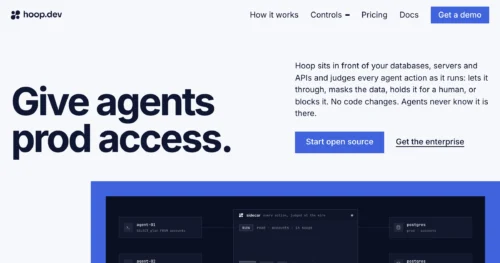
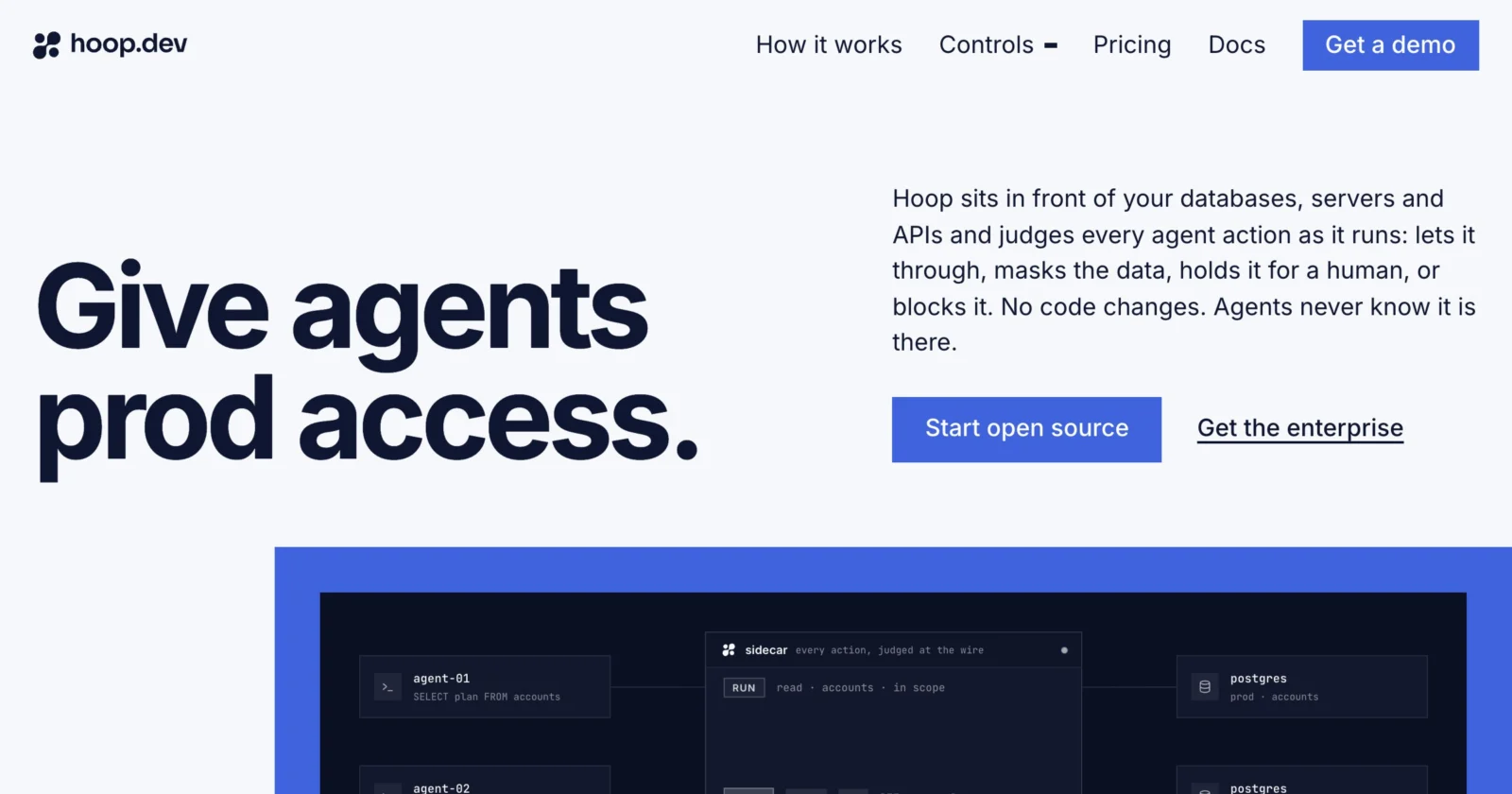
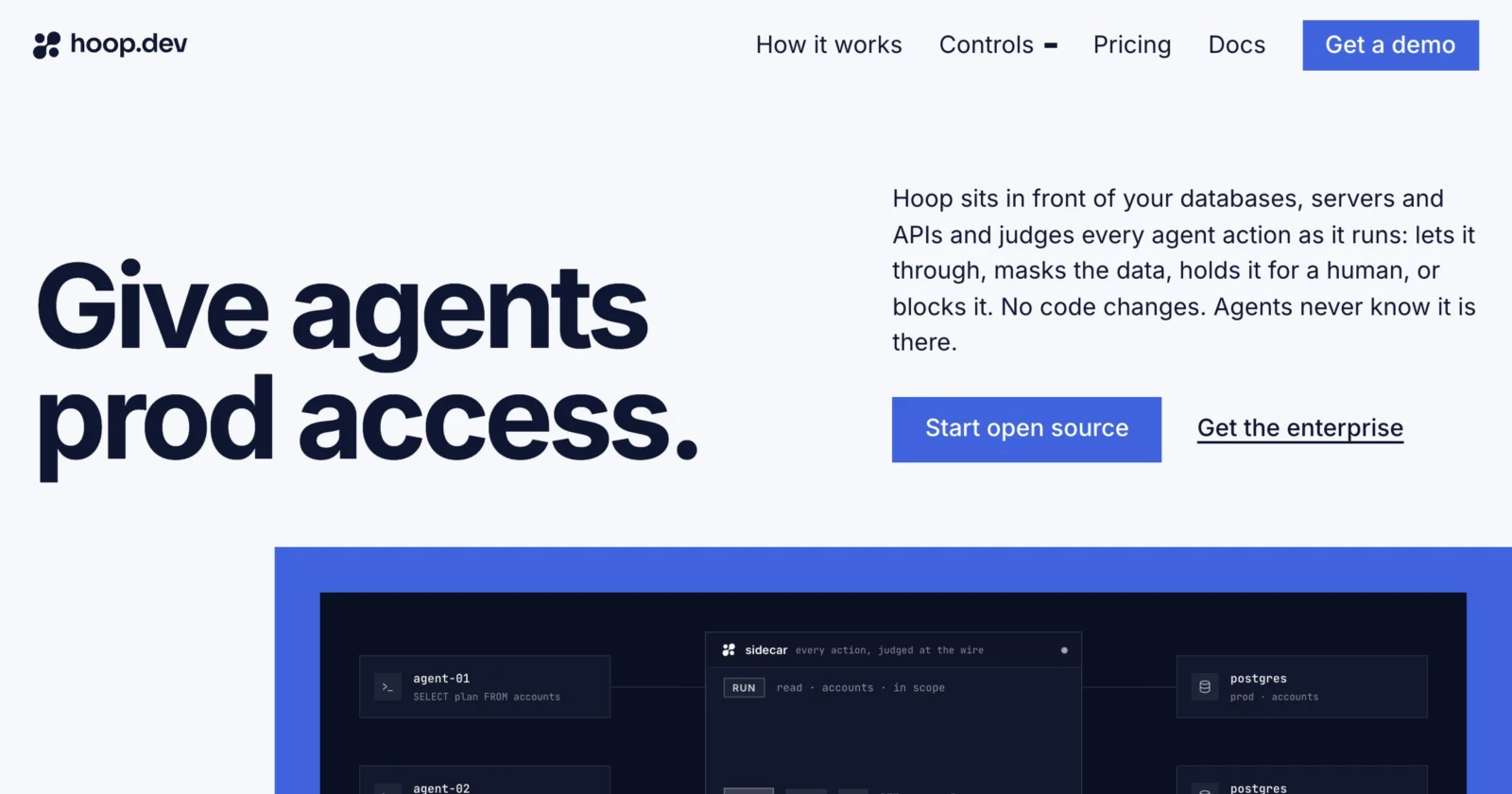
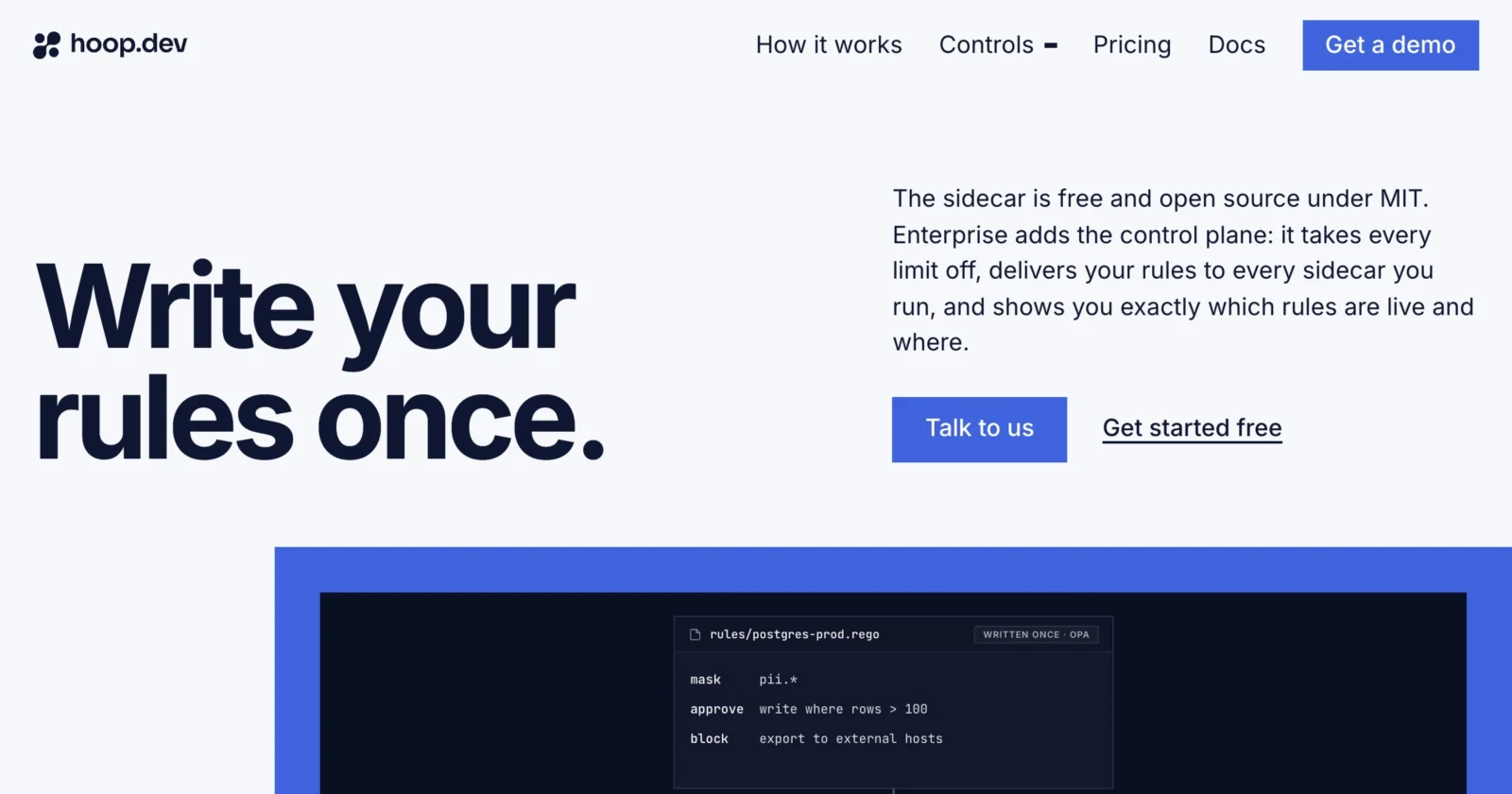
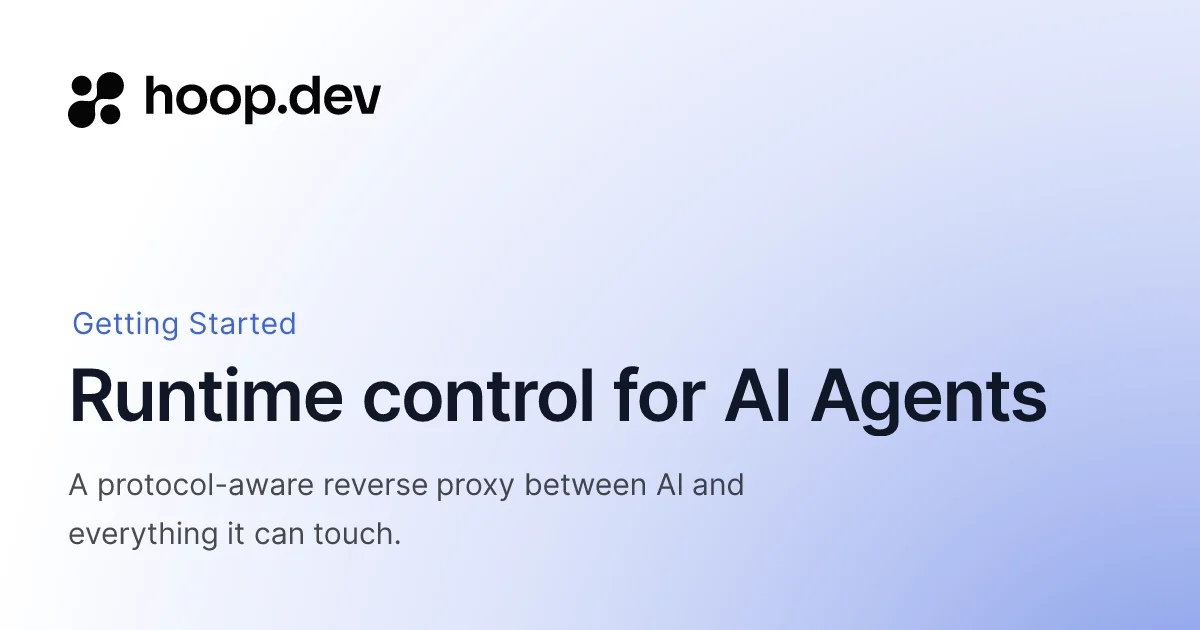
HOOP.dev places a sidecar proxy between clients and infrastructure resources. It parses supported protocols and evaluates requests against configured controls before traffic reaches its destination.
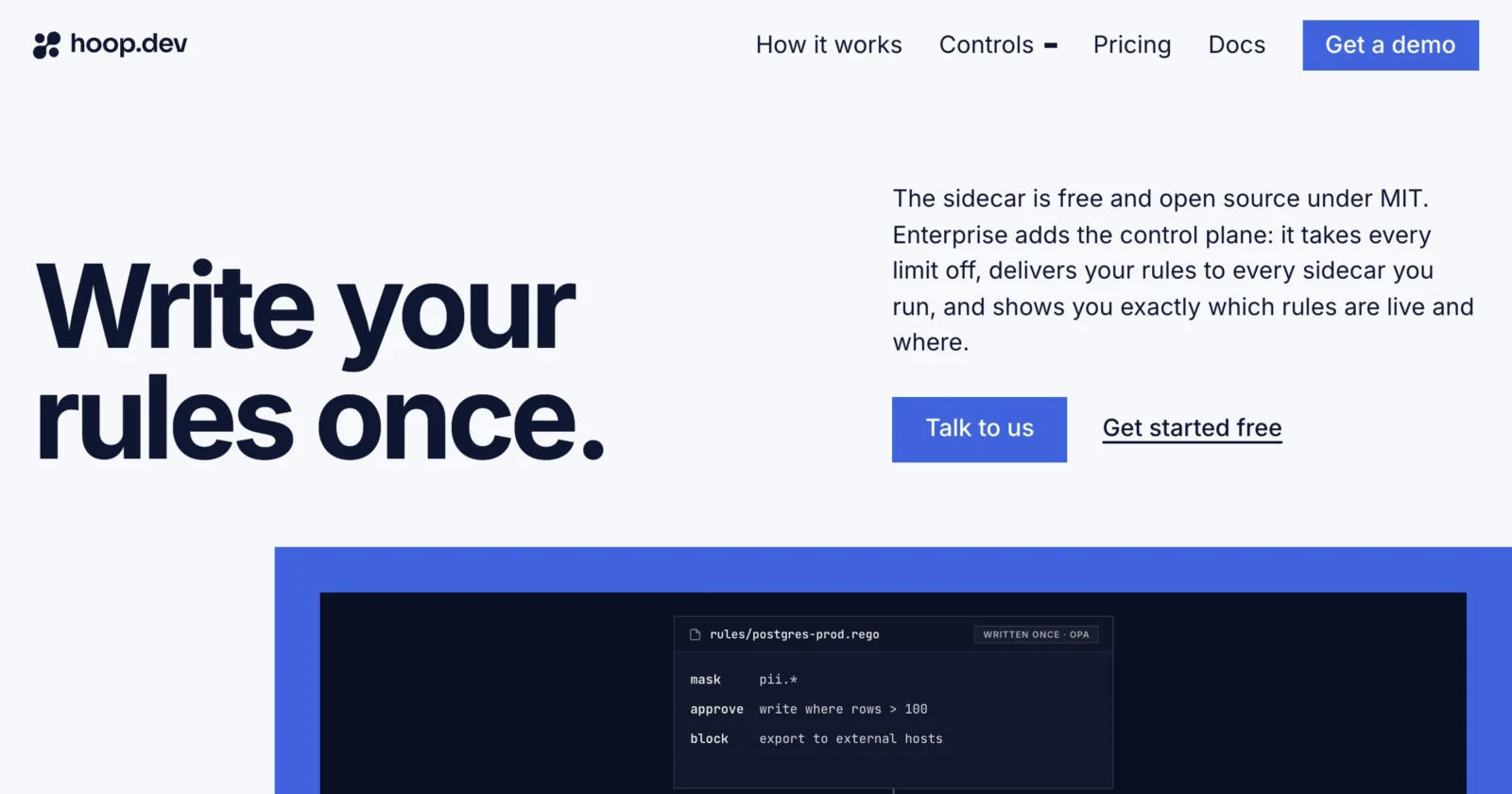
Controls include guardrails, response data masking, session auditing, and optional AI-assisted analysis or human review. The sidecar can run independently; Enterprise adds centralized configuration and fleet management.
This makes HOOP.dev relevant when teams want to govern what an agent or engineer does after connecting. It is not a replacement for an identity provider or privileged-access platform.
HOOP.dev Decision Snapshot
A quick way to understand who this product may suit, where its limits matter, and which facts are most relevant before you compare alternatives.
Best suited toEngineering and security teams that need to inspect and control requests between AI agents or other clients and databases, APIs, or infrastructure.
Look elsewhere ifTeams seeking a turnkey hosted product with published Enterprise prices, or buyers whose main requirement is identity provisioning rather than controlling actions after access is granted, and should evaluate alternatives such as StrongDM u2014 Overlaps in proxy-based infrastructure access and runtime policy, while HOOP.dev emphasizes inline data masking and action guardrails. or Teleport u2014 Overlaps in infrastructure and database access auditing, while HOOP.dev focuses on inline request controls and response rewriting. instead.
PlatformsKubernetes, Linux, macOS, Self-hosted, Windows
TechZella assessment7.6/10
HOOP.dev — What Sets It Apart?
These are the product-specific differences that may matter when deciding whether the software fits your workflow. They are based on documented evidence rather than a universal ranking.
- The sidecar inspects supported protocols in the traffic path, allowing rules to evaluate queries and requests rather than relying only on identity or prompts.
- Response masking can rewrite sensitive values before they reach a client.
- A standalone, MIT-licensed sidecar is available without an account; centralized rule management and expanded Enterprise controls are licensed separately.
Editorial assessmentHOOP.dev Pros & Cons
Pros
- Free, MIT-licensed sidecar can run without an account.
- Inspects supported protocols rather than relying only on application-level prompts or identity permissions.
- Can mask sensitive response data before it reaches the client.
- Supports standalone use before adding Enterprise central management.
Cons
- The free tier has limits on rules per sidecar.
- Enterprise pricing is quote-based and not publicly itemized.
- Self-hosting the Enterprise Control Plane requires PostgreSQL and deployment resources.
- The local admin API's read routes do not provide their own authentication.
HOOP.dev Gotchas & Operational Limits
These are documented constraints or practical friction points that may matter before you adopt the product.
The free standalone sidecar has rule limits, and the Enterprise Control Plane requires a license.
Teams managing multiple sidecars or needing more rules must assess Enterprise licensing rather than assume the free tier covers fleet-wide management.
Evidence source ↗The local sidecar admin API's read routes have no authentication of their own.
Its listener can expose audit details, including statements. Documentation advises binding it to loopback or protecting it through an existing access control.
Evidence source ↗A listener that holds statements for human review depends on the Control Plane for that review workflow.
If the Control Plane is unreachable, held statements are denied, even though other sidecar traffic can continue using its last loaded configuration.
Evidence source ↗Security & Privacy
For security-sensitive software, TechZella focuses on documented architecture, authentication, data handling, deployment and privacy details that can affect a buying decision. This is product research, not an independent security audit.
Security posture at a glance
| Deployment | Self-hosted sidecar; managed or self-hosted Enterprise Control Plane |
|---|
| Enterprise Control Plane database | PostgreSQL required for self-hosting |
|---|
Security claims are presented only when supported by documented sources. The presence of this section does not constitute a penetration test, certification or independent security audit.
Plans & pricingHOOP.dev Pricing & Plans
Open Source
Free
MIT-licensed, self-hosted sidecar with rule limits and community support. No account or credit card is required.
Check current pricing →Enterprise
Talk to sales
Requires a license; adds unlimited rules, centralized management, expanded analysis and review features, and support. Pricing is quoted for the customer's environment.
Check current pricing →Pricing may change. Verify current plans on the vendor's website.
Cost contextTotal Cost & Hidden Costs
Additional costs or implementation requirements that are documented in the available evidence.
Implementation and configuration
The sidecar is installed as a binary and configured with a file; documentation does not publish onboarding hours or professional-services costs.
Evidence source ↗Hosting and infrastructure
The open-source sidecar is self-hosted. A self-hosted Enterprise Control Plane needs PostgreSQL and deployment infrastructure; a managed Control Plane is also offered, but its price is not published.
Evidence source ↗Licensing and support
The open-source tier is free with community support and rule limits. Enterprise requires a license and is quoted; the pricing page says features are included per identity with no add-on pricing, but does not publish a quote or minimum.
Evidence source ↗Quick Comparison
Compare the product with documented alternatives across the factors that can change a buying decision. Each row is evidence-backed rather than a generic feature checklist.
HOOP.dev vs. StrongDM
Documented comparisonHOOP.dev vs. Teleport
Documented comparisonOnly factors supported by the available research are shown. The comparison is descriptive, not a ranking.
CapabilitiesHOOP.dev Features
Runtime controls
- Protocol-aware request inspection
- Guardrails
- Response data masking
- AI-assisted action analysis
- Human review workflows
Operations
- Session audit
- Local HTTP admin API
- Enterprise Control Plane
- OpenTelemetry export
Supported traffic
- Database protocols
- HTTP and gRPC APIs
- SSH and RDP
- Kubernetes and cloud resource workflows
HOOP.dev Specifications
| License | MIT for open-source sidecar |
|---|
| Deployment | Self-hosted sidecar; managed or self-hosted Enterprise Control Plane |
|---|
| Enterprise Control Plane database | PostgreSQL required for self-hosting |
|---|
| API | HTTP admin API and documented Control Plane API |
|---|
| Rule limits | Open-source tier has per-sidecar limits; Enterprise offers unlimited rules |
|---|
| Telemetry | OpenTelemetry export supported |
|---|
| Support | Community support for open-source; Enterprise includes support and SLAs |
|---|
| Free trial | No separate trial terms found; free open-source tier is available |
|---|
Alternatives
StrongDM may suit teams prioritizing brokered infrastructure access, just-in-time permissions, and session recording across databases, servers, and clusters. HOOP.dev is more specifically focused on inspecting and modifying actions and responses in the data path.
Teleport may suit organizations seeking a broader infrastructure identity and access platform with database audit and session playback. HOOP.dev may fit better when inline guardrails and response masking are central requirements.
Migration & Lock-In
Documented portability, standards, export, or switching considerations. No switching-cost score is shown unless the evidence supports one.
Client and resource changes
The documented proxy pattern changes the client connection address to the sidecar; protected resources retain their ports and credentials.
Evidence source ↗Our evidence-based assessmentTechZella Score
A proprietary editorial score based on product capabilities, usability, value, performance, support and user sentiment evidence.
7.6/10Moderate confidence
The documented sidecar combines protocol-aware rules, response masking, auditing, and optional centralized management. The open-source tier is free, while Enterprise pricing is quoted. Performance and sentiment scores have limited independent evidence.
Methodology v1.0. The assessment weighs feature coverage (25%), ease of use (15%), value for money (20%), performance (15%), support (10%) and user sentiment (15%), using researched product evidence and verified review evidence where available. It is a TechZella editorial assessment, not a direct user-review average.
Editorial transparency
Our Review Methodology
Key claims are linked to the sources used to verify them. This evidence record is separate from third-party user ratings.
TechZella evaluates software using documented product capabilities, pricing information, usability and value considerations, independent user evidence where available, and competitive context. The assessment is an editorial review, not a hands-on test unless one is explicitly identified. Our editorial assessment is based on 5 documented sources.
What TechZella adds- The sidecar inspects supported protocols in the traffic path, allowing rules to evaluate queries and requests rather than relying only on identity or prompts.
- Response masking can rewrite sensitive values before they reach a client.
- A standalone, MIT-licensed sidecar is available without an account; centralized rule management and expanded Enterprise controls are licensed separately.
Important limitations- The free sidecar has per-sidecar rule limits; centralized management, unlimited rules, and some review capabilities require Enterprise.
- Self-hosting the Enterprise Control Plane requires a PostgreSQL database and operational ownership of the deployment.
- G2's public rating is based on only two reviews, limiting its usefulness as a broad measure of customer sentiment.
Evidence-backed claimsHOOP.dev provides a free, MIT-licensed open-source sidecar.The pricing page identifies the Open Source tier as free, self-hosted, MIT-licensed, and available without an account.
View source ↗Verified 2026-11-23The sidecar can inspect supported protocol traffic and apply controls inline.Getting-started documentation describes a protocol-aware reverse proxy that evaluates queries, results, and API calls.
View source ↗Verified 2026-11-23The Enterprise Control Plane centralizes sidecar configuration and rule management.Documentation describes rules delivered centrally to registered sidecars and identifies the Control Plane as an Enterprise feature.
View source ↗Verified 2026-11-23HOOP.dev documents an HTTP admin API for sidecar health, configuration, statistics, and events.The sidecar documentation lists read endpoints for health, stats, configuration, sessions, and events.
View source ↗Verified 2026-11-23The self-hosted Control Plane requires PostgreSQL.The installation guide lists PostgreSQL as a prerequisite for the self-hosted Control Plane.
View source ↗Verified 2026-11-23HOOP.dev's public Enterprise pricing is quote-based.The pricing page asks customers to contact the vendor for an environment-specific Enterprise price.
View source ↗Verified 2026-11-23 Independent review sources
HOOP.dev Ratings & Reviews
Ratings are published by the respective review platforms and may change over time.
FAQ
See the buyer FAQ entries for verified details on open-source availability, deployment, APIs, and supported traffic types.
Community feedback
Reviews
No reviews yet. Be the first to share your experience.
Write a Review
Please log in to submit a review.
Recently added Cybersecurity Software