
Standalone Kubeflow Pipelines deployments do not enforce authentication or multi-user RBAC by default.
An operator must configure a secure access boundary rather than expose an unauthenticated pipeline service.
Evidence source ↗
Kubeflow is an open-source, Kubernetes-based platform for building and operating machine-learning workflows, including notebooks, training, pipelines, and model serving.
The project documents a broad set of machine-learning lifecycle components and deployment options. Setup and ongoing infrastructure are the user's responsibility; public review evidence was not analyzed.
This profile combines documented product information and independent evidence where available. It is not a hands-on test unless TechZella explicitly identifies one.
Kubeflow is an open-source project for operating machine-learning workloads on Kubernetes. Its components cover interactive notebooks, training, pipeline orchestration, model metadata, and serving.
Teams can install individual subprojects or use a community or vendor-packaged distribution. This flexibility supports custom platforms, but also means buyers must plan Kubernetes operations, infrastructure, and support ownership.
A quick way to understand who this product may suit, where its limits matter, and which facts are most relevant before you compare alternatives.
Organizations with Kubernetes expertise that want to assemble, operate, and adapt an open-source machine-learning platform across Kubernetes environments.
Teams seeking a turnkey hosted service, vendor-managed infrastructure, or guaranteed community support may prefer a managed machine-learning platform, and should evaluate alternatives such as Vertex AI Pipelines instead.
Google Cloud, Kubernetes, Microsoft Azure, Self-hosted
6.4/10
These are the product-specific differences that may matter when deciding whether the software fits your workflow. They are based on documented evidence rather than a universal ranking.
These are documented constraints or practical friction points that may matter before you adopt the product.
An operator must configure a secure access boundary rather than expose an unauthenticated pipeline service.
Evidence source ↗Buyers needing contractual support should identify a distribution maintainer and support arrangement before deployment.
Evidence source ↗Teams relying on Katib should review its roadmap and assess alternatives or migration needs.
Evidence source ↗Kubeflow project software is open source. Users separately provide and fund Kubernetes infrastructure and operations; third-party distribution support may be separately offered.
Check current pricing →Pricing may change. Verify current plans on the vendor's website.
Compare similar products directly, then see which alternatives may make more sense when your requirements differ.
| Decision factor | Kubeflow | Vertex AI Pipelines |
|---|---|---|
| Core scope | Open-source platform components for Kubernetes-based machine-learning workflows and related lifecycle tasks. | Google Cloud's managed pipeline service, also usable as a Kubeflow Pipelines-compatible backend. Source ↗ |
| Deployment model | Install and operate Kubeflow or selected subprojects on Kubernetes. | Run pipelines through Google's cloud service; usage incurs service and resource charges. Source ↗ |
| Pricing model | Open-source project software; the user pays for the infrastructure and operation used to run it. | Usage-based pricing; Google's product page lists pipeline execution starting at $0.03 per run, with resource and additional service charges. Source ↗ |
| Workflow portability | KFP SDK compiles pipelines to an intermediate representation that can run on its open-source backend or a compatible backend. | A documented compatible backend for KFP pipelines, while Google Cloud service dependencies may affect portability. Source ↗ |
Only factors supported by the available research are shown. The comparison is descriptive, not a ranking.
These products address broadly similar requirements. The descriptions focus on documented reasons a buyer might compare them with Kubeflow.
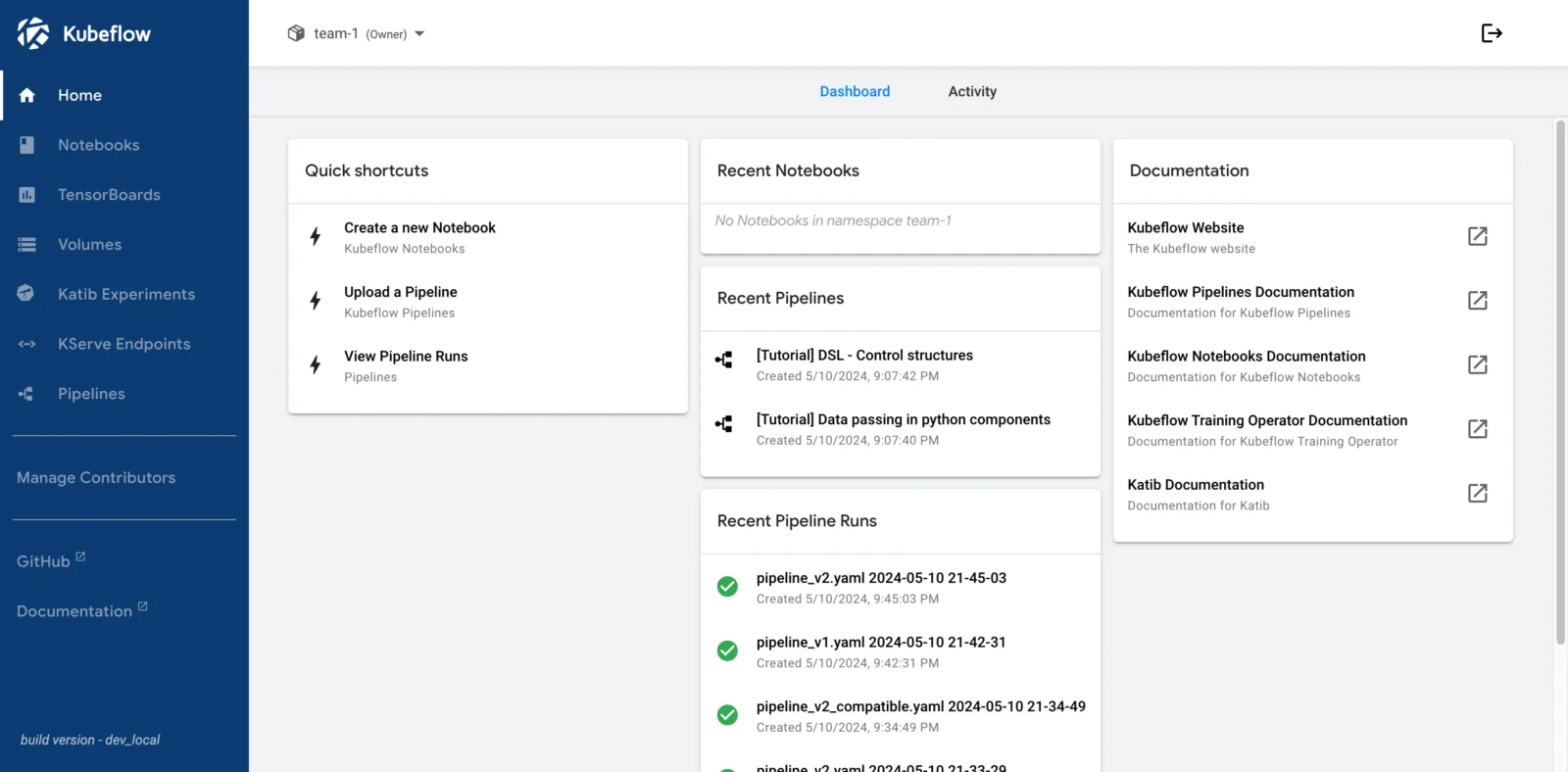



| License | Apache-2.0 |
|---|---|
| Deployment | Self-managed Kubernetes; individual subprojects or distributions |
| API | Kubeflow Pipelines REST API and Python SDK |
| Validated Kubernetes version | Kubernetes 1.34+ for the 26.03 community distribution manifests; packaged distributions may differ |
| Object storage integrations | AWS S3, Google Cloud Storage, and S3-compatible providers documented for Kubeflow Pipelines |
| Support | Best-effort community support for stable projects; packaged distributions are supported by their maintainers |
| Free trial | No hosted trial listed; software can be installed for evaluation |
Verified installation, hosting, administration, or environment details that can affect implementation.
| Installation or hosting | Self-managed on Kubernetes, installed as individual subprojects or as a distribution; vendor-packaged distributions are maintained separately. Source ↗ |
|---|
Documented portability, standards, export, or switching considerations. No switching-cost score is shown unless the evidence supports one.
Kubeflow Pipelines compiles workflows to an intermediate representation that can be submitted to compatible backends, including the open-source backend and Vertex AI Pipelines. Platform-specific features can limit portability.
Evidence source ↗A proprietary editorial score based on product capabilities, usability, value, performance, support and user sentiment evidence.
The project documents a broad set of machine-learning lifecycle components and deployment options. Setup and ongoing infrastructure are the user's responsibility; public review evidence was not analyzed.
Methodology v1.0. The assessment weighs feature coverage (25%), ease of use (15%), value for money (20%), performance (15%), support (10%) and user sentiment (15%), using researched product evidence and verified review evidence where available. It is a TechZella editorial assessment, not a direct user-review average.
Key claims are linked to the sources used to verify them. This evidence record is separate from third-party user ratings.
TechZella evaluates software using documented product capabilities, pricing information, usability and value considerations, independent user evidence where available, and competitive context. The assessment is an editorial review, not a hands-on test unless one is explicitly identified. Our editorial assessment is based on 6 documented sources.
The architecture overview describes Kubernetes as the system for deploying, scaling, and managing Kubeflow AI platforms, and describes notebooks, training, Hub, and Pipelines roles.
View source ↗Verified 2026-11-11The overview says the SDK compiles workflows to intermediate-representation YAML and identifies the open-source backend and Vertex AI Pipelines as compatible targets.
View source ↗Verified 2026-11-11The installation guide documents separate subproject and distribution deployment options.
View source ↗Verified 2026-11-11The governance page states Kubeflow is part of CNCF and describes project steering and distribution committees.
View source ↗Verified 2026-11-11A Kubeflow project article describes the project beginning in 2017 with TFJob.
View source ↗Verified 2026-11-11The SDK connection guide warns that standalone mode has no multi-user authentication or RBAC and that the service has no authentication enforced.
View source ↗Verified 2026-11-11The current installation guide's deprecated projects table lists those dates for Katib.
View source ↗Verified 2026-11-11Kubeflow is an open-source project. The software has no listed subscription price, but users pay for the infrastructure and operational resources they provide.
Yes. Kubeflow is built around Kubernetes; its community distribution and subprojects are deployed on Kubernetes clusters.
Yes. Kubeflow Pipelines documents Vertex AI Pipelines as a compatible backend for pipeline definitions compiled by the KFP SDK.
No. The documentation says standalone mode does not enforce multi-user authentication or RBAC by default.
No reviews yet. Be the first to share your experience.
Please log in to submit a review.