Editorial overview
Aggregated Overview
Product documentation verifies broad data-source support, SQL clients, APIs, deployment choices and a free Community Edition. G2 shows 71 reviews and a 4.6/5 average; accessible comments mention useful acceleration alongside setup, administration and performance concerns. No hands-on testing was conducted.
This profile combines documented product information and independent evidence where available. It is not a hands-on test unless TechZella explicitly identifies one.
Overview
Dremio is a data lakehouse platform for querying data across object storage, databases and other supported sources. It provides SQL access, data acceleration and shared data definitions for analytics workflows.
Its product editions include a free self-managed Community Edition, paid self-managed Enterprise and managed Cloud. SAP completed its acquisition of Dremio on July 6, 2026.
Dremio Decision Snapshot
A quick way to understand who this product may suit, where its limits matter, and which facts are most relevant before you compare alternatives.
Best suited toData and analytics teams that want SQL access across lakehouse storage, databases and warehouses, particularly when they need an open Iceberg-oriented architecture or self-managed deployment options.
Look elsewhere ifTeams seeking a simple standalone BI tool, or buyers who need fully managed service on a cloud provider other than the currently listed Dremio Cloud environment, should check deployment fit before adopting it, and should evaluate alternatives such as Snowflake or Databricks instead.
PlatformsAWS, Azure, Docker, Kubernetes, On-premises
TechZella assessment8.1/10
Dremio — What Sets It Apart?
These are the product-specific differences that may matter when deciding whether the software fits your workflow. They are based on documented evidence rather than a universal ranking.
- Offers a free self-managed Community Edition alongside paid self-managed Enterprise and managed Cloud editions.
- Connects SQL analytics to multiple data sources and open table formats, including Apache Iceberg, without requiring all data to be consolidated in a proprietary warehouse.
- Supports BI clients and agent interfaces through SQL drivers, REST APIs and MCP connections.
Editorial assessmentDremio Pros & Cons
Pros
- Free Community Edition provides a no-license-cost route for self-managed evaluation and use.
- Supports querying across multiple data-source categories and open table formats.
- Offers managed and self-managed deployment choices.
- Documents integrations for common BI clients, REST APIs and MCP-compatible agents.
Cons
- Community Edition has fewer governance and catalog capabilities than Enterprise and Cloud.
- Self-managed deployment requires the customer to operate infrastructure and manage upgrades.
- Detailed and main pricing pages describe infrastructure costs differently, requiring buyers to validate total charges.
Dremio Gotchas & Operational Limits
These are documented constraints or practical friction points that may matter before you adopt the product.
The main pricing page and detailed pricing page describe infrastructure charges differently.
Before forecasting spend, clarify whether storage and network charges apply to the selected region and service configuration; the detailed page lists regional storage and data-transfer rates.
Evidence source ↗Some features differ by edition.
Community Edition is free but lacks several hosted catalog and governance capabilities available in Enterprise and Cloud, so edition selection affects governance design.
Evidence source ↗Dremio's AI integrations send queries through external AI services or connected agents, depending on configuration.
Review the selected model provider's data handling and access requirements; Dremio documents that MCP responses may be affected by LLM hallucination.
Evidence source ↗Dremio Pricing & Plans
Community Edition
$0
ongoing
Free self-managed edition; deploy with Docker or Kubernetes, on-premises or in a supported cloud environment.
Check current pricing →Dremio Cloud pay-as-you-go
$0.20 per DCU
usage-based
Consumption-based compute pricing. Detailed pricing lists regional storage, network and model-token charges; verify charges applicable to the selected configuration.
Check current pricing →Dremio Enterprise
Contact Sales
usage-based
Self-managed Enterprise offering; pricing is provided through Dremio sales.
Check current pricing →Dremio Cloud free trial
$400 credit
30 days
Trial credit for Dremio Cloud; the pricing page says no credit card is required.
Check current pricing →Pricing may change. Verify current plans on the vendor's website.
Cost contextTotal Cost & Hidden Costs
Additional costs or implementation requirements that are documented in the available evidence.
Implementation and onboarding
G2 reports an average implementation time of two months across its review data. This is a user-reported average, not a vendor guarantee; Dremio does not publish a standard implementation duration on its pricing page.
Evidence source ↗Hosting and infrastructure
Dremio Cloud is managed, while Community and Enterprise deployments are self-managed. The detailed Cloud pricing page lists regional managed-storage and network rates; self-managed users must account for their own infrastructure.
Evidence source ↗Usage and ancillary charges
Cloud compute is listed at $0.20 per DCU. The detailed page separately lists storage, network and model-token rates; confirm applicable charges because the main pricing page also says infrastructure costs are included in DCU pricing.
Evidence source ↗Dremio Competitors & Alternatives
Compare similar products directly, then see which alternatives may make more sense when your requirements differ.
At a glance
Developer ToolsOnly factors supported by the available research are shown. The comparison is descriptive, not a ranking.
Direct competitors
These products address broadly similar requirements. The descriptions focus on documented reasons a buyer might compare them with Dremio.
CapabilitiesDremio Features
Data access and formats
- Federated SQL queries across supported data sources
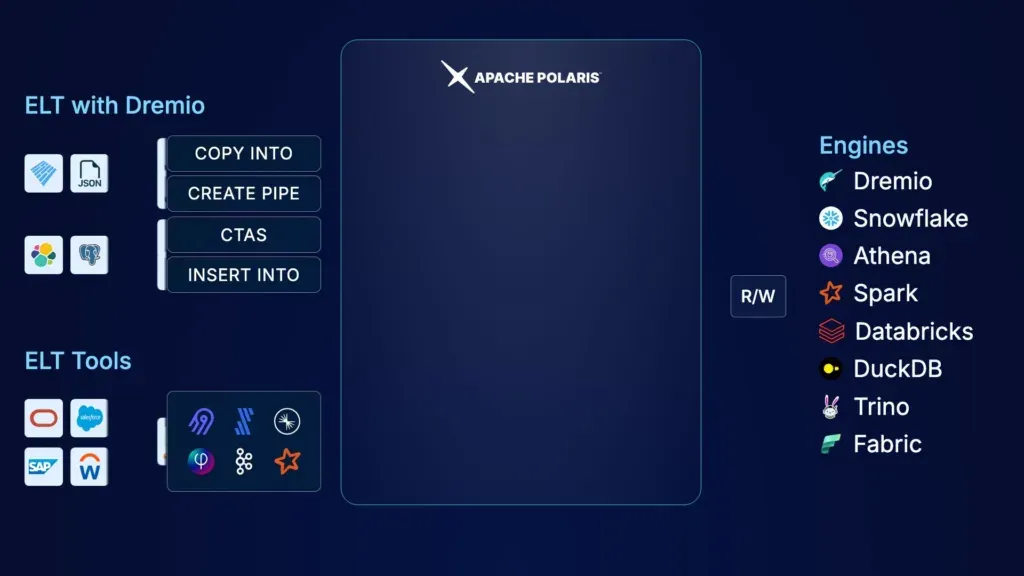
- Support for Apache Iceberg, Parquet, CSV, JSON, Excel, Delta Lake and UniForm
- Connections to object storage, lakehouse catalogs and databases
Query and acceleration
- Cost-based query optimizer
- Reflections for query acceleration
- Query history and results cache
- Columnar Cloud Cache
Analytics and integrations
- Tableau and Microsoft Power BI connections
- Arrow Flight SQL JDBC and ODBC
- REST API for data infrastructure and query operations
AI connectivity
- Built-in AI agent in Dremio Cloud
- MCP server for compatible AI clients and agents
- AI Semantic Layer for shared business definitions
Dremio Specifications
| Deployment | Managed Cloud; self-managed Docker or Kubernetes; on-premises and supported public clouds |
|---|
| Cloud compute pricing | $0.20 per DCU pay-as-you-go |
|---|
| Free trial | 30 days with $400 in credits |
|---|
| API | REST API; Iceberg Catalog REST API documented for Cloud |
|---|
| BI clients | Tableau, Microsoft Power BI and other JDBC/ODBC-compatible clients |
|---|
| Open table formats | Apache Iceberg, Parquet, Delta Lake, UniForm |
|---|
| Acquisition | Acquired by SAP; transaction closed July 6, 2026 |
|---|
Exit planningMigration & Lock-In
Documented portability, standards, export, or switching considerations. No switching-cost score is shown unless the evidence supports one.
Open formats
Dremio supports Apache Iceberg, Parquet, CSV, JSON, Excel, Delta Lake and UniForm; data in supported open formats can be accessed outside Dremio by compatible engines.
Evidence source ↗Our evidence-based assessmentTechZella Score
A proprietary editorial score based on product capabilities, usability, value, performance, support and user sentiment evidence.
8.1/10Moderate confidence
Product documentation verifies broad data-source support, SQL clients, APIs, deployment choices and a free Community Edition. G2 shows 71 reviews and a 4.6/5 average; accessible comments mention useful acceleration alongside setup, administration and performance concerns. No hands-on testing was conducted.
Methodology v1.0. The assessment weighs feature coverage (25%), ease of use (15%), value for money (20%), performance (15%), support (10%) and user sentiment (15%), using researched product evidence and verified review evidence where available. It is a TechZella editorial assessment, not a direct user-review average.
Editorial transparency
Our Review Methodology
Key claims are linked to the sources used to verify them. This evidence record is separate from third-party user ratings.
TechZella evaluates software using documented product capabilities, pricing information, usability and value considerations, independent user evidence where available, and competitive context. The assessment is an editorial review, not a hands-on test unless one is explicitly identified. Our editorial assessment is based on 6 documented sources.
What TechZella adds- Offers a free self-managed Community Edition alongside paid self-managed Enterprise and managed Cloud editions.
- Connects SQL analytics to multiple data sources and open table formats, including Apache Iceberg, without requiring all data to be consolidated in a proprietary warehouse.
- Supports BI clients and agent interfaces through SQL drivers, REST APIs and MCP connections.
Important limitations- Community Edition lacks several Enterprise and Cloud governance and catalog capabilities, including hosted catalog, data lineage, audit history and fine-grained row or column access controls.
- Self-managed installations require customers to operate and upgrade their infrastructure; the pricing site describes Enterprise upgrades and scaling as self-managed.
- Published pricing pages differ in how they describe included infrastructure costs: the main pricing page says infrastructure is included in DCU pricing, while the detailed pricing page lists regional storage and network charges separately.
Evidence-backed claimsDremio Community Edition is free and self-managed.The editions matrix lists Community as free and supports self-managed Docker or Kubernetes deployment.
View source ↗Verified 2026-11-07Dremio Cloud has a 30-day trial with $400 in credits.The official pricing page lists a $400 credit for a 30-day trial.
View source ↗Verified 2026-11-07Dremio Cloud compute is listed at $0.20 per DCU.The official detailed pricing page lists the pay-as-you-go Cloud DCU list price as US$0.20 per DCU.
View source ↗Verified 2026-11-07Dremio connects to lakehouse catalogs, object storage and databases.The source documentation enumerates supported catalogs, storage services and database sources, including AWS Glue, S3, Azure Storage, BigQuery, Snowflake and PostgreSQL.
View source ↗Verified 2026-11-07Dremio provides REST API access for managing data infrastructure and queries.The Cloud API reference describes programmatic access to manage data infrastructure, execute queries and configure sources.
View source ↗Verified 2026-11-07SAP completed its acquisition of Dremio on July 6, 2026.SAP's Q3 2026 statement says the acquisition closed on July 6, 2026, following regulatory approvals.
View source ↗Verified 2026-11-07 Independent review sources
Dremio Ratings & Reviews
Ratings are published by the respective review platforms and may change over time.
Common questionsDremio FAQs
Answers begin with the clearest available response, followed by the context that helps you act on it.
Does Dremio offer a free trial?
Yes. Dremio Cloud lists a 30-day trial with $400 in credits. Enterprise buyers are directed to contact sales.
Is Dremio Community Edition free?
Yes. The Community Edition is free and self-managed.
Can Dremio be deployed on-premises?
Yes. The editions documentation lists self-managed on-premises deployment for Community and Enterprise.
Does Dremio have an API?
Yes. Dremio documents REST APIs for managing infrastructure, executing queries and configuring data sources.
Which BI tools connect to Dremio?
Documentation lists Tableau, Microsoft Power BI and additional client applications, with drivers varying by client.
Community feedback
Reviews
No reviews yet. Be the first to share your experience.
Write a Review
Please log in to submit a review.
Recently added Developer Tools