
Additional machine usage and stronger machines are charged per minute when applicable.
The per-editor plan price may not represent total spend for workloads that exceed included compute or require larger machines.
Evidence source ↗
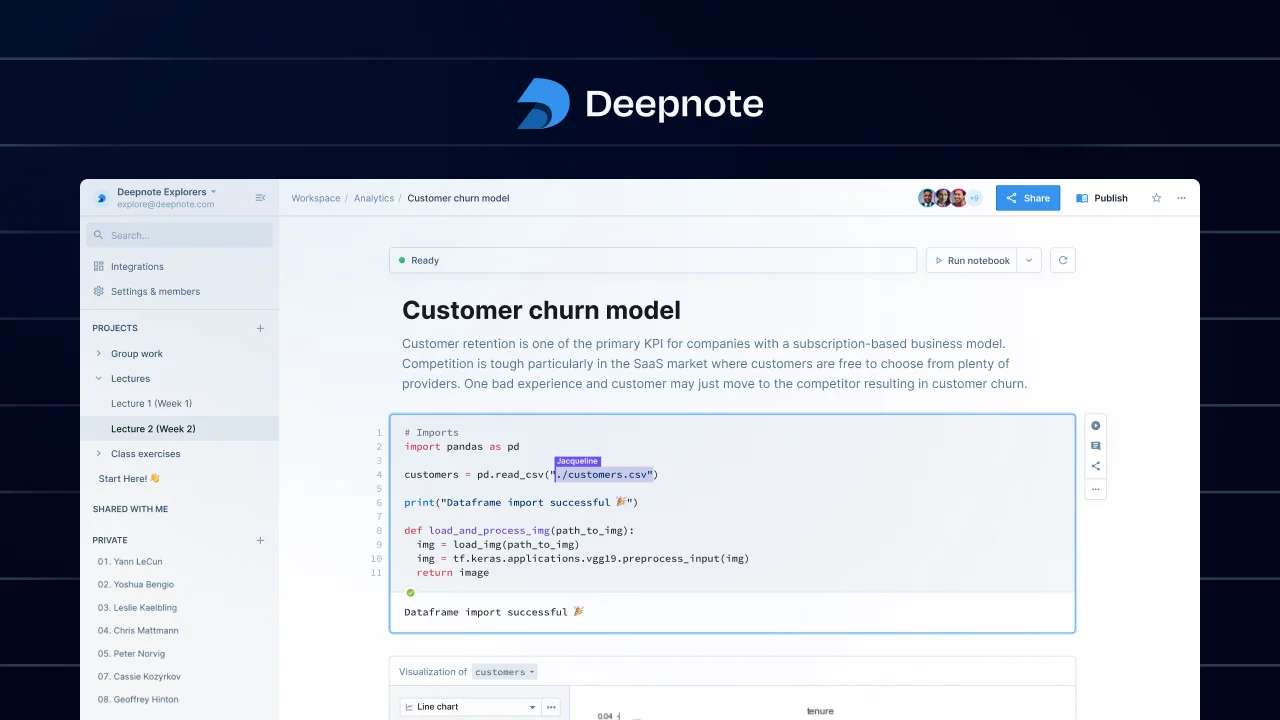
Deepnote is a cloud workspace for collaborative data analysis and machine learning. It combines Python, SQL, connected data sources, AI assistance, and notebook publishing.
The product offers integrated Python and SQL notebooks, connected data services, collaboration, scheduling, and publishing. G2 lists 387 reviews and a 4.5 average; scores are editorial assessments, not hands-on test results.
This profile combines documented product information and independent evidence where available. It is not a hands-on test unless TechZella explicitly identifies one.
Deepnote is a cloud workspace for data analysis, exploration, and machine learning. Its collaborative notebooks combine Python, SQL, visualizations, text, and interactive inputs.
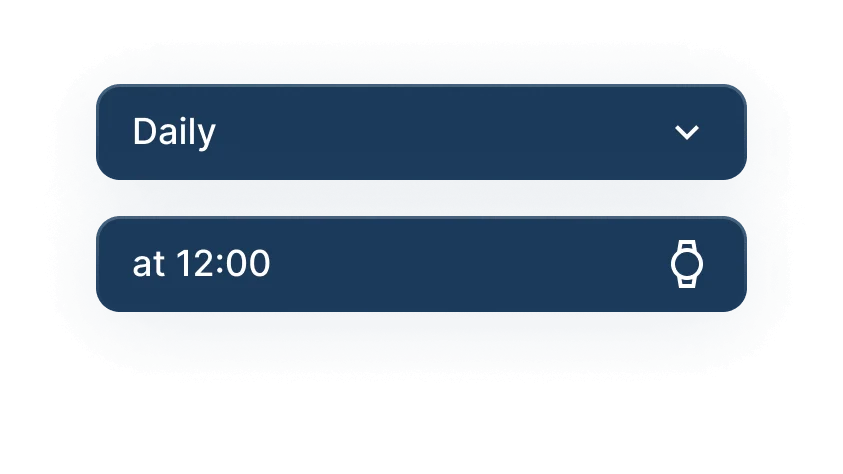
Teams can connect databases and warehouses, organize notebooks in projects, schedule executions, and publish results as dashboards or apps. Free users face project and editor limits; larger teams can select paid plans.
A quick way to understand who this product may suit, where its limits matter, and which facts are most relevant before you compare alternatives.
Data and software teams that want a shared cloud workspace for Python and SQL analysis, connected data sources, notebook collaboration, scheduled work, and shareable apps.
Teams requiring a fully air-gapped environment or an entirely self-managed installation should evaluate deployment requirements carefully. Deepnote documents network-dependent deployments and presents self-hosted or customer-cloud options through sales, and should evaluate alternatives such as Hex for collaborative data analysis, notebooks, and published data apps. or Google Colab for browser-based Jupyter notebooks, data science, and machine learning. instead.
Cloud, GitHub, Microsoft Azure, REST API, Web
8.3/10
These are the product-specific differences that may matter when deciding whether the software fits your workflow. They are based on documented evidence rather than a universal ranking.
These are documented constraints or practical friction points that may matter before you adopt the product.
The per-editor plan price may not represent total spend for workloads that exceed included compute or require larger machines.
Evidence source ↗Teams relying on preview endpoints in production-critical automation should account for possible endpoint or schema changes.
Evidence source ↗Token expiration or revocation can interrupt unattended schedules; the docs recommend service-account or username-and-password authentication for certain workflows.
Evidence source ↗Up to three editors, five projects, limited AI, basic machines, and seven-day revision history.
Check current pricing →Includes unlimited viewers and notebooks, scheduled notebooks, premium integrations, background execution, monthly AI and compute credits, and a 14-day free trial.
Check current pricing →Adds enterprise administration and deployment options, including SSO, directory sync, audit logs, single tenancy, and priority support.
Check current pricing →Pricing may change. Verify current plans on the vendor's website.
Compare the product with documented alternatives across the factors that can change a buying decision. Each row is evidence-backed rather than a generic feature checklist.
| Decision factor | Deepnote | Hex |
|---|---|---|
| Core scope | Collaborative notebook workspace for data analysis, data science, machine learning, scheduled work, and data apps. | Analytics and BI-oriented workspace centered on warehouse exploration, dashboards, reports, and interactive apps. Source ↗ |
| Paid team pricing | Team is listed at $39 per editor per month when billed yearly. | Team is listed at $75 per editor per month. Source ↗ |
| Notebook portability and local work | Supports Jupyter, Quarto, Percent, and Marimo conversions; official VS Code and Cursor extensions support local editing and execution. | Hex documents CLI and project import/export; its full Notebook and App experience remains hosted. Source ↗ |
| Decision factor | Deepnote | Google Colab |
|---|---|---|
| Core scope | Combines collaborative notebooks with data-source integrations, SQL blocks, and project-level organization. | Hosted Jupyter notebook service with access to free computing resources, including GPUs and TPUs, subject to availability and usage limits. Source ↗ |
| Pricing model | Offers a free tier and a paid Team plan listed at $39 per editor per month when billed yearly. | Offers free access; paid options and included compute benefits depend on Colab or eligible Google AI plans. Source ↗ |
| Notebook and runtime model | Projects organize notebooks, files, integrations, and a shared environment; cloud machines can be selected by project. | Notebooks are stored in Google Drive or loaded from GitHub, while execution uses account-specific virtual machines that can be terminated when idle. Source ↗ |
Only factors supported by the available research are shown. The comparison is descriptive, not a ranking.
| Founded | 2019 |
|---|---|
| Primary interface | Web browser |
| Deployment | Managed cloud; dedicated single-tenant and customer-cloud options are documented |
| Cloud provider | AWS for processing and storage, according to Deepnote's security overview |
| Notebook formats | Jupyter .ipynb; converter also supports Quarto, Percent, and Marimo |
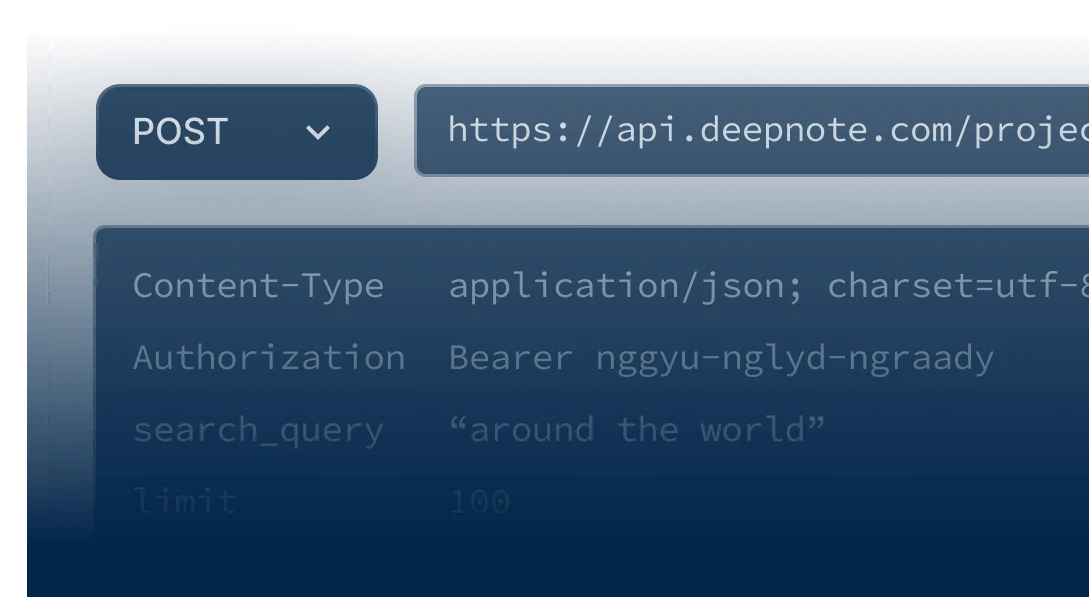
| API | Notebook execution API on Team and Enterprise; Public API v2 is in preview |
| Free plan limits | Up to 3 editors, 5 projects, and 7-day revision history |
| Team plan revision history | 30 days |
| Data security | Deepnote documents SOC 2 Type II, AES-256 at-rest encryption, and TLS 1.2 or higher in transit |
| Free trial | 14 days for Team |
Verified installation, hosting, administration, or environment details that can affect implementation.
| Standard hosting | Managed, multi-tenant cloud service; Deepnote's security documentation says it uses AWS for processing and storage. Source ↗ |
|---|---|
| Dedicated or customer-cloud deployment | Deepnote documents managed single-tenant and customer-cloud deployment options; contact sales for details. Source ↗ |
| Local development | Official extensions support notebook editing and execution in VS Code and Cursor, with Python 3.10 or higher required. Source ↗ |
Hex is a relevant alternative for teams whose main requirement is warehouse-centered BI, self-service exploration, reporting, and analytics apps. Its official Team price is $75 per editor per month.
Google Colab is a relevant alternative for individuals, educators, and researchers seeking hosted Jupyter notebooks and free access to compute resources. Google notes that free resources are not guaranteed and usage limits can fluctuate.
Documented portability, standards, export, or switching considerations. No switching-cost score is shown unless the evidence supports one.
Deepnote documents importing and exporting Jupyter .ipynb notebooks. Its converter also supports Quarto, Percent, and Marimo formats.
Evidence source ↗Deepnote-specific SQL, chart, input, and rich-text blocks may not be represented exactly in standard Jupyter exports.
Evidence source ↗A proprietary editorial score based on product capabilities, usability, value, performance, support and user sentiment evidence.
The product offers integrated Python and SQL notebooks, connected data services, collaboration, scheduling, and publishing. G2 lists 387 reviews and a 4.5 average; scores are editorial assessments, not hands-on test results.
Methodology v1.0. The assessment weighs feature coverage (25%), ease of use (15%), value for money (20%), performance (15%), support (10%) and user sentiment (15%), using researched product evidence and verified review evidence where available. It is a TechZella editorial assessment, not a direct user-review average.
Key claims are linked to the sources used to verify them. This evidence record is separate from third-party user ratings.
TechZella evaluates software using documented product capabilities, pricing information, usability and value considerations, independent user evidence where available, and competitive context. The assessment is an editorial review, not a hands-on test unless one is explicitly identified. Our editorial assessment is based on 6 documented sources.
The official getting-started page describes Python, SQL, no-code tools, data connections, collaboration, AI assistance, and publishing.
View source ↗Verified 2026-11-07The official pricing page lists those limits and seven-day revision history for Free.
View source ↗Verified 2026-11-07The official pricing page displays the Team price, annual billing basis, and trial offer.
View source ↗Verified 2026-11-07The official getting-started page gives the integration count and names BigQuery, Snowflake, and PostgreSQL as examples.
View source ↗Verified 2026-11-07The API documentation describes programmatic notebook execution and lists plan availability.
View source ↗Verified 2026-11-07The official documentation explains .ipynb import and export and notes compatibility limits for Deepnote-specific blocks.
View source ↗Verified 2026-11-07The security overview states that Deepnote has a SOC 2 Type II report and describes AES-256 at-rest encryption and TLS 1.2 or higher in transit.
View source ↗Verified 2026-11-07A Deepnote-authored company blog post states that the company was founded in 2019.
View source ↗Verified 2026-11-07Answers begin with the clearest available response, followed by the context that helps you act on it.
No reviews yet. Be the first to share your experience.
Please log in to submit a review.