
The game must read and interpret Ogmo's JSON level data.
Using the editor does not by itself connect authored levels to a game's runtime; the development team needs a compatible loader or custom parsing.
Evidence source ↗
Ogmo Editor is a free, open-source desktop tool for designing 2D game levels. It exports project and level data as JSON.
The editor offers several layer types, desktop downloads, and JSON output at no charge. Scores reflect documented capabilities and public product information; no hands-on testing or review-text analysis was performed.
This profile combines documented product information and independent evidence where available. It is not a hands-on test unless TechZella explicitly identifies one.
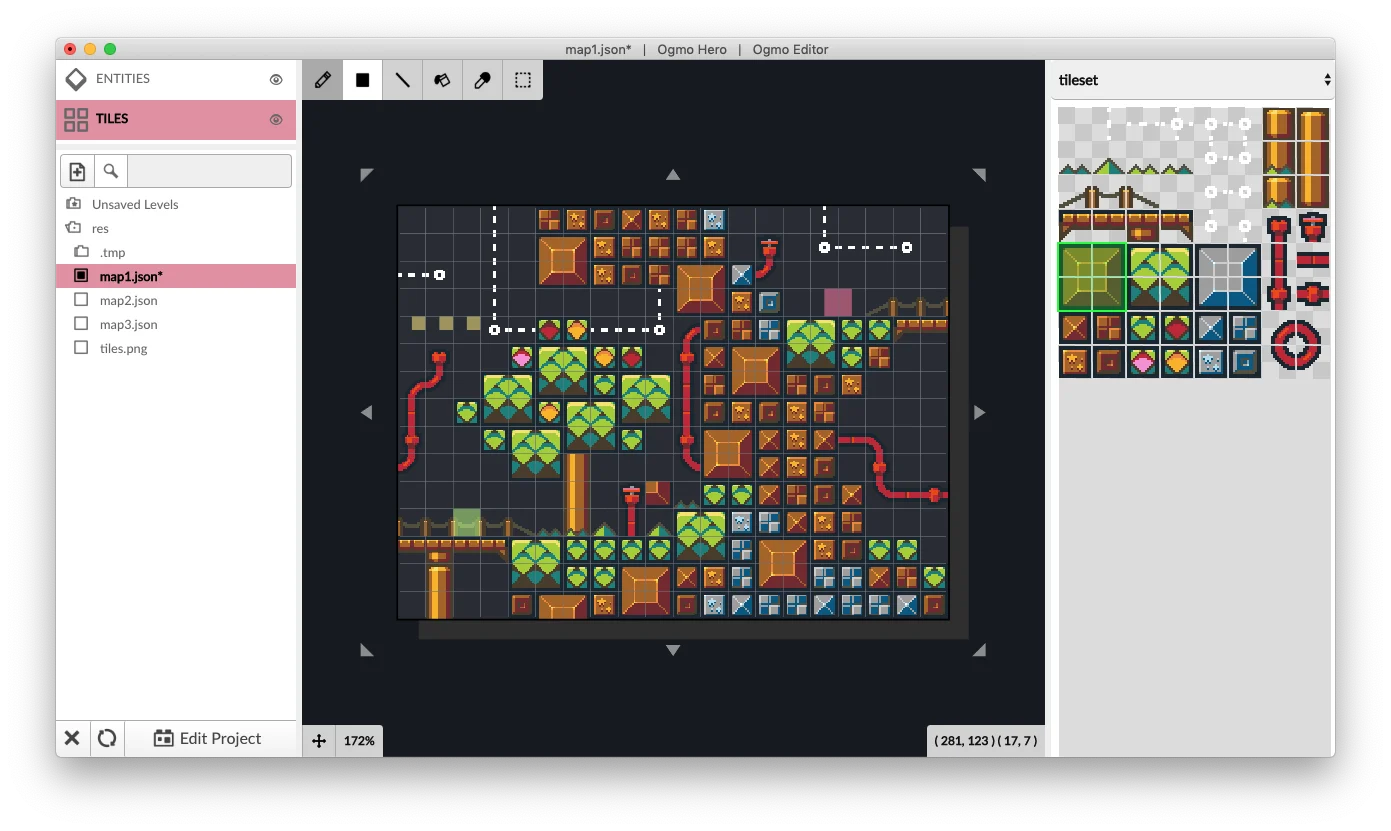
Ogmo Editor is a free, open-source desktop editor for designing 2D game levels. Its project-based workflow supports tile, decal, entity, and grid layers, with levels saved as JSON.
The editor is intended to work across engines, but that does not mean it includes a native integration for every engine. Developers should confirm that their game can read Ogmo’s output or plan to write a loader.
A quick way to understand who this product may suit, where its limits matter, and which facts are most relevant before you compare alternatives.
Indie game developers who want a free, desktop-based editor for project-organized 2D levels and can implement a reader for its JSON output.
Teams that need a browser-based collaborative editor, a documented native engine integration, or vendor-provided implementation support, and should evaluate alternatives such as Tiled or LDtk instead.
Linux, macOS, Windows
7.2/10
These are the product-specific differences that may matter when deciding whether the software fits your workflow. They are based on documented evidence rather than a universal ranking.
These are documented constraints or practical friction points that may matter before you adopt the product.
Using the editor does not by itself connect authored levels to a game's runtime; the development team needs a compatible loader or custom parsing.
Evidence source ↗Teams should check that the available build and documentation meet their operating-system and maintenance requirements before adopting it.
Evidence source ↗Free for personal and commercial projects; the project identifies the license as MIT.
Check current pricing →Pricing may change. Verify current plans on the vendor's website.
Compare similar products directly, then see which alternatives may make more sense when your requirements differ.
| Decision factor | Ogmo Editor | Tiled | LDtk |
|---|---|---|---|
| Core scope | Project-oriented 2D level editor with tile, decal, entity, and grid layers. | 2D editor with tile and object workflows, including orthogonal, isometric, and hexagonal maps. Source ↗ | 2D level editor with integer grid, tile, and entity layers, plus auto-layer features. Source ↗ |
| Data format and extensibility | Saves project and level data as JSON. | Supports JSON and other exports, and can be extended with JavaScript. Source ↗ | Uses a documented JSON project format and offers a Tiled-compatible file option. Source ↗ |
| Pricing model | Free for personal and commercial use under the MIT license. | Free and open source; the project invites voluntary sponsorship. Source ↗ | Free to download; its creator also offers a pay-what-you-want option. Source ↗ |
Only factors supported by the available research are shown. The comparison is descriptive, not a ranking.
These products address broadly similar requirements. The descriptions focus on documented reasons a buyer might compare them with Ogmo Editor.
| Software type | Desktop 2D level editor |
|---|---|
| Platforms | Windows, macOS, Linux |
| Output format | JSON |
| License | MIT |
| Latest listed release | 3.4.0, released December 31, 2020 |
| API | No public API documented in the reviewed official materials |
| Integrations | No specific native engine integration verified; the documented workflow uses JSON output |
| Free trial | Not listed; the editor itself is free |
Verified installation, hosting, administration, or environment details that can affect implementation.
| Installation or hosting | Downloadable desktop builds are listed for Windows, macOS, and Linux; no hosted deployment is documented. Source ↗ |
|---|
Documented portability, standards, export, or switching considerations. No switching-cost score is shown unless the evidence supports one.
The manual describes project and level data as JSON. Moving data to another tool may require mapping its structure to that tool's format.
Evidence source ↗A proprietary editorial score based on product capabilities, usability, value, performance, support and user sentiment evidence.
The editor offers several layer types, desktop downloads, and JSON output at no charge. Scores reflect documented capabilities and public product information; no hands-on testing or review-text analysis was performed.
Methodology v1.0. The assessment weighs feature coverage (25%), ease of use (15%), value for money (20%), performance (15%), support (10%) and user sentiment (15%), using researched product evidence and verified review evidence where available. It is a TechZella editorial assessment, not a direct user-review average.
Key claims are linked to the sources used to verify them. This evidence record is separate from third-party user ratings.
TechZella evaluates software using documented product capabilities, pricing information, usability and value considerations, independent user evidence where available, and competitive context. The assessment is an editorial review, not a hands-on test unless one is explicitly identified. Our editorial assessment is based on 4 documented sources.
The project site describes tile, decal, entity, and grid layers.
View source ↗Verified 2026-11-16The official site and manual describe JSON level files intended for reading by game projects.
View source ↗Verified 2026-11-16The official project site states this and identifies the MIT license.
View source ↗Verified 2026-11-16The product listing names all three platforms and lists downloadable archives.
View source ↗Verified 2026-11-16The project repository's releases page labels version 3.4.0 as the latest and gives its release date as December 31, 2020.
View source ↗Verified 2026-11-16Answers begin with the clearest available response, followed by the context that helps you act on it.
No reviews yet. Be the first to share your experience.
Please log in to submit a review.