
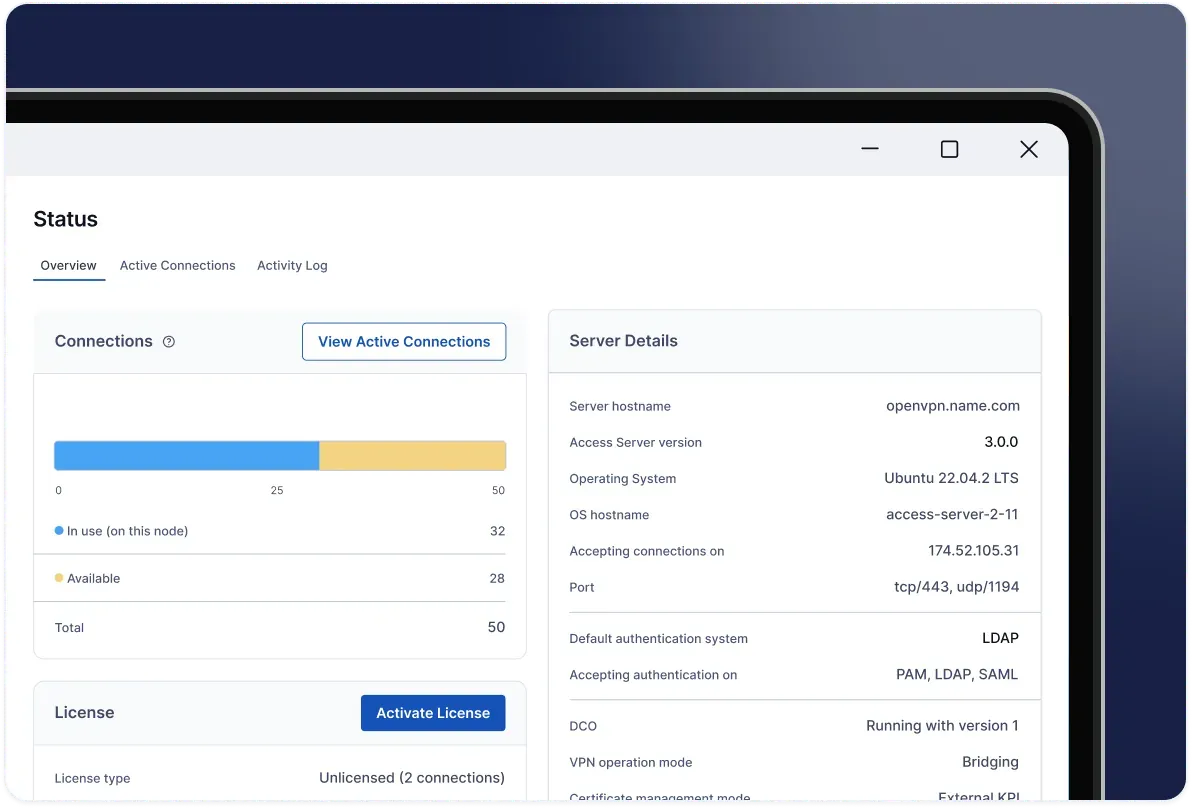
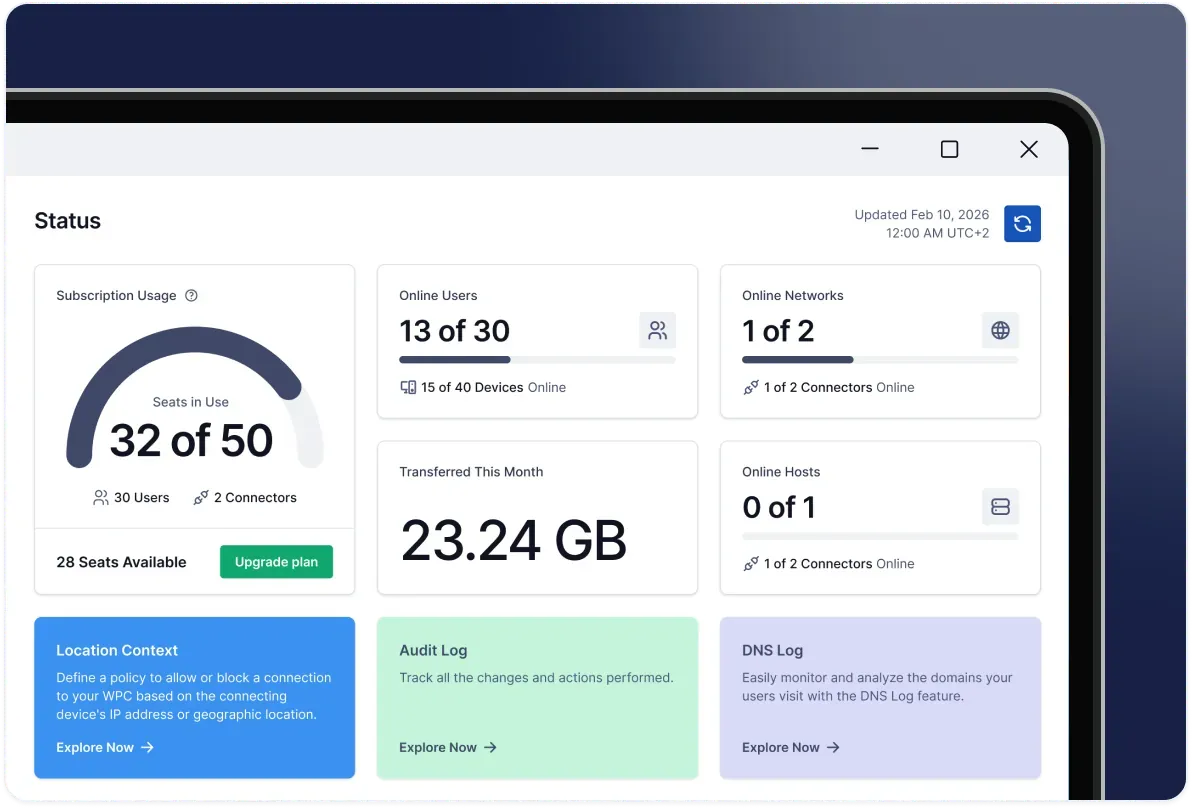
A connection license counts simultaneous active device connections, not the number of provisioned user accounts.
A company can create many users, but only the licensed number of devices can connect at the same time.
Evidence source ↗
OpenVPN is an open-source VPN project and a family of connectivity products. Access Server adds a web-managed, self-hosted VPN for remote and site-to-site access.
Access Server documents broad authentication, access-control, deployment, and API capabilities. Public G2 reviews include positive comments about access and administration, alongside reports of setup and troubleshooting complexity. These are editorial assessments, not hands-on test results.
This profile combines documented product information and independent evidence where available. It is not a hands-on test unless TechZella explicitly identifies one.
OpenVPN refers to an open-source VPN project and a broader set of commercial connectivity products from OpenVPN Inc. The project provides VPN software; Access Server packages VPN hosting with web-based administration for businesses.
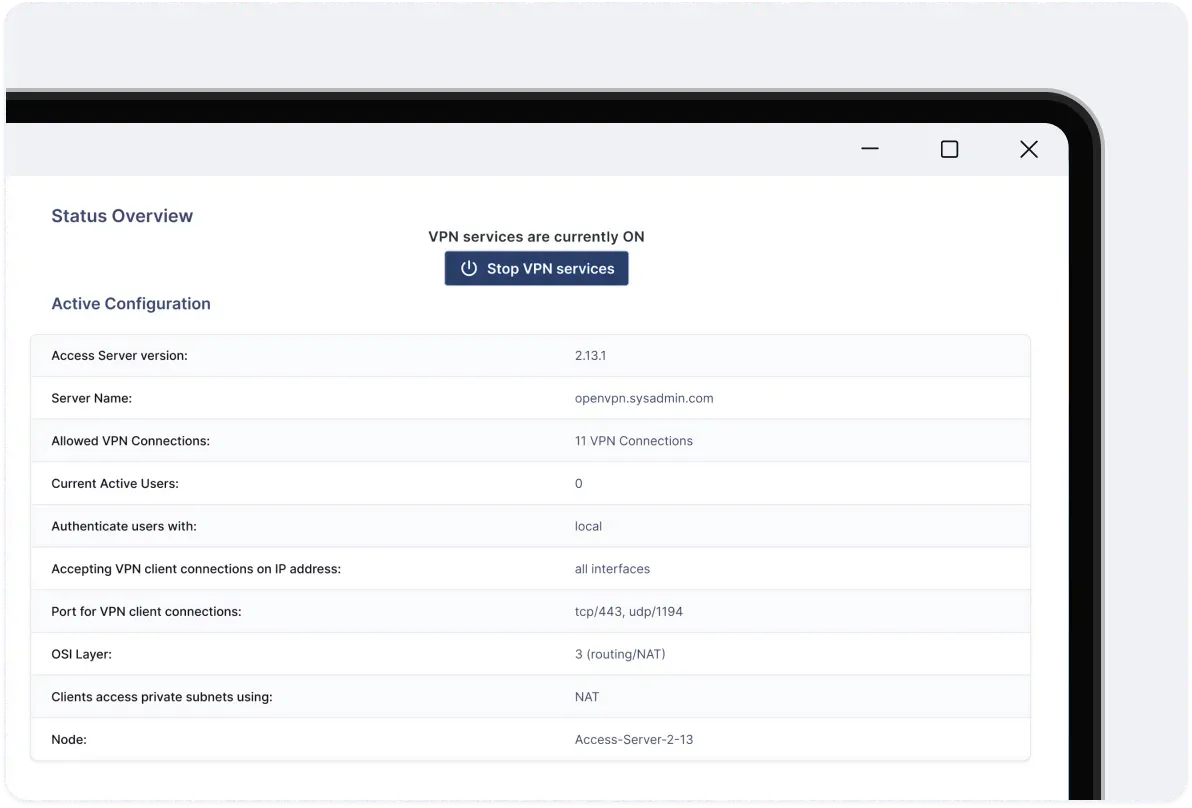
Access Server is self-hosted, so the organization chooses and manages its server environment. It supports remote and site-to-site VPN connections, user and group access controls, external authentication, and a REST API. CloudConnexa is the vendor-managed option for teams that do not want to operate VPN servers.
A quick way to understand who this product may suit, where its limits matter, and which facts are most relevant before you compare alternatives.
Organizations that want to operate their own VPN server while providing employees or administrators remote access to private networks and cloud environments.
Teams that do not want to provision, monitor, patch, and scale VPN server infrastructure may prefer a managed service such as CloudConnexa, and should evaluate alternatives such as Tailscale instead.
Android, iOS, Linux, macOS, Windows
7.8/10
These are the product-specific differences that may matter when deciding whether the software fits your workflow. They are based on documented evidence rather than a universal ranking.
These are documented constraints or practical friction points that may matter before you adopt the product.
A company can create many users, but only the licensed number of devices can connect at the same time.
Evidence source ↗The temporary trial capacity can be mistaken for the permanent free-plan limit.
Evidence source ↗Linux endpoints may require a different client and setup documentation than other operating systems.
Evidence source ↗For security-sensitive software, TechZella focuses on documented architecture, authentication, data handling, deployment and privacy details that can affect a buying decision. This is product research, not an independent security audit.
| Server deployment | Self-hosted on Linux, supported cloud infrastructure, Docker, Hyper-V, or VMware ESXi |
|---|---|
| Authentication | Local, LDAP, RADIUS, SAML, PAM |
OpenVPN's authentication documentation enumerates these five methods.
Source ↗Security claims are presented only when supported by documented sources. The presence of this section does not constitute a penetration test, certification or independent security audit.
Open-source VPN software with manual, command-line-oriented setup.
Check current pricing →Access Server with up to two simultaneous connections; listed as free forever.
Check current pricing →Connection-based pricing; listed up to 2,000 connections, with volume pricing options.
Check current pricing →Custom pricing and volume discounts; guided onboarding and priority support are listed.
Check current pricing →Pricing may change. Verify current plans on the vendor's website.
Compare similar products directly, then see which alternatives may make more sense when your requirements differ.
| Decision factor | OpenVPN | Tailscale | CloudConnexa |
|---|---|---|---|
| Architecture | Access Server uses a customer-hosted central VPN server. | Tailscale provides peer-to-peer secure connectivity, with relay infrastructure available when direct connections cannot be made. Source ↗ | CloudConnexa is a vendor-hosted service with worldwide points of presence. Source ↗ |
| Hosting responsibility | The customer deploys and maintains the server. | Tailscale is a managed service; its Personal plan is free for up to six users. Source ↗ | OpenVPN manages the cloud service and its infrastructure. Source ↗ |
| Pricing model | Free up to two connections; Growth lists $7 per connection per month. | Personal is free for up to six users; Standard lists $8 per user per month. Source ↗ | Starter is free for five seats; Essential lists $7 per seat per month. Source ↗ |
Only factors supported by the available research are shown. The comparison is descriptive, not a ranking.
These products address broadly similar requirements. The descriptions focus on documented reasons a buyer might compare them with OpenVPN.
| Server deployment | Self-hosted on Linux, supported cloud infrastructure, Docker, Hyper-V, or VMware ESXi |
|---|---|
| Client applications | OpenVPN Connect for Windows, macOS, iOS, and Android |
| Linux client | Separate OpenVPN client options documented; OpenVPN Connect is not listed for Linux |
| API | REST API; Web API v0.2 is available in Access Server 3.2.0 and newer |
| License metric | Simultaneous active connections |
| Authentication | Local, LDAP, RADIUS, SAML, PAM |
| Free connection limit | 2 simultaneous connections |
| New-install TLS default | TLS 1.3 in Access Server 3.2 |
Verified installation, hosting, administration, or environment details that can affect implementation.
| Installation or hosting | Access Server is self-hosted on the customer's hardware, data center, or supported public cloud; deployment options include Linux, Docker, Hyper-V, and VMware ESXi. Source ↗ |
|---|---|
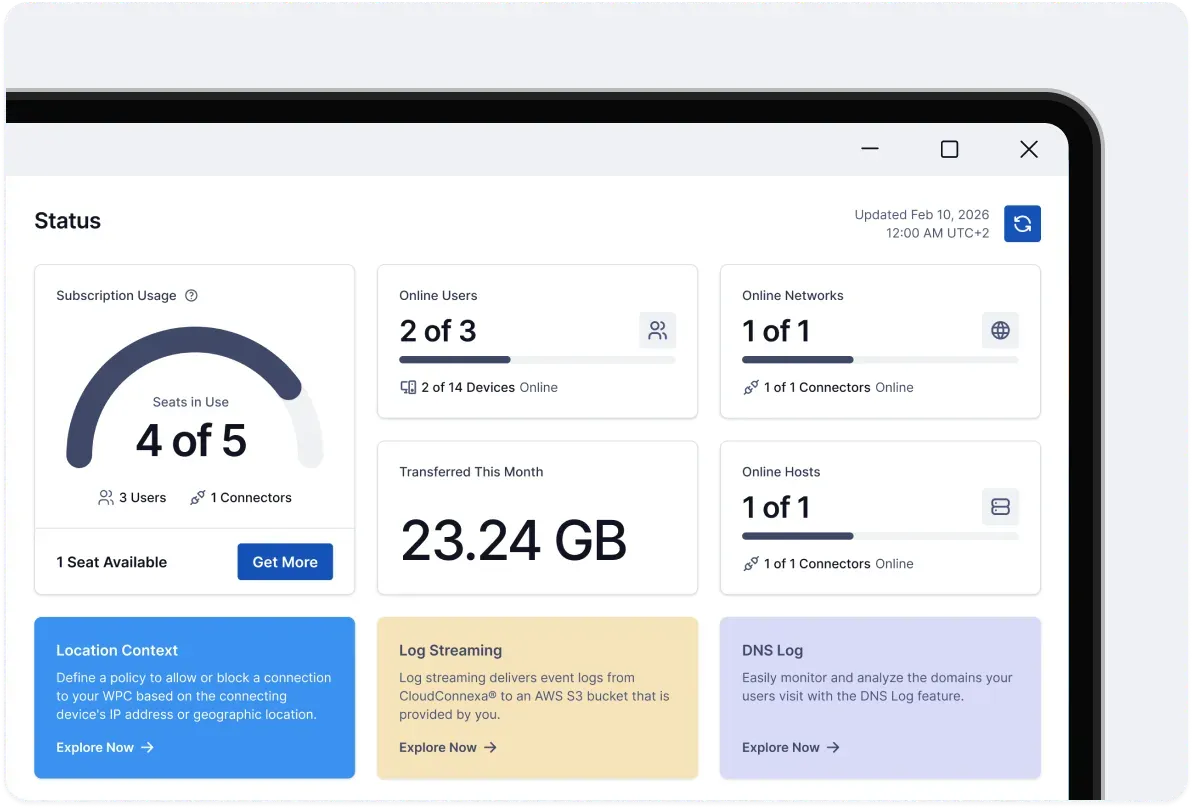
| Infrastructure responsibility | The customer operates the Access Server environment; CloudConnexa is the vendor-managed cloud alternative. Source ↗ |
Documented portability, standards, export, or switching considerations. No switching-cost score is shown unless the evidence supports one.
OpenVPN says customers can switch between Access Server and CloudConnexa by contacting support.
Evidence source ↗A proprietary editorial score based on product capabilities, usability, value, performance, support and user sentiment evidence.
Access Server documents broad authentication, access-control, deployment, and API capabilities. Public G2 reviews include positive comments about access and administration, alongside reports of setup and troubleshooting complexity. These are editorial assessments, not hands-on test results.
Methodology v1.0. The assessment weighs feature coverage (25%), ease of use (15%), value for money (20%), performance (15%), support (10%) and user sentiment (15%), using researched product evidence and verified review evidence where available. It is a TechZella editorial assessment, not a direct user-review average.
Key claims are linked to the sources used to verify them. This evidence record is separate from third-party user ratings.
TechZella evaluates software using documented product capabilities, pricing information, usability and value considerations, independent user evidence where available, and competitive context. The assessment is an editorial review, not a hands-on test unless one is explicitly identified. Our editorial assessment is based on 5 documented sources.
OpenVPN's company history identifies 2001 as the year of the first official public release of the OpenVPN source protocol.
View source ↗Verified 2026-11-22The official pricing page lists Free up to two connections and Growth at $7 per connection per month.
View source ↗Verified 2026-11-22OpenVPN's authentication documentation enumerates these five methods.
View source ↗Verified 2026-11-22The API reference describes these functions and identifies Web API v0.2 as available in Access Server 3.2.0 and newer.
View source ↗Verified 2026-11-22The official pricing and comparison pages list self-hosted deployment, cloud marketplace options, Docker, Hyper-V, and VMware ESXi.
View source ↗Verified 2026-11-22The 3.2 release notes state that new installations default to TLS 1.3 for the web interface and VPN connections.
View source ↗Verified 2026-11-22See the buyer questions below for verified answers about free usage, trials, Linux clients, and authentication integrations.
No reviews yet. Be the first to share your experience.
Please log in to submit a review.