
Packages from repositories other than Netgate's are unsupported and can cause failed upgrades or unbootable systems.
Organizations relying on third-party packages should assess maintenance and recovery risks before deployment.
Evidence source ↗
pfSense is firewall, routing, and VPN software for compatible hardware, virtual machines, and cloud deployments. Netgate publishes Community Edition and pfSense Plus releases.
The assessment reflects documented firewall, VPN, routing, package, and high-availability functions. Setup, sizing, and rule configuration require networking knowledge; public review evidence was not verified.
This profile combines documented product information and independent evidence where available. It is not a hands-on test unless TechZella explicitly identifies one.
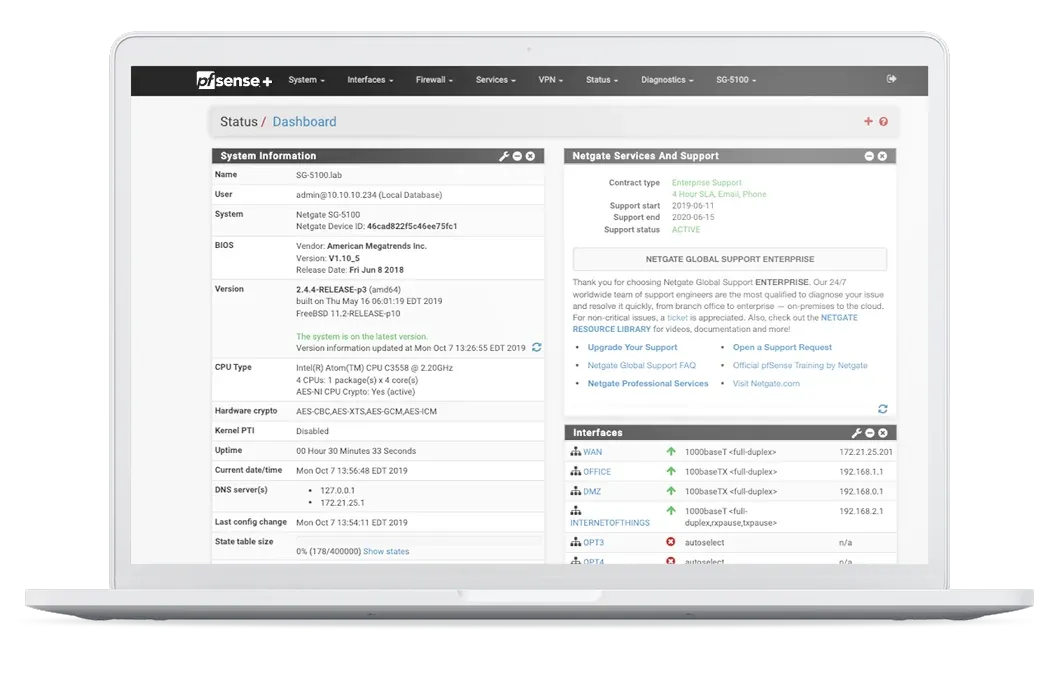
pfSense is firewall and routing software published by Netgate. Administrators install it on compatible hardware or virtual machines, then configure firewall rules, NAT, routing, VPNs, and network services through a web interface.
Netgate currently documents Community Edition and Plus releases. On October 29, 2026, it announced that release 26.10 would combine the editions and add a built-in API for users. Confirm the release and subscription state before planning an upgrade.
A quick way to understand who this product may suit, where its limits matter, and which facts are most relevant before you compare alternatives.
Network administrators needing configurable firewall, routing, VPN, and failover functions on compatible hardware or cloud instances.
Teams seeking a hosted service with minimal administration, a turnkey graphical management experience, or guaranteed compatibility with arbitrary hardware, and should evaluate alternatives such as OPNsense instead.
AWS, Azure, FreeBSD, On-premises, Self-hosted
7.9/10
These are the product-specific differences that may matter when deciding whether the software fits your workflow. They are based on documented evidence rather than a universal ranking.
These are documented constraints or practical friction points that may matter before you adopt the product.
Organizations relying on third-party packages should assess maintenance and recovery risks before deployment.
Evidence source ↗Teams planning larger firewall clusters need another architecture or management approach.
Evidence source ↗For security-sensitive software, TechZella focuses on documented architecture, authentication, data handling, deployment and privacy details that can affect a buying decision. This is product research, not an independent security audit.
| Deployment | Self-hosted hardware, virtual machine, AWS, Azure |
|---|
Security claims are presented only when supported by documented sources. The presence of this section does not constitute a penetration test, certification or independent security audit.
Community Edition software is available at no charge. Netgate announced that the separate CE and Plus editions will be combined starting with release 26.10.
Check current pricing →The current pricing page lists this starting annual subscription price for pfSense Plus software on third-party hardware.
Check current pricing →Netgate's Plus pricing page lists free 30-day software trials for cloud marketplace deployments. Cloud infrastructure charges may apply.
Check current pricing →Pricing may change. Verify current plans on the vendor's website.
Compare similar products directly, then see which alternatives may make more sense when your requirements differ.
| Decision factor | pfSense | OPNsense | OpenWrt |
|---|---|---|---|
| Core scope | Firewall and routing distribution with VPN, NAT, and optional packages. | Open-source firewall and routing platform with separate Community and Business editions. Source ↗ | Linux operating system for embedded devices, with writable filesystem and package management. Source ↗ |
| Pricing model | CE is no-charge; Netgate's current Plus pages list paid subscriptions, while a planned 26.10 change would unify editions. | Community software is free; Business Edition and commercial support are separately offered. Source ↗ | The OpenWrt project says its software is provided without monetary cost. Source ↗ |
| Deployment model | Supports compatible self-hosted hardware, virtual machines, and listed cloud marketplace options. | Provides downloadable installation images and a Business Edition, with an official virtualisation image listed for Business Edition. Source ↗ | Targets embedded devices and has a documented x86 installation path for PCs, virtual machines, and servers. Source ↗ |
Only factors supported by the available research are shown. The comparison is descriptive, not a ranking.
These products address broadly similar requirements. The descriptions focus on documented reasons a buyer might compare them with pfSense.




| Operating system base | FreeBSD-based distribution |
|---|---|
| Minimum third-party hardware | 64-bit amd64 CPU, 1 GB RAM, 8 GB storage, compatible network interface |
| Deployment | Self-hosted hardware, virtual machine, AWS, Azure |
| API | Netgate announced a built-in API beginning with release 26.10; availability depends on release status |
| High availability | Officially supported cluster configuration consists of two nodes |
Verified installation, hosting, administration, or environment details that can affect implementation.
| Hardware and architecture | For third-party hardware, documentation specifies a 64-bit amd64 CPU, at least 1 GB RAM, at least 8 GB storage, and compatible network interfaces. Requirements vary by workload. Source ↗ |
|---|---|
| Installation and hosting | Available for self-hosted hardware and virtual machines; Netgate also offers AWS and Azure marketplace deployments. Source ↗ |
Documented portability, standards, export, or switching considerations. No switching-cost score is shown unless the evidence supports one.
Netgate says existing CE configurations carry forward when upgrading to release 26.10; its announcement describes an in-place upgrade from CE 2.9 as free.
Evidence source ↗A proprietary editorial score based on product capabilities, usability, value, performance, support and user sentiment evidence.
The assessment reflects documented firewall, VPN, routing, package, and high-availability functions. Setup, sizing, and rule configuration require networking knowledge; public review evidence was not verified.
Methodology v1.0. The assessment weighs feature coverage (25%), ease of use (15%), value for money (20%), performance (15%), support (10%) and user sentiment (15%), using researched product evidence and verified review evidence where available. It is a TechZella editorial assessment, not a direct user-review average.
Key claims are linked to the sources used to verify them. This evidence record is separate from third-party user ratings.
TechZella evaluates software using documented product capabilities, pricing information, usability and value considerations, independent user evidence where available, and competitive context. The assessment is an editorial review, not a hands-on test unless one is explicitly identified. Our editorial assessment is based on 6 documented sources.
The announcement says the editions will be combined and describes a free full feature set on amd64 hardware.
View source ↗Verified 2026-11-20The official documentation covers these configuration areas and their management in the interface.
View source ↗Verified 2026-11-20It lists an amd64-compatible CPU, at least 1 GB RAM, at least 8 GB storage, and compatible network interfaces.
View source ↗Verified 2026-11-20Netgate's package documentation names pfBlockerNG, Snort, Suricata, WireGuard, BGP, and OSPF among examples.
View source ↗Verified 2026-11-20Documentation describes CARP, XMLRPC configuration synchronization, pfsync state synchronization, and a two-node supported cluster.
View source ↗Verified 2026-11-20The company page says Netgate was formed in 2004 and is headquartered in Austin, Texas.
View source ↗Verified 2026-11-20See the buyer questions below for source-backed answers about cost, trial availability, compatibility, and the announced API transition.
No reviews yet. Be the first to share your experience.
Please log in to submit a review.