
A Wazuh Cloud trial environment can be terminated if no agent is enrolled within three days.
Trial users need to plan agent installation promptly rather than postponing setup until late in the evaluation.
Evidence source ↗
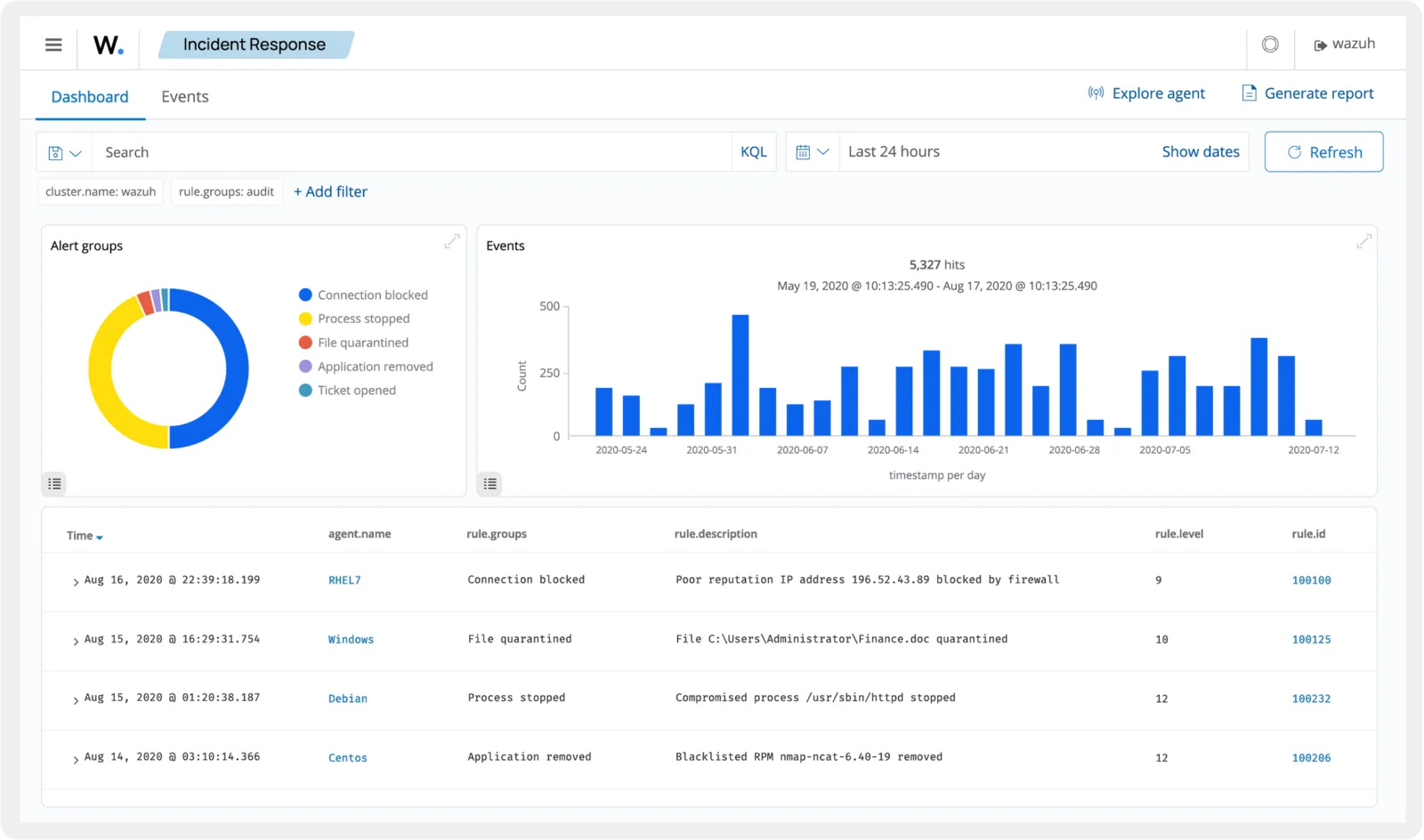
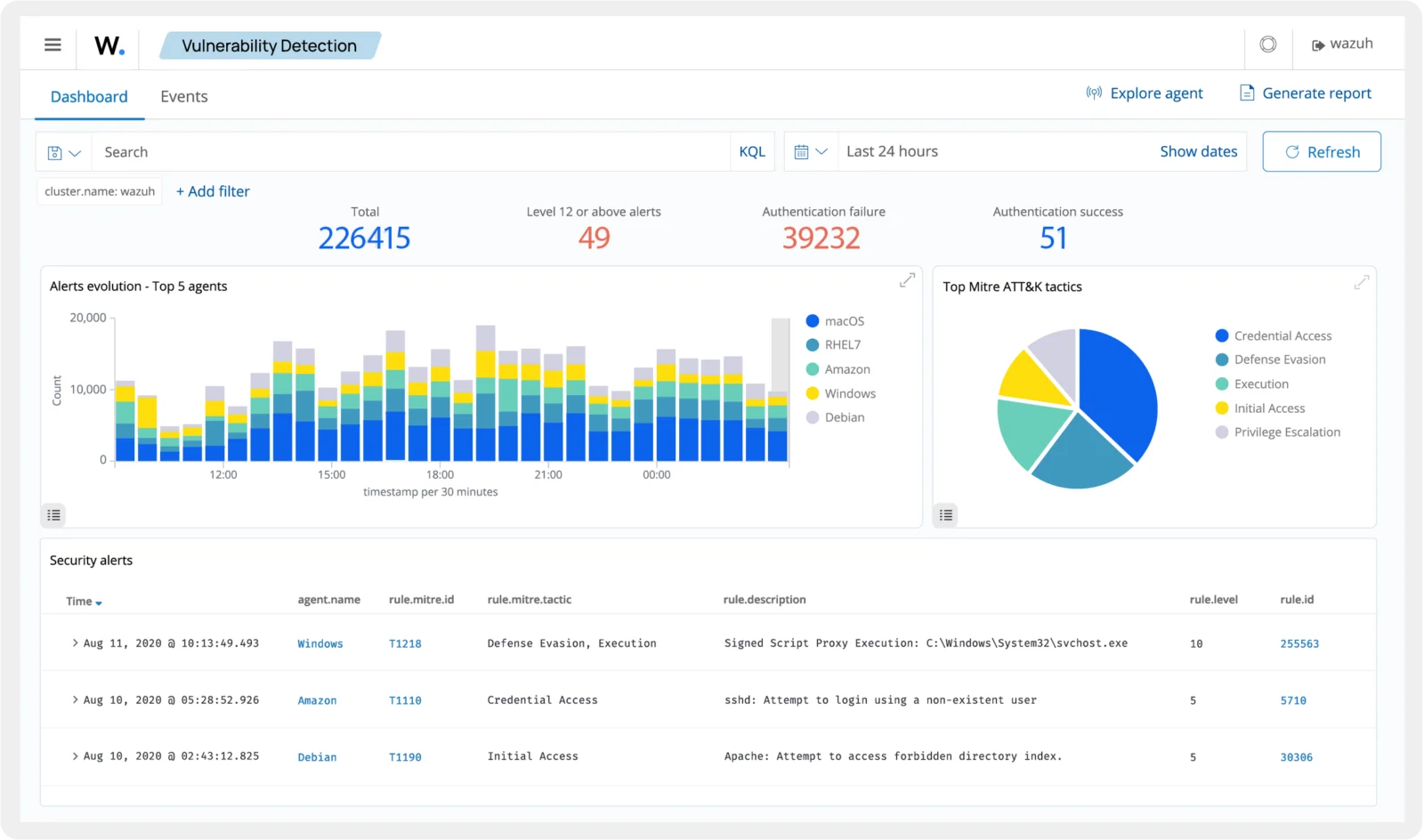
Wazuh is an open-source security platform that combines SIEM and XDR capabilities. It collects endpoint and cloud data for threat detection, vulnerability monitoring, and security analysis.
The platform combines endpoint monitoring, SIEM, vulnerability detection, and file integrity monitoring. G2 reviews show a positive average, alongside reported setup and configuration effort. Self-hosting also requires customer-managed infrastructure.
This profile combines documented product information and independent evidence where available. It is not a hands-on test unless TechZella explicitly identifies one.
Wazuh is an open-source security platform combining SIEM and XDR capabilities. Its agents collect endpoint data, while a central server analyzes events and sends alerts to an indexer and dashboard.
Organizations can operate the platform themselves or use Wazuh Cloud. Self-hosting offers infrastructure control but requires teams to provision and maintain the central components. Cloud shifts hosting and platform maintenance to Wazuh, while customers still configure agents, rules, integrations, and incident response.
A quick way to understand who this product may suit, where its limits matter, and which facts are most relevant before you compare alternatives.
Security and IT teams that want an open-source SIEM and endpoint-monitoring platform, and can operate its self-hosted components or prefer Wazuh-managed Cloud.
Teams seeking a turnkey self-hosted deployment with minimal configuration may find the platform's infrastructure and rule-tuning responsibilities burdensome, and should evaluate alternatives such as Elastic Security or Splunk Enterprise Security instead.
Cloud, Kubernetes, Linux, macOS, Windows
8.0/10
These are the product-specific differences that may matter when deciding whether the software fits your workflow. They are based on documented evidence rather than a universal ranking.
These are documented constraints or practical friction points that may matter before you adopt the product.
Trial users need to plan agent installation promptly rather than postponing setup until late in the evaluation.
Evidence source ↗Teams that rely on direct API writes or integrations requiring those operations should check their workflow requirements before choosing Cloud.
Evidence source ↗Organizations still need their own policies, procedures, evidence, and independent assessment.
Evidence source ↗For security-sensitive software, TechZella focuses on documented architecture, authentication, data handling, deployment and privacy details that can affect a buying decision. This is product research, not an independent security audit.
| Hosting | Self-hosted, customer-managed cloud, or Wazuh Cloud SaaS |
|---|
Wazuh's documentation states that its control mappings are indicative and that compliance also depends on organizational practices and independent assessment.
Source ↗Security claims are presented only when supported by documented sources. The presence of this section does not constitute a penetration test, certification or independent security audit.
Free and open-source software. Customer supplies and operates the infrastructure.
Check current pricing →Wazuh Cloud profile for up to 100 active agents, with one month of indexed data retention and three months of archived data retention.
Check current pricing →Wazuh Cloud profile for up to 250 active agents, with three months of indexed data retention and one year of archived data retention.
Check current pricing →Wazuh Cloud profile for up to 500 active agents, with three months of indexed data retention and one year of archived data retention.
Check current pricing →Custom Wazuh Cloud environment and settings.
Check current pricing →Pricing may change. Verify current plans on the vendor's website.
Compare similar products directly, then see which alternatives may make more sense when your requirements differ.
| Decision factor | Wazuh | Elastic Security | Splunk Enterprise Security |
|---|---|---|---|
| Core scope | Open-source SIEM and XDR platform with endpoint agents and central server, indexer, and dashboard components. | Security analytics and endpoint protection delivered through Elastic's security platform. Source ↗ | SIEM with security analytics, detection lifecycle tooling, and optional Premier capabilities such as SOAR and UEBA. Source ↗ |
| Deployment model | Self-hosted, customer-managed cloud, or Wazuh-hosted SaaS. | Self-managed, hosted, or serverless deployment options. Source ↗ | Enterprise Security is offered in cloud and on-premises purchasing contexts; cloud purchase requires a Splunk Cloud license. Source ↗ |
| Pricing model | Core software is free and open source; Wazuh Cloud has published monthly starting prices. | Cloud pricing is resource- or usage-based; security estimates depend on workload and deployment. Source ↗ | Quote-based pricing, with workload pricing based on compute capacity for Enterprise Security. Source ↗ |
Only factors supported by the available research are shown. The comparison is descriptive, not a ranking.
These products address broadly similar requirements. The descriptions focus on documented reasons a buyer might compare them with Wazuh.
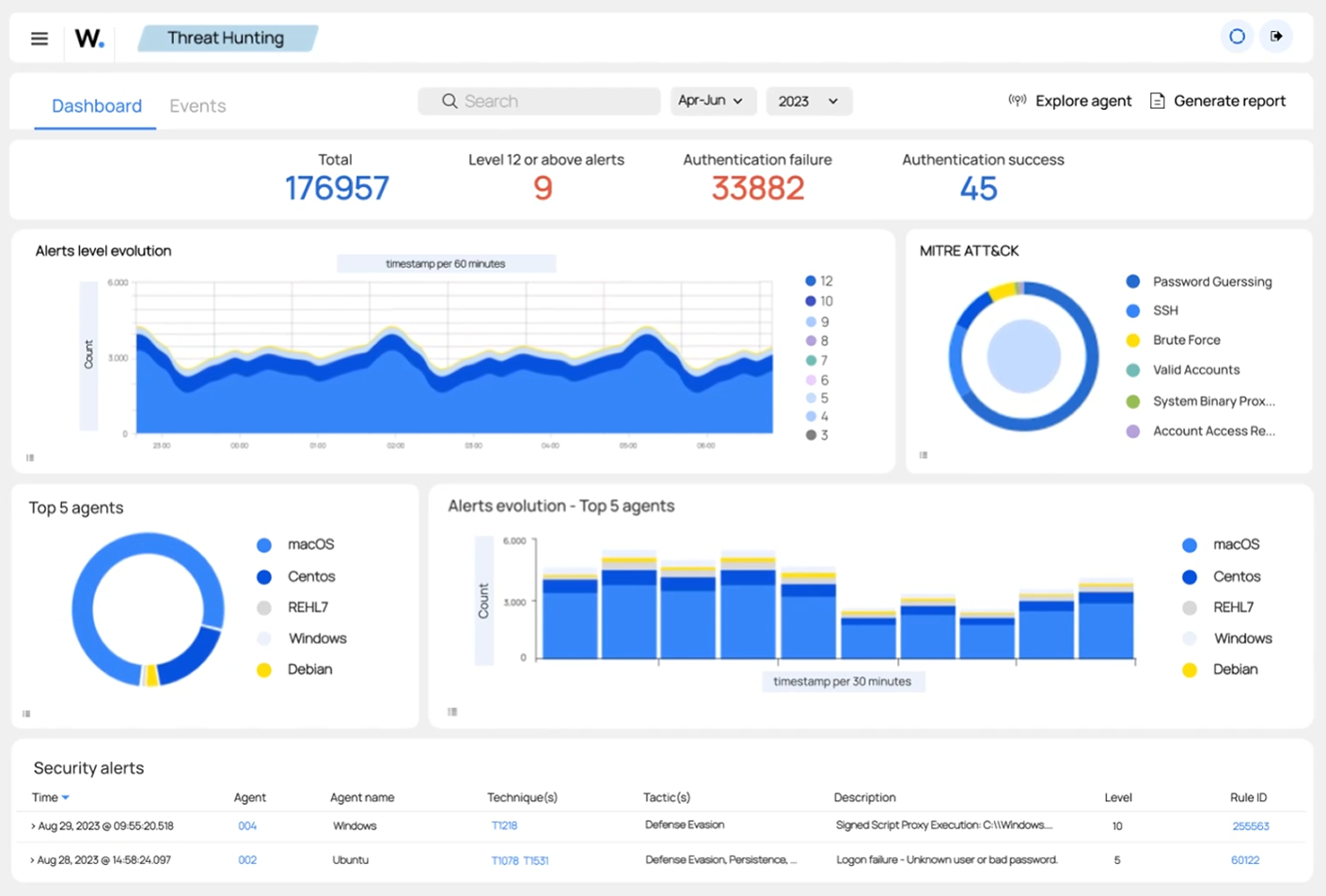
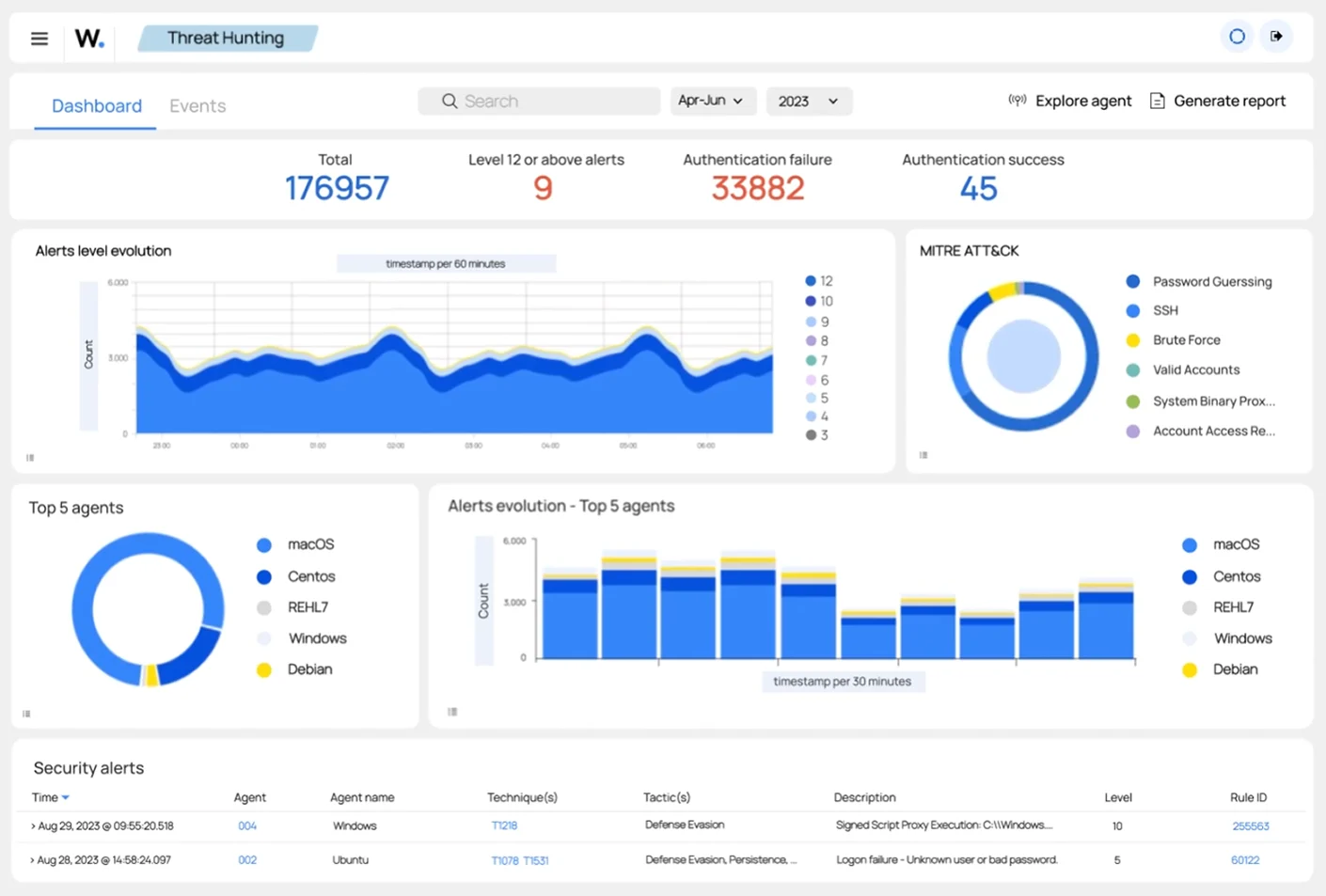
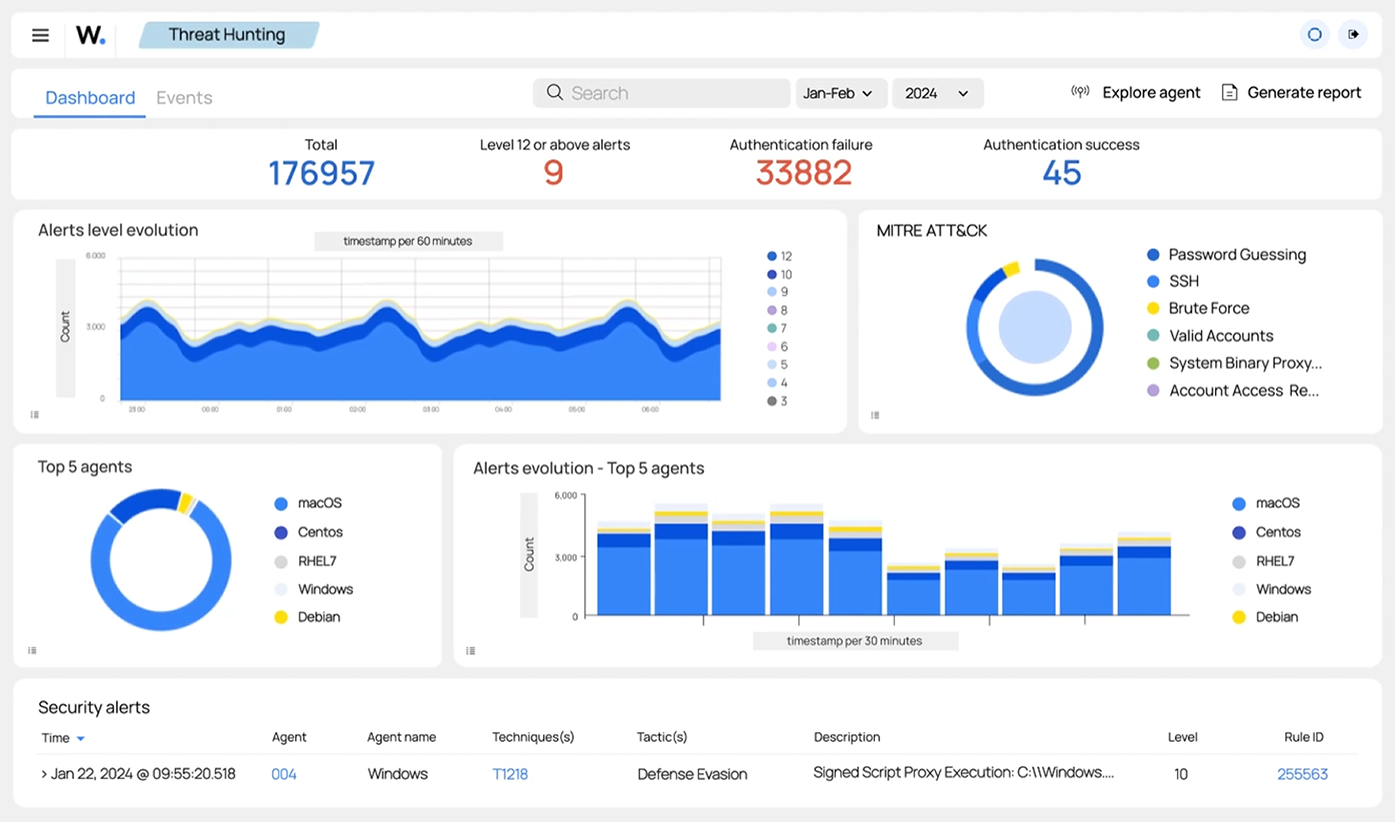
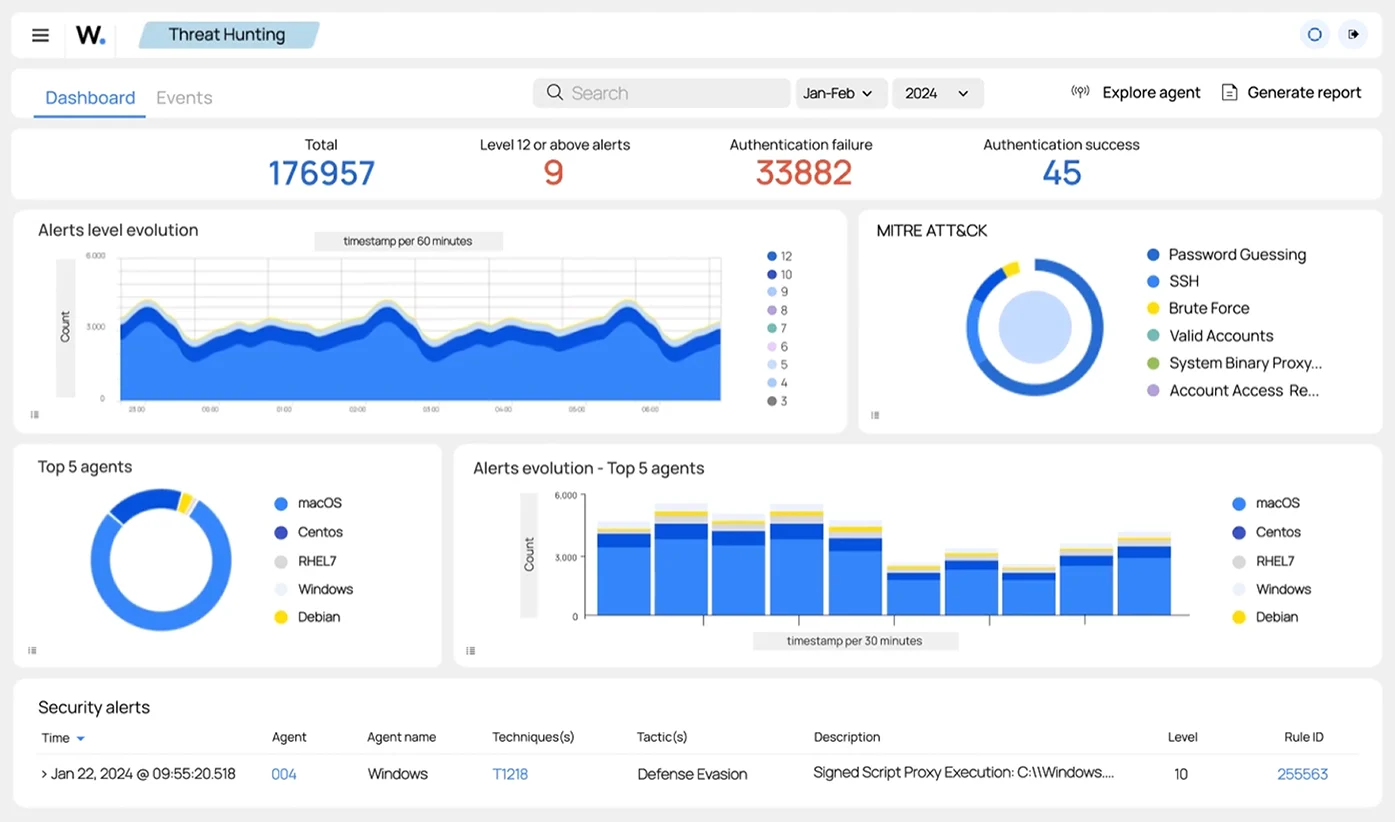
| Product scope | SIEM and XDR |
|---|---|
| License | Free and open source; GPL 2.0 and Apache License 2.0 components |
| Agent operating systems | Linux, Windows, macOS, Solaris, AIX, and other systems |
| Central component operating system | 64-bit Linux on x86_64/AMD64 or AARCH64/ARM64 |
| Hosting | Self-hosted, customer-managed cloud, or Wazuh Cloud SaaS |
| API | Open-source REST API |
| Cloud trial | 14 days; no credit card required |
| Cloud profile limits | Published profiles support up to 100, 250, or 500 active agents |
Verified installation, hosting, administration, or environment details that can affect implementation.
| Hosting choices | Deploy on-premises, in a cloud environment managed by the customer, or through Wazuh Cloud SaaS. Source ↗ |
|---|---|
| Self-hosted architecture | The central platform comprises the Wazuh server, indexer, and dashboard; deployments can be all-in-one, single-node, or multi-node. Source ↗ |
Documented portability, standards, export, or switching considerations. No switching-cost score is shown unless the evidence supports one.
Wazuh documents backup and restore procedures for central components and agents. The documentation reviewed does not specify an automated migration service from competing SIEMs.
Evidence source ↗A proprietary editorial score based on product capabilities, usability, value, performance, support and user sentiment evidence.
The platform combines endpoint monitoring, SIEM, vulnerability detection, and file integrity monitoring. G2 reviews show a positive average, alongside reported setup and configuration effort. Self-hosting also requires customer-managed infrastructure.
Methodology v1.0. The assessment weighs feature coverage (25%), ease of use (15%), value for money (20%), performance (15%), support (10%) and user sentiment (15%), using researched product evidence and verified review evidence where available. It is a TechZella editorial assessment, not a direct user-review average.
Key claims are linked to the sources used to verify them. This evidence record is separate from third-party user ratings.
TechZella evaluates software using documented product capabilities, pricing information, usability and value considerations, independent user evidence where available, and competitive context. The assessment is an editorial review, not a hands-on test unless one is explicitly identified. Our editorial assessment is based on 7 documented sources.
The documentation identifies the Wazuh server, Wazuh indexer, and Wazuh dashboard as central components, alongside agents deployed to monitored endpoints.
View source ↗Verified 2026-11-20The official quickstart describes Wazuh as free and open source and identifies GPL 2.0 and Apache License 2.0 components.
View source ↗Verified 2026-11-20The Cloud trial documentation states a 14-day trial and says no credit card is required.
View source ↗Verified 2026-11-20Official documentation lists Slack, PagerDuty, VirusTotal, Shuffle, and Maltiverse, and describes configuration through the Wazuh Integrator module.
View source ↗Verified 2026-11-20The API reference describes agent, cluster, rule, and manager endpoints, among other functions.
View source ↗Verified 2026-11-20The company's About Us page states that it began in 2015.
View source ↗Verified 2026-11-20Wazuh's documentation states that its control mappings are indicative and that compliance also depends on organizational practices and independent assessment.
View source ↗Verified 2026-11-20Common buyer questions cover Wazuh’s software cost, Cloud trial, supported integrations, API, and compliance boundaries. Answers appear in the structured FAQ data.
No reviews yet. Be the first to share your experience.
Please log in to submit a review.